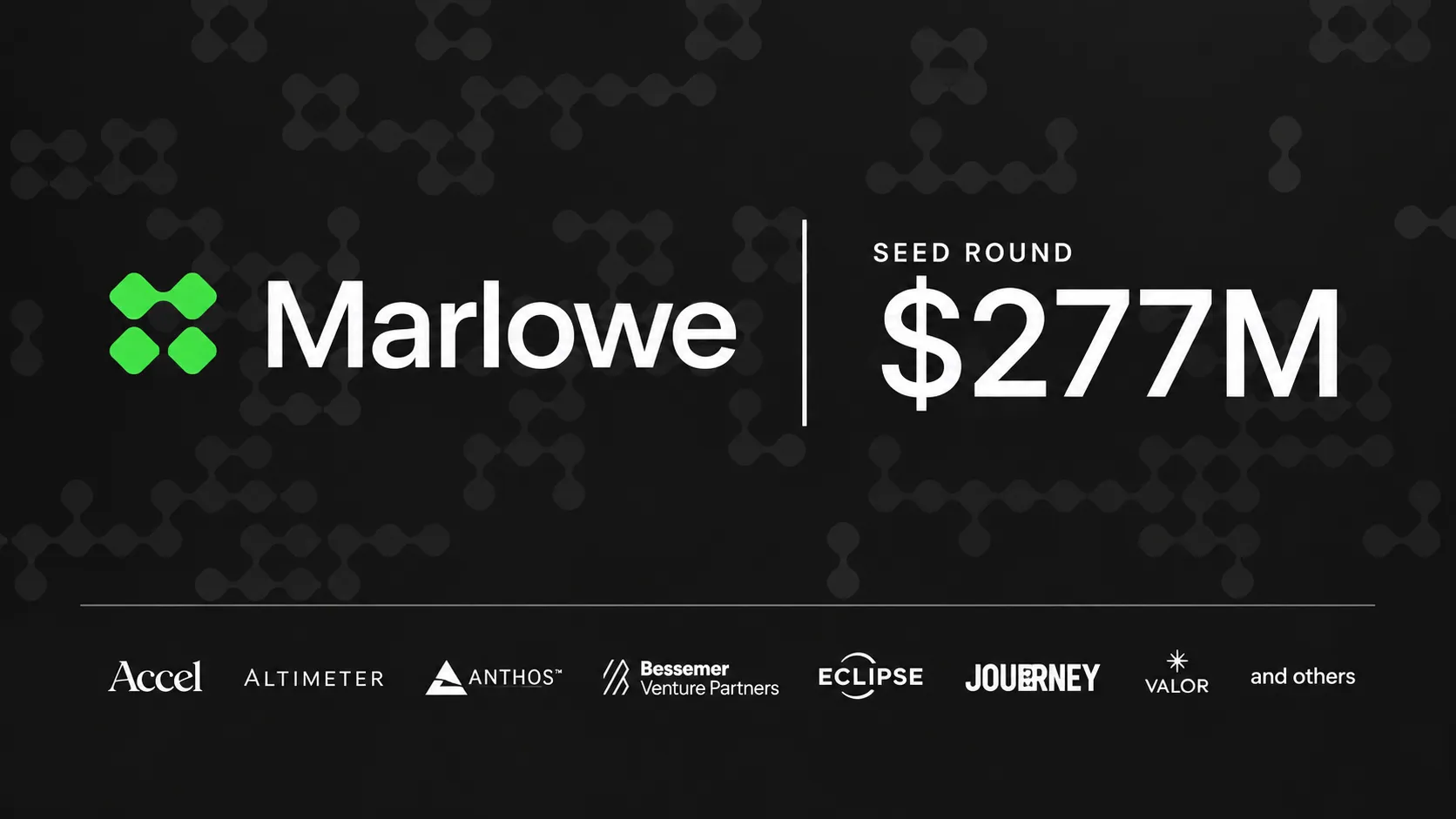
Seed rounds were once measured in hundreds of thousands of dollars. In the age of artificial intelligence infrastructure, one startup has raised more than a quarter of a billion before opening its first facility.
Marlowe, a startup based in Bellevue, Washington, has raised $277 million in a seed round at a $1.15 billion valuation, according to AI Funding Tracker, which logged the deal on November 23. Bloomberg also reported the raise. The round was led by Accel, with participation from Bessemer Venture Partners, Altimeter, Atreides, Valor and Eclipse, as well as individual investors including Henry Kravis, Dara Khosrowshahi and Aaron Levie.
The company plans to build data centres for AI inference that use chips from Etched and AMD rather than relying solely on Nvidia.
Founders with operating experience
Marlowe was founded in May by Dan Lewis and Kutta Srinivasan, according to AI Funding Tracker. Lewis was previously chief executive of Convoy, the Seattle-based digital freight company that raised more than $1 billion before shutting down in 2023. Srinivasan previously led AI infrastructure efforts at Microsoft, giving the company deep expertise in building and operating large-scale computing facilities.
The founders' experience and networks help explain how a company only a few months old was able to raise such a large seed round at a unicorn valuation.
The inference opportunity
AI computing involves two main workloads: training, in which models learn from vast amounts of data, and inference, in which trained models generate responses for users. Training has dominated investment so far, but inference is expected to become the larger market as AI applications are deployed to hundreds of millions of users.
Inference workloads are more cost-sensitive than training, because they run continuously and at scale. Companies serving AI applications want the lowest possible cost per query, which creates an opportunity for specialised chips that can deliver better price-performance than general-purpose processors for specific tasks.
Betting on Etched and AMD
Marlowe's data centres will use chips from Etched, a startup that has designed specialised processors optimised for transformer-based AI models, and AMD, Nvidia's main competitor among established chipmakers.
Etched's chips are designed specifically for the transformer architecture that underlies most modern large language models, potentially allowing them to run these models far more efficiently than general-purpose GPUs. AMD's Instinct accelerators have gained traction with major AI developers seeking alternatives to Nvidia.
By building data centres around these chips, Marlowe aims to offer AI developers lower-cost inference capacity.
First site in December
Marlowe plans to open its first site in December, according to AI Funding Tracker. The speed of deployment reflects intense demand for AI computing capacity, which has outstripped supply for much of the past two years.
Building data centres requires securing land, power, cooling and network connections, as well as chips and other equipment. Access to power has become one of the biggest constraints on AI data centre construction in the United States.
A crowded field
Marlowe enters a competitive market. Large cloud providers such as Amazon Web Services, Microsoft Azure and Google Cloud are expanding their AI capacity, while specialist "neoclouds" such as CoreWeave, Lambda, Crusoe and Nebius have raised billions to build AI-focused data centres.
Most of these providers rely heavily on Nvidia chips. Marlowe's differentiation lies in its focus on inference and its use of alternative chips, which it hopes will allow it to offer lower prices.