India's largest carmaker has never sold more vehicles in a single quarter. Yet its profit has fallen sharply, highlighting how rising costs are squeezing even the most dominant companies in the Indian automobile industry.
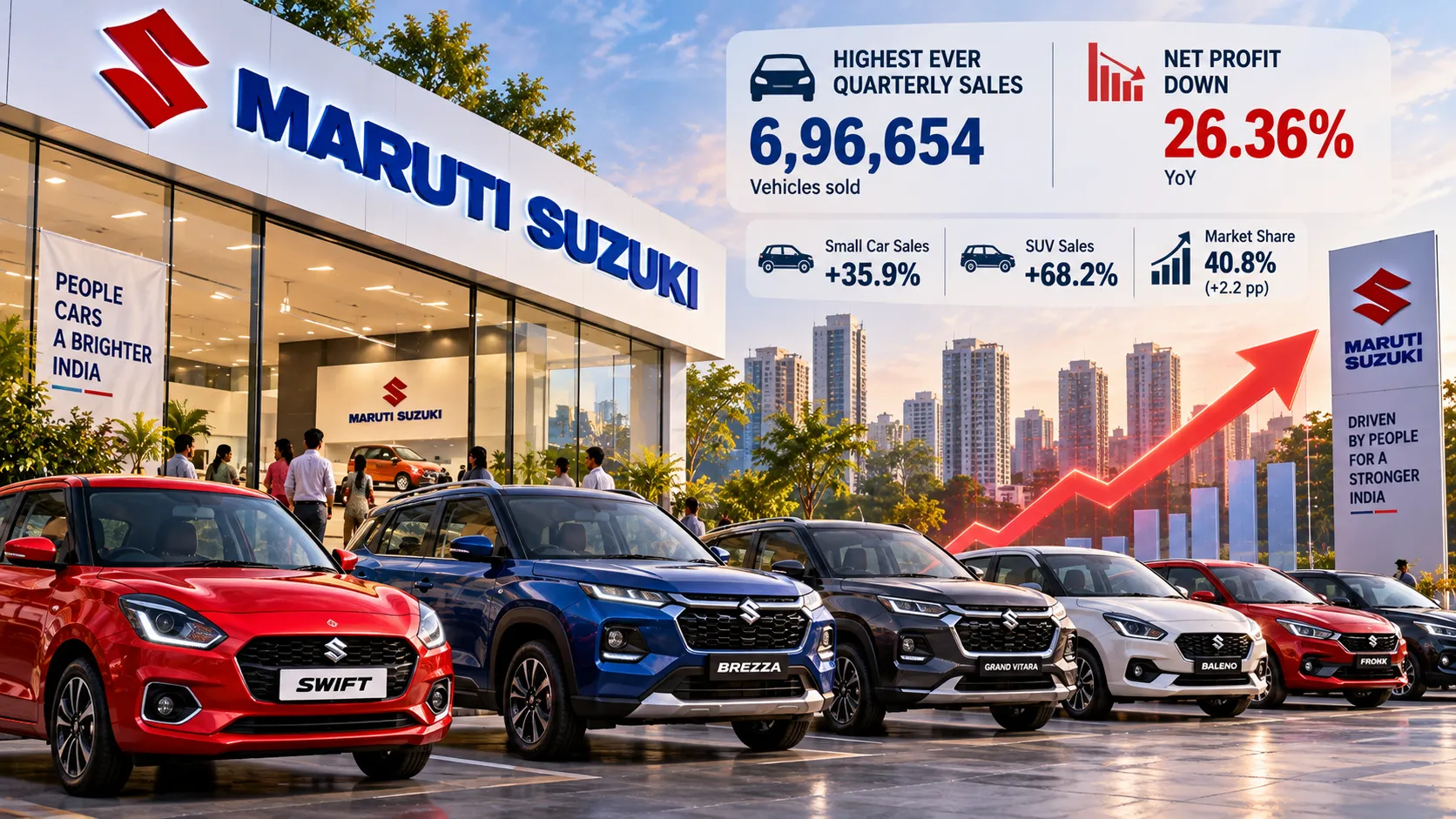
Maruti Suzuki India reported consolidated net profit attributable to owners of ₹2,466.1 crore for the July-September quarter, down 26.36% from ₹3,349 crore a year earlier and 28.46% lower than ₹3,446.9 crore in the April-June quarter, according to Business Today.
Revenue from operations rose 26% to ₹53,355.5 crore from ₹42,344.2 crore a year earlier.
Despite the profit decline, Maruti shares rose 2.28% to ₹11,454.85 on the BSE after the results were announced on Tuesday, October 27, suggesting investors focused on the strength of demand.
A record quarter for volumes
Maruti sold 6,96,654 vehicles in the quarter, its highest-ever quarterly volume and 26.5% more than a year earlier. Domestic small car sales rose 35.9%, while sales of sport utility vehicles jumped 68.2%.
The company's domestic market share increased by 2.2 percentage points to 40.8%, reversing a period in which it had lost ground to rivals in the fast-growing SUV segment.
Demand "continued to outpace supply," the company said. Network inventory was about 17 days at the end of the quarter, and roughly 2 lakh customer bookings were pending.
Why profit fell
The results statement did not detail the reasons for the decline in profit, but analysts had expected higher input costs to weigh on margins. A preview of the results had projected that net profit could fall by up to 12% because of rising costs. The actual decline was considerably steeper.
Carmakers face higher prices for steel, aluminium, precious metals used in emission control systems, and electronic components. Elevated fuel prices, with Brent crude above $100 a barrel, raise logistics costs. Currency movements also matter: Maruti imports components and pays royalties to its Japanese parent, Suzuki Motor Corporation, so a weaker rupee increases costs.
Investors will look to the company's earnings call and detailed financial statements for a breakdown of the margin pressure, including the impact of discounts, marketing spending and the product mix.
Exports lose momentum
Exports, which have been a growth engine for Maruti in recent years, slipped. The company shipped 1,08,119 vehicles abroad in the quarter, down about 2.1% from 1,10,487 a year earlier. It cited a "challenging geopolitical situation."
Maruti exports to markets across Latin America, Africa, the Middle East and Southeast Asia. Conflict in West Asia, shipping disruptions and economic pressures in some importing countries have affected demand and logistics.
The small car revival
The 35.9% increase in domestic small car sales is particularly notable. Entry-level cars had been losing share for years as buyers moved to SUVs and as rising prices made small cars less affordable for first-time buyers. Lower taxes on small cars following changes to India's goods and services tax regime, along with improving rural incomes, have helped revive demand.
Maruti dominates the small car segment with models such as the Alto, WagonR, Swift and Baleno, so a revival in that segment disproportionately benefits the company.
SUV comeback
The 68.2% jump in SUV sales shows that Maruti's push into the segment is paying off. Models such as the Brezza, Grand Vitara, Fronx and newer launches have helped it compete with Hyundai, Tata Motors and Mahindra & Mahindra, which had gained share in SUVs.
SUVs typically carry higher prices and margins than small cars, so continued growth in the segment could help support profitability in future quarters.
Industry context
India's passenger vehicle market is the third-largest in the world. Demand has been supported by festive season buying, tax changes, improving rural sentiment and new model launches. However, high fuel prices and inflation pose risks to consumer budgets, and carmakers face rising costs across their supply chains.
Electric vehicles are also becoming more important. Maruti has been preparing its electric vehicle line-up, and competition in the segment is intensifying as Tata Motors, Mahindra, Hyundai and others launch new models.
Supply constraints
The fact that demand is outpacing supply suggests that Maruti could sell more vehicles if it had more production capacity. The company has been expanding its manufacturing footprint, including a new plant in Kharkhoda, Haryana, and increasing capacity at its existing facilities in Gurugram, Manesar and Gujarat.
Increasing capacity will be important to capture demand and support future growth, especially as export markets recover.
What it means for investors
Maruti's results present a mixed picture. Volume growth and market share gains show the strength of its brand and distribution network. But the sharp fall in profit raises questions about pricing power and cost management.
Investors will watch whether Maruti raises prices to offset costs, which could affect demand, or absorbs them to protect market share. Commodity price trends and the rupee will also be important.
Pricing decisions ahead
Maruti faces a difficult choice on pricing. Raising prices could help restore margins, but might dampen demand among price-sensitive buyers, particularly in the small car segment where affordability is crucial. Holding prices steady protects volumes and market share but leaves margins exposed to rising costs.
Carmakers in India typically announce price increases at the start of the calendar year, and Maruti's decision will be closely watched as an indicator of how much pricing power the industry has in the current environment.
The Suzuki connection
Maruti is majority-owned by Japan's Suzuki Motor Corporation, which relies heavily on India for its global sales and profits. India is Suzuki's largest market, and Maruti serves as a production and export base for markets around the world. Suzuki has committed to large investments in India, including in electric vehicles and new manufacturing capacity, reflecting the country's central role in its strategy.
The festive season
The September quarter includes the start of India's festive season, when car purchases traditionally rise. Strong bookings heading into the October and November festivals suggest that demand momentum could continue into the December quarter, supporting volumes even if margins remain under pressure.
What comes next
With a strong order backlog, Maruti enters the second half of the financial year with solid demand. The key question is whether it can translate record sales into stronger profitability. The company's commentary on margins, pricing and cost-reduction efforts will shape investor sentiment in the coming weeks.