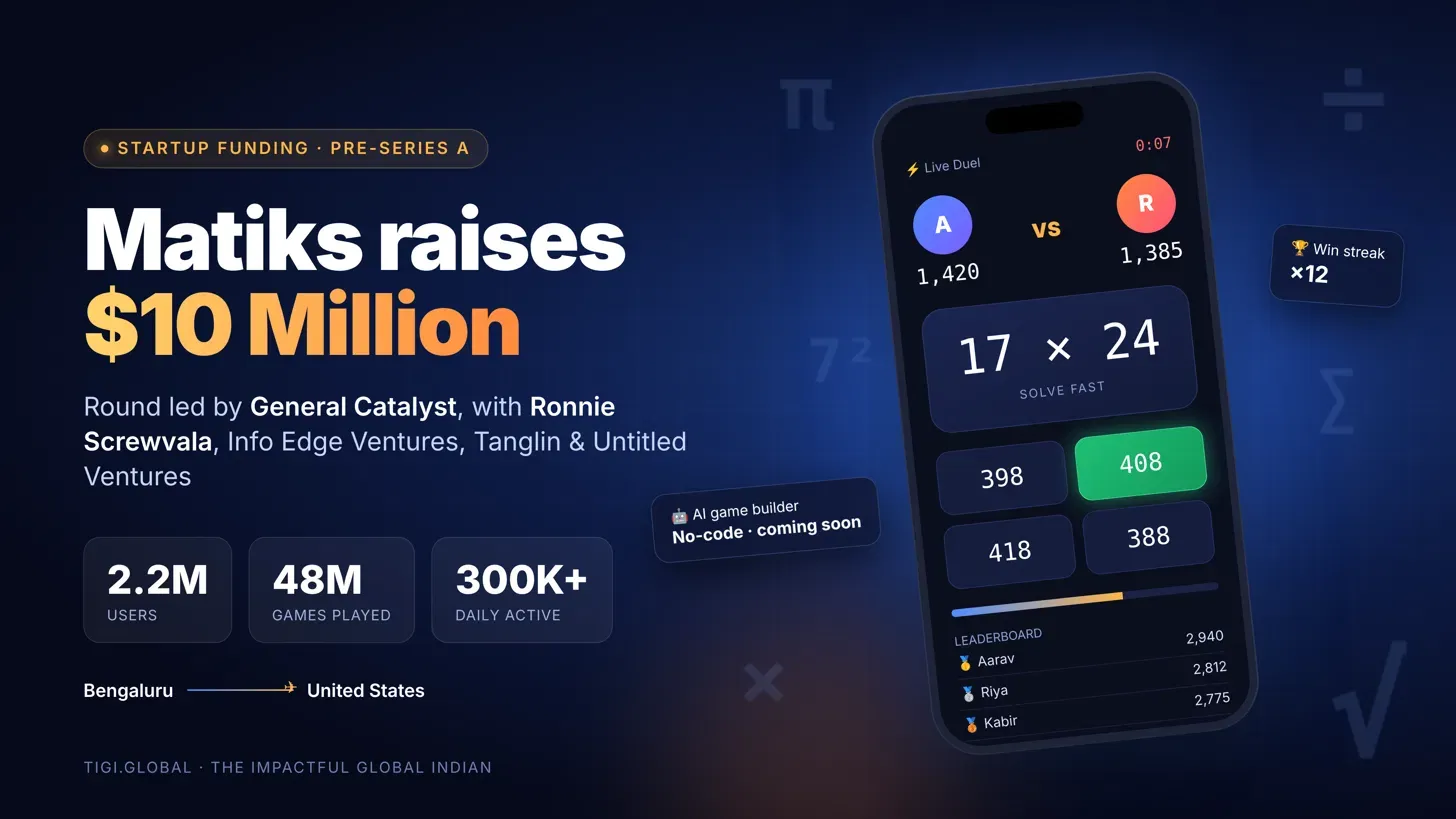
Matiks, a Bengaluru-based startup that turns mental maths into a competitive social game, has raised $10 million in a pre-Series A funding round led by General Catalyst, as it prepares to expand into the United States.
The round, announced on 26 October, also included Ronnie Screwvala, the entrepreneur and investor who founded UTV and co-founded upGrad, along with Info Edge Ventures, Tanglin Venture Partners and Untitled Ventures.
The startup plans to use the funds for its US expansion and to develop an AI-powered tool that will allow users to build games without writing code.
Rapid Growth in Two Years
Matiks was founded in 2024 by Sudhanshu Bhatia, Sushant and Mohan. The app offers fast-paced maths puzzles and challenges that users can play against friends or strangers, combining elements of brain-training apps with the competitive mechanics of multiplayer games.
The company has grown quickly. As of September 2026, it reported 2.2 million users, 48 million games played and more than 300,000 daily active users. Those numbers suggest strong engagement for a category that has historically struggled to retain players beyond an initial burst of interest.
The latest round follows a $3.1 million pre-Series A round led by Tanglin Venture Partners, which participated again in the new financing. The scale of the new round, led by one of the world's most prominent venture capital firms, indicates growing investor confidence in the company's traction.
Why General Catalyst Is Interested
General Catalyst, a US venture capital firm with a significant presence in India following its merger with Venture Highway, has backed companies across consumer technology, healthcare, fintech and enterprise software. Its decision to lead Matiks' round signals interest in consumer products that combine engagement with a sense of purpose.
Brain games and educational entertainment occupy a niche that appeals to consumers who want to spend time on their phones productively. Apps such as Duolingo, Elevate and Lumosity have shown that people will engage daily with products that offer a sense of self-improvement, and Duolingo in particular has demonstrated that gamified learning can build a large and profitable business.
The Social Element
What distinguishes Matiks from many brain-training apps is its social and competitive focus. Rather than solitary exercises, users compete in real-time duels and leaderboards, which can drive repeat engagement as players seek to improve their rankings and challenge friends.
Social features also help with organic growth, as users invite friends to compete, reducing the need for expensive paid user acquisition. In the gaming industry, multiplayer mechanics and social sharing are among the most powerful drivers of viral growth.
Building With AI
The company's plan to develop a no-code AI game-building tool represents an ambitious extension of its platform. Such a tool would allow users or educators to create their own maths games and puzzles, potentially generating a large library of user-created content.
Generative AI has made it far easier to create software and digital content, and several companies are exploring tools that let non-programmers build games. If successful, user-generated content could help Matiks keep its offering fresh and expand into new types of puzzles beyond arithmetic.
Going to America
Expanding to the US is a significant step. The American market offers higher revenue per user, through subscriptions and in-app purchases, than India, where consumers are typically less willing to pay for apps. Many Indian consumer app companies have targeted the US or other developed markets to improve monetisation.
But competition for attention in the US is intense. Matiks will compete not only with other puzzle and brain games but with social media, streaming and established mobile game franchises. Building a brand in a new market requires marketing investment and localisation of content and community.
India's Gaming Landscape
India's gaming industry has undergone significant change. The government's ban on real-money online gaming, enacted under legislation passed in 2025, upended companies that had built businesses around fantasy sports and card games played for money, forcing many to pivot or shut down.
The ban has pushed investors and entrepreneurs towards casual, skill-based and educational games that do not involve wagering. Matiks, which focuses on free-to-play competitive maths, fits squarely into the category of gaming that policymakers have sought to encourage.
India has a vast population of young smartphone users and a growing community of game developers, which could support a new generation of gaming companies building for both domestic and global audiences.
The Education Angle
Matiks' focus on mental maths also connects with longstanding concerns about numeracy skills. Surveys of learning outcomes in India have repeatedly found that many students struggle with basic arithmetic. While Matiks is positioned as entertainment rather than education, games that make maths enjoyable could help build confidence and skills among young users.
That positioning could open opportunities in schools and with parents, though the company's primary focus appears to be on consumer gaming and social competition.
Monetisation Choices
Like most consumer apps, Matiks faces a choice about how to make money. Options include subscriptions offering premium features, in-app purchases for cosmetic items or extra content, and advertising. Duolingo's success with a freemium model, in which most users play for free while a minority pay for premium features, offers one template, while many casual games rely on advertising revenue.
The choice matters for growth and user experience. Heavy advertising can drive revenue but frustrate users and reduce engagement, while subscriptions require a product compelling enough for users to pay regularly. The US market, where consumers are more accustomed to paying for apps and where advertising rates are higher, could make either model more viable than in India. How Matiks balances monetisation with its focus on competitive play will be a key question for investors as the company scales.
What Comes Next
With $10 million in fresh capital, Matiks will seek to sustain its growth in India, establish a foothold in the US and build its AI game-creation tool. Investors will watch retention, the conversion of users to paying customers and the company's ability to replicate its traction in a new market.
For the founders, the challenge will be maintaining the simple, addictive core experience that drove early growth while expanding into new products and geographies. If they succeed, Matiks could become one of the more distinctive consumer gaming companies to emerge from India.