Meesho, the e-commerce platform that has built its business on selling low-priced goods to shoppers in smaller Indian towns, has sharply reduced its losses as its revenue continues to grow rapidly.
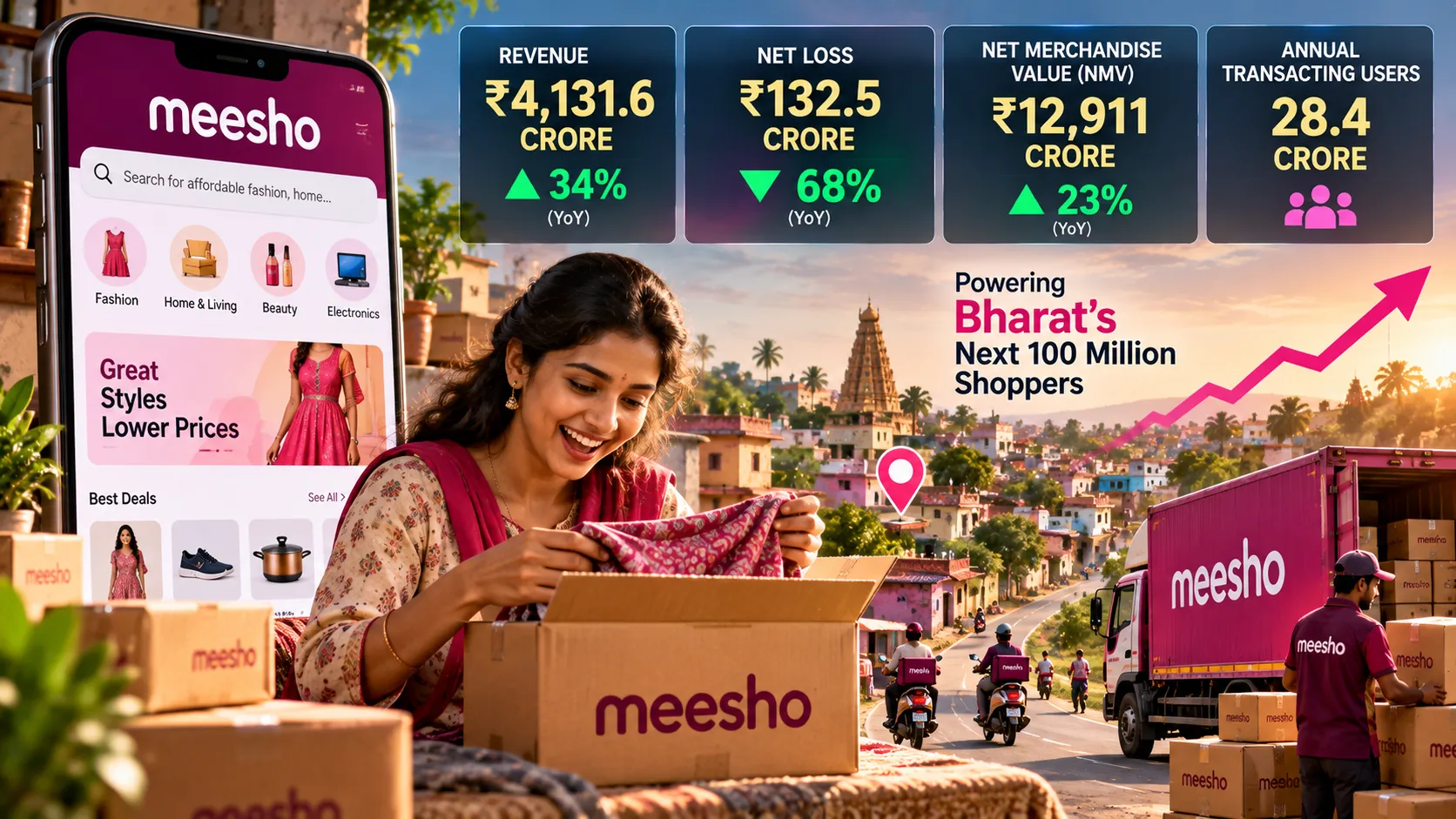
The Bengaluru-based company reported a consolidated net loss of ₹132.5 crore for the July-September quarter, down 68% from ₹411.4 crore a year earlier, according to Inc42 on Wednesday, October 28. Operating revenue rose 34% year on year to ₹4,131.6 crore, and 11% from the previous quarter.
The loss was roughly unchanged from ₹132.8 crore in the April-June quarter.
The key metrics
Meesho's net merchandise value (NMV), the total value of goods sold on the platform after cancellations and returns, rose 23% to ₹12,911 crore, according to Upstox. Annual transacting users reached 28.4 crore, making Meesho one of India's largest e-commerce platforms by number of shoppers.
First-time buyers increased 16% from the previous quarter, and NMV linked to the festive season rose 33%, the company said.
Behind the numbers
Total income, including other income of ₹127.4 crore, rose 31% to ₹4,259 crore. Total expenses increased 24% to ₹4,382.3 crore, growing more slowly than revenue, which helped narrow the loss.
The loss before exceptional items and tax fell 57% to ₹123.3 crore from ₹285.5 crore. The year-earlier quarter had included ₹45 crore of exceptional expenses related to a business combination and a vendor dispute settlement, as well as a ₹64.4 crore tax charge linked to the business combination. Neither recurred this quarter, flattering the year-on-year comparison.
Losses in Meesho's new initiatives segment rose to ₹41.6 crore from ₹13.5 crore, reflecting investments in newer businesses.
The value commerce model
Meesho was founded in 2015 by Vidit Aatrey and Sanjeev Barnwal, initially as a platform for social sellers who resold products through WhatsApp and Facebook. It has since evolved into a marketplace focused on value-conscious shoppers, particularly in Tier 2 cities, smaller towns and rural areas.
The company's model relies on low prices, a wide range of unbranded and small-brand products, and zero commission for sellers, earning revenue mainly from advertising, logistics and other services. That approach has helped it attract millions of small sellers and price-sensitive buyers who may not shop on Amazon or Flipkart.
Content commerce
Meesho has been growing its content commerce business, in which shoppers discover products through videos and creator content. Storyboard18 reported that content commerce grew 160%, reflecting broader trends in Indian e-commerce, where short videos and live streaming are increasingly influencing purchases.
Logistics as a lever
Meesho has also built its own logistics network, Valmo, which connects small logistics providers to deliver orders at low cost. Lower logistics costs are critical for a platform selling low-priced items, where shipping can represent a large share of the order value.
A listed company
Meesho is now a publicly listed company, and its results are closely watched as a gauge of India's new-age technology sector. After listing, investors have focused on whether the company can sustain revenue growth while moving towards profitability.
The results suggest progress on both fronts compared with a year ago, though the flat loss sequentially indicates that the path to profitability will not be linear, particularly as the company invests in new initiatives.
The festive season
The September quarter included the early part of India's festive shopping season, which runs through Navratri, Dussehra and Diwali and is the most important period of the year for e-commerce companies. Meesho's 33% growth in festive-aligned NMV indicates strong demand from its core customers.
The December quarter, which includes the bulk of the festive season this year, will be an important test of whether that momentum continues.
Competition in value e-commerce
Meesho's success has drawn competition. Flipkart has launched Shopsy, a value-focused platform, and Amazon has introduced low-price storefronts targeting similar customers. Quick commerce companies are also expanding their product ranges beyond groceries.
Meesho's advantages include its large seller base, low-cost logistics and strong brand among value-conscious shoppers, but sustaining growth will require continued investment in technology and customer acquisition.
What it means for India's digital economy
Meesho's growth reflects the expansion of e-commerce beyond India's largest cities. As smartphone and internet access spread and digital payments through UPI become ubiquitous, hundreds of millions of Indians in smaller towns are shopping online for the first time.
Platforms that serve these customers effectively can tap a vast market, but they must operate with very low costs, as average order values are small.
The path to profitability
Meesho's narrowing loss is the latest step in a long effort to show that value e-commerce can be profitable. The company has focused on reducing costs per order, increasing revenue from advertising and seller services, and using technology to automate operations. Its zero-commission model for sellers means that it earns money mainly from services such as advertising, logistics and fulfilment rather than from commissions on sales, which differentiates it from many marketplaces.
Because Meesho's customers are highly price-sensitive, the company cannot easily raise prices or fees. Instead, it has relied on scale, efficient logistics and data-driven targeting of advertising to improve its economics. The 68% reduction in loss suggests these efforts are working, though investors will want to see a sustained move to profit.
Reaching Bharat
Much of Meesho's growth comes from smaller towns and cities, where many of its users are shopping online for the first time. These consumers often buy unbranded or regional products, such as clothing, home goods and accessories, at low prices. Serving them requires a deep understanding of local preferences, regional languages and affordable delivery, and Meesho has built its platform around these needs.
The company's user base of 28.4 crore annual transacting users places it among the largest e-commerce platforms in India by number of shoppers, even if its average order values are lower than those of rivals focused on urban consumers.
What comes next
Investors will watch Meesho's December-quarter results for the impact of the peak festive season, as well as progress on reducing losses. Commentary on advertising revenue, logistics efficiency and the performance of new initiatives will help gauge whether the company can deliver sustained profitability in the coming year. Investors will also follow the company's progress on advertising revenue, logistics efficiency and the share of users who return to shop repeatedly, since these measures will determine how quickly Meesho can move from narrowing losses to consistent profitability.