Scientific research has long depended on skilled people performing repetitive experiments by hand. A Chinese startup is betting that robots and artificial intelligence can do much of that work faster and more reliably.
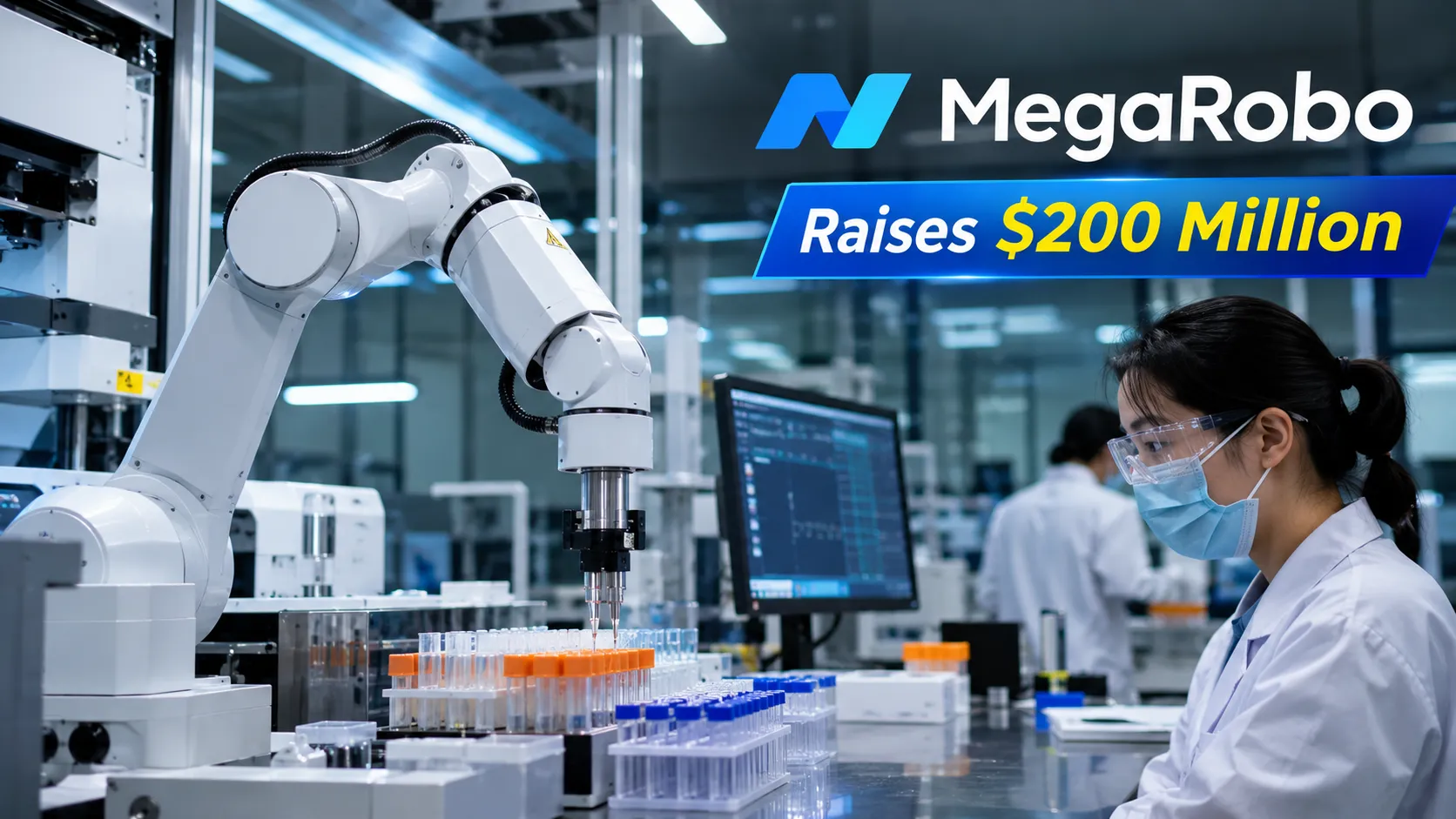
MegaRobo, a company based in Suzhou, China, has raised nearly $200 million in a new funding round, the company announced on Thursday, November 19, China time. Investors included the Oman Investment Authority, Oman's sovereign wealth fund, along with CMB International, Asia Investment Capital, Granite Asia, Sinovation Ventures and several investors based in Suzhou.
The company has now raised about $600 million in total.
What MegaRobo does
MegaRobo develops robotic systems that automate laboratory work, combined with AI software that designs and analyses experiments, an approach often described as "AI for Science." Its systems can carry out tasks such as handling samples, mixing chemicals and running tests, while AI models help decide which experiments to run next based on the results.
The company serves customers in life sciences, including pharmaceutical and biotechnology companies, as well as in industrial sectors. It has also applied its technology to defect diagnosis in semiconductor and display manufacturing, where identifying tiny flaws quickly is critical to production yields.
MegaRobo says it serves more than 500 customers in one segment and more than 200 in another, according to the company's own figures, which could not be independently verified.
Why lab automation matters
Laboratory research is often slow, expensive and labour-intensive. Scientists spend significant time on routine tasks, and experiments can be difficult to reproduce. Automated labs can run experiments around the clock, with greater precision and consistency, and generate large amounts of data that AI models can learn from.
Combining automation with AI creates what some call "self-driving labs," where systems can design, run and analyse experiments with minimal human intervention. This approach could accelerate discoveries in drug development, materials science and chemistry.
Gulf capital flows into Asian tech
The participation of the Oman Investment Authority highlights a growing trend of Gulf sovereign wealth funds investing in Asian technology companies. Funds from Saudi Arabia, the UAE, Qatar and Oman have increased investments in China, India and Southeast Asia, seeking to diversify their portfolios and gain exposure to fast-growing technology sectors.
For Asian startups, Gulf investors offer large pools of patient capital and potential access to Middle Eastern markets, where governments are investing heavily in research, healthcare and technology as part of economic diversification plans.
China's AI for Science push
China has made AI for Science a strategic priority, seeing it as a way to accelerate innovation in areas such as pharmaceuticals, new materials and advanced manufacturing. Chinese companies and research institutes have invested heavily in automated labs and AI models for scientific research.
The global race in AI for Science involves major technology companies, such as Google DeepMind, whose AlphaFold system predicted protein structures, and startups in the US, Europe and Asia. This week, Isomorphic Labs, a DeepMind spinout focused on AI drug discovery, has been in the spotlight after raising significant capital.
The investors
CMB International is the investment arm of China Merchants Bank. Granite Asia, formerly known as GGV Capital's Asia business, invests in technology companies across Asia. Sinovation Ventures was founded by Kai-Fu Lee, a prominent AI expert and former head of Google China.