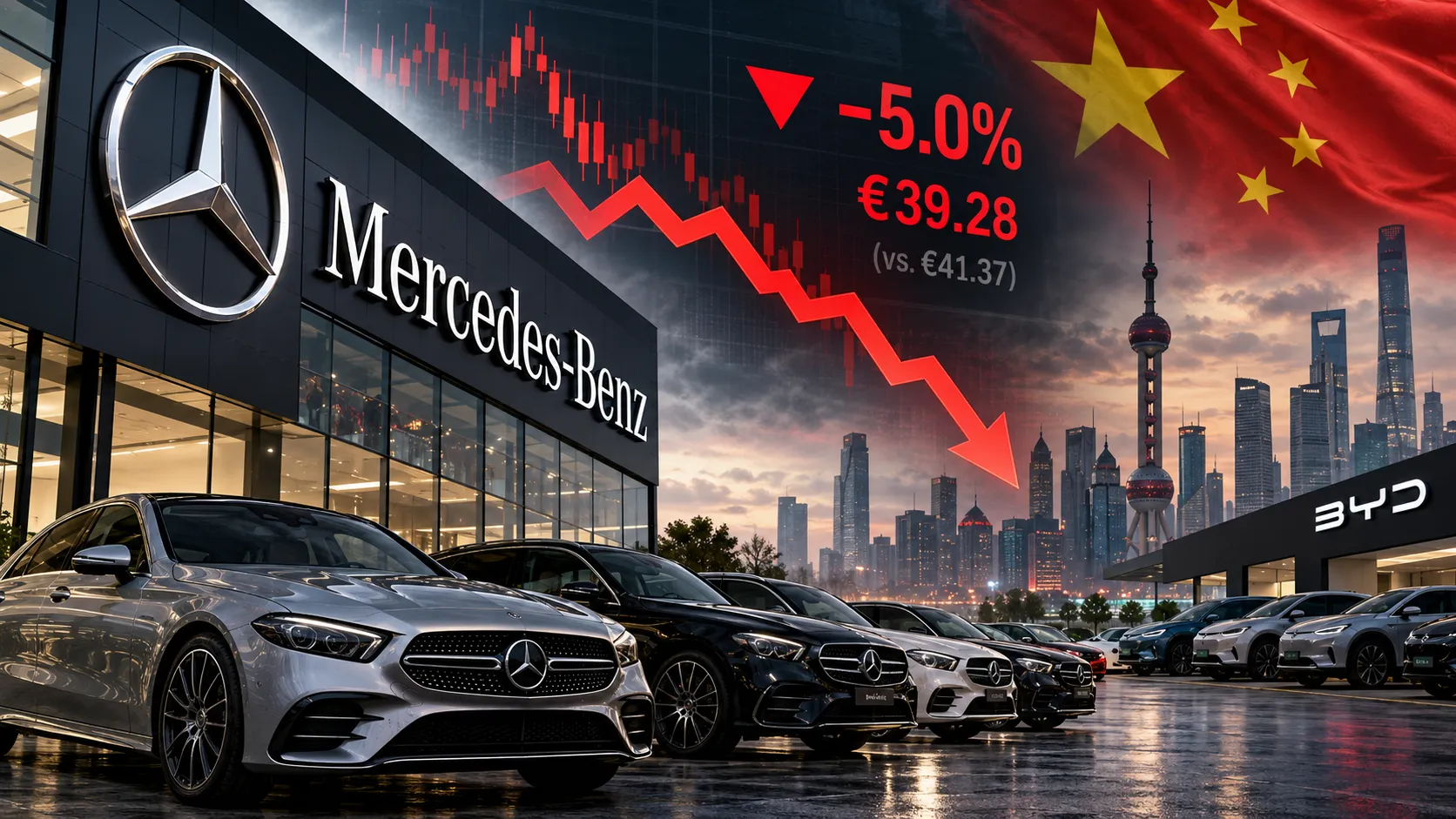
Mercedes-Benz, one of the world's most famous luxury carmakers, has cut its profit outlook for the year as a collapse in Chinese demand and rising costs eroded its margins.
The Stuttgart-based company lowered its 2026 guidance on Tuesday, October 27, while releasing preliminary third-quarter figures, according to German financial news site Ad Hoc News and other reports. The full third-quarter report is due on Wednesday, October 28.
Mercedes shares fell about 5% to €39.28 on the Lang & Schwarz trading platform, from a previous close of €41.37 on Xetra, close to their 52-week low of €38.89.
The outlook cut
Mercedes now expects the adjusted return on sales for its cars division to be 2% to 3% in 2026, down from its previous range of 3% to 5%. Group earnings before interest and tax (EBIT) are now expected to be at the level of the previous year, about €5.8 billion, rather than rising. Earlier, the company had projected an increase of at least 15%.
Industrial free cash flow is now expected to be significantly below the previous year.
The company's vans division is expected to maintain a return on sales of 8% to 10%, and its financial services division a return on equity of 12% to 14%.
The third quarter
Preliminary third-quarter results were mixed. Group EBIT came in at €1.77 billion, above the €1.60 billion consensus forecast. The cars division's adjusted return on sales was 2.5%, slightly above expectations of 2.4%. The vans division's return on sales was 9.4%, and financial services' return on equity was 13.8%.
But industrial free cash flow was just €172 million, well below the €422 million consensus.
Mercedes sold 491,700 cars and vans in the quarter, down 6% from a year earlier, with core car sales down 8%.
China's collapse
The main reason for the outlook cut is China, the world's largest car market and historically one of Mercedes's most profitable. Deliveries in China fell 29% in the nine months to September, after annual volumes had already fallen to their lowest since 2016, according to reports.
Chinese demand for foreign luxury cars has slumped as the Chinese economy has slowed and as domestic brands, led by BYD, Li Auto, Nio, Xiaomi and others, have captured buyers with technologically advanced electric vehicles at lower prices. Chinese consumers increasingly view domestic brands as more innovative, particularly in software, connectivity and autonomous driving features.
German luxury carmakers, including BMW and Porsche, have all suffered from the shift. For Mercedes, which depended on China for a large share of profits, the impact has been severe.
Rising costs
Mercedes also cited higher material costs, particularly in the fourth quarter. Rising prices for metals, energy and components have squeezed margins across the automotive industry. High oil prices linked to the conflict in West Asia have added to costs for logistics and production.
The electric challenge
Mercedes has been investing heavily in electric vehicles, but the transition has been slower and more expensive than expected. Demand for electric vehicles in Europe has been uneven, while Chinese competitors have set a high bar on price and technology.
The company has adjusted its strategy, extending the life of combustion engine models while continuing to develop new electric platforms. Balancing investment in new technology with profitability has become a central challenge.