FundingAnalysis6 MIN READ

Meta Launches Plan to Raise Up to $95 Billion in Stock as AI Spending Pushes Free Cash Flow Negative

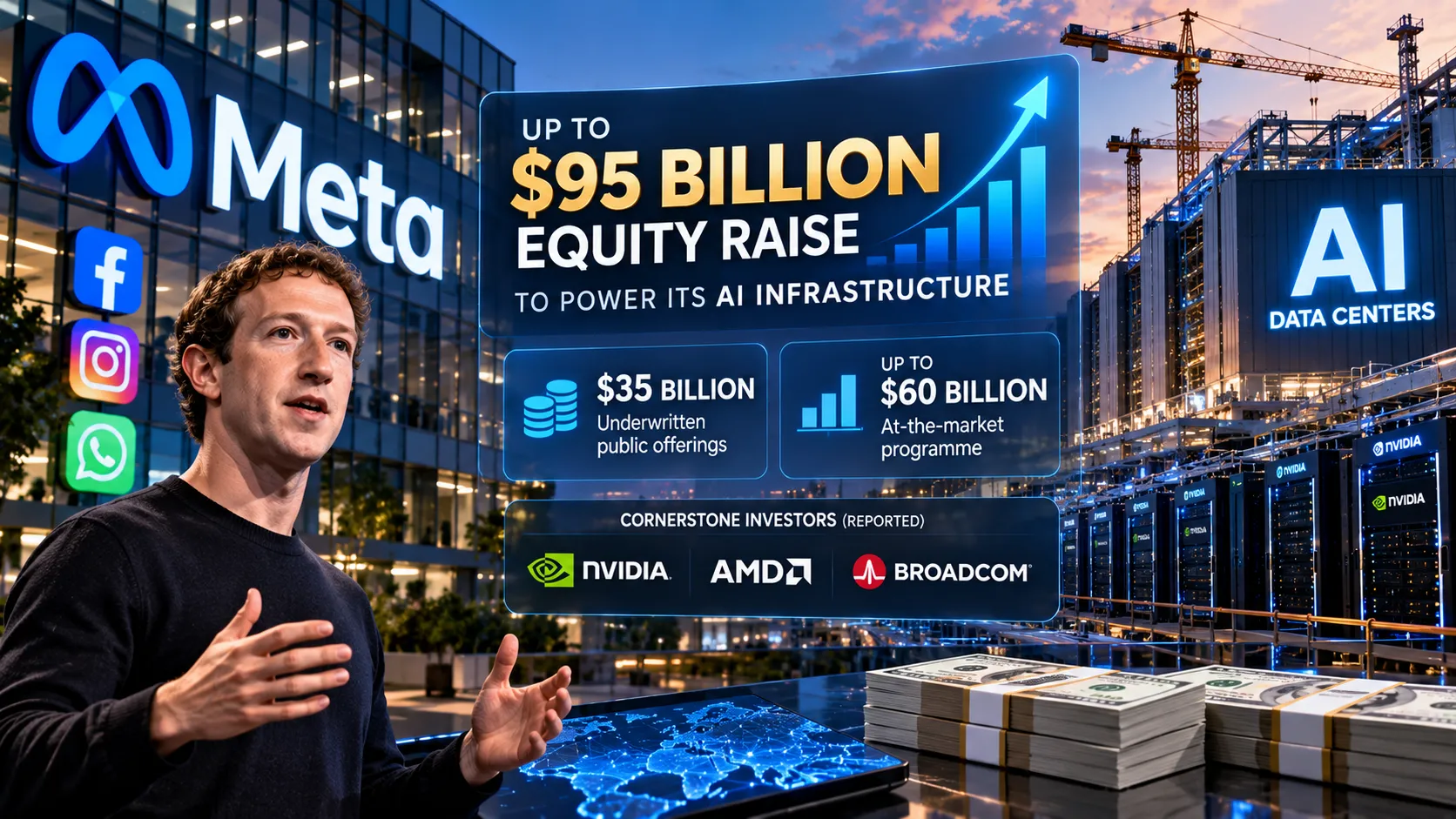
Meta Platforms plans to raise up to $95 billion through equity, including about $35 billion of underwritten offerings and up to $60 billion of new non-voting Class C shares, after its AI build-out produced the company's first negative free cash flow in more than a decade.

By Nisha Omkumar · Author27 October 2026New
Meta Launches Plan to Raise Up to $95 Billion in Stock as AI Spending Pushes Free Cash Flow Negative

Meta Platforms has launched plans to raise up to $95 billion by selling new shares, its largest equity raise ever, as the cost of building artificial intelligence infrastructure outstrips the cash generated by its advertising business.

The owner of Facebook, Instagram and WhatsApp said on 26 October that it would begin with about $35 billion of underwritten public offerings, covering Class A common stock and depositary shares tied to mandatory convertible preferred stock. It also plans to raise up to $60 billion by selling new non-voting Class C shares through an at-the-market programme, under which shares are sold gradually into the market. Trading in the Class C shares is expected to start in the first quarter of 2027, though timing and terms are not final.

Nvidia, AMD and Broadcom have reportedly expressed interest in buying up to $5 billion of Class A shares combined, positioning the chipmakers, which supply Meta's AI infrastructure, as cornerstone investors.

A First Cash Shortfall in a Decade
bc7085fd-07d0-416f-9c84-096dbb2afb7a.png

The equity raise follows third-quarter results in which Meta's free cash flow turned negative for the first time in more than a decade. The company reported negative free cash flow of $2.12 billion in the quarter, compared with positive free cash flow of $10.63 billion a year earlier.

The shortfall came despite strong revenue growth. Third-quarter revenue rose 26 per cent to $64.60 billion, beating analysts' expectations of $63.37 billion, according to LSEG data.

The problem is the scale of investment. Meta raised the lower end of its 2026 capital expenditure forecast to $135 billion from $130 billion, while keeping the upper end at $145 billion. Reuters reported that the company's future spending commitments total about $825 billion. Meta has warned investors that it will need to raise "hundreds of billions of dollars" over several years to fund its AI push.

The Balance Sheet

As of 30 September, Meta held $82.45 billion in cash, cash equivalents and marketable securities, against $80.92 billion of long-term debt. The company has already tapped bond markets heavily to fund its build-out, and says it will fund future spending through operating cash flow, investment-grade debt, partnerships and equity.

Equity issuance is unusual for a company of Meta's size and profitability. Large technology companies have typically funded investment from operating cash flow and returned surplus cash to shareholders through buybacks and dividends. Selling new shares dilutes existing shareholders, and the decision signals how capital-intensive the AI race has become.

Zuckerberg's Control

The non-voting Class C share structure is designed to help preserve the voting control of chief executive Mark Zuckerberg. Meta first disclosed the Class C plan on 21 October, describing it as a two-for-one split.

Under the arrangement, Zuckerberg can immediately sell 20 per cent of the Class C shares he receives, equivalent to about 10 per cent of his total economic stake, which would allow him to meet potential tax obligations without giving up voting control. In return, he committed to remain a resident of California, or wherever Meta is headquartered, for eight years. Reports have linked the arrangement to Proposition 40, a proposed one-time 5 per cent tax on California's billionaires.

A Wider Trend

Meta is not alone in turning to equity markets. Alphabet sold $84.75 billion of equity in June, and other technology companies have explored creative financing structures to fund AI infrastructure. SpaceX recently disclosed a financing arrangement under which an Apollo affiliate buys AI chips and servers and leases them to the company, and banks and Blackstone have lined up $63 billion to finance Broadcom chips for Anthropic.


“We expect investors to continue to question the financing and potential for future capital raises.”
— William Blair analysts, in a note to clients

The scale of financing has raised concerns among some investors about whether returns on AI investment will justify the spending. Analysts at William Blair wrote: "We expect investors to continue to question the financing and potential for future capital raises."

Where the Money Goes

Meta's spending is concentrated on data centres, AI chips and the power infrastructure needed to run them. The company has been building some of the world's largest data centre campuses and has committed to large purchases of chips from Nvidia and others, alongside developing its own custom silicon.

Zuckerberg has framed the investment as essential to Meta's ambition to build advanced AI, which he describes as "personal superintelligence", and to maintain its position against rivals including OpenAI, Google and Anthropic. Meta's AI efforts include its Llama models, AI assistants across its apps and new products such as Muse, which the company says attracted more than 10 million accounts in the US and Canada within about six weeks of its September launch.

Chief financial officer Susan Li has said AI businesses should start contributing incremental revenue in 2027.

Investor Reaction

Meta shares fell sharply after its third-quarter results, and dipped further in early trading as the offering was announced, as investors digested the prospect of dilution and the implications for future spending. Yet demand for the offering, and interest from chipmakers as cornerstone investors, suggests that many investors remain willing to back Meta's strategy.

Implications for India

Meta's AI build-out matters for India in several ways. India is Meta's largest market by users for Facebook, Instagram and WhatsApp, and the company has invested heavily in AI features for Indian users and businesses. Meta has also formed an enterprise AI joint venture with Reliance Industries, reflecting the growing importance of India to its AI strategy.

Comparing the Big Tech Spending Race

Meta is one of several technology giants spending at unprecedented levels on AI infrastructure. Microsoft, Alphabet and Amazon have each guided to capital expenditure measured in the tens of billions of dollars per quarter, much of it on data centres and chips. Combined, the largest US technology companies are expected to spend hundreds of billions of dollars a year on AI infrastructure, a level of investment that has few precedents in corporate history.

Unlike its peers, however, Meta does not operate a large public cloud business that rents computing capacity to other companies. Microsoft, Amazon and Google can generate revenue directly from AI infrastructure by selling cloud services, while Meta must justify its spending through improvements to its own products, advertising performance and new AI services. That difference partly explains why investors scrutinise Meta's spending so closely, and why the company's ability to demonstrate returns will be central to its share performance.

What Comes Next

The underwritten tranche began on 26 October, while the Class C programme is expected to begin in early 2027. Investors will watch whether Meta's AI investments begin to generate meaningful revenue, and whether the company's spending plans continue to expand.

The $95 billion raise is a striking measure of the AI arms race. Even one of the world's most profitable companies now needs to tap equity markets to keep up, a sign of how much capital the race to build advanced AI is consuming.

TagsMetaMark ZuckerbergStock OfferingEquity RaiseAI SpendingCapexFree Cash FlowClass C SharesNvidiaAMDBroadcomData CentresBig TechSusan LiAI Infrastructure

Reader reviews

Sign in to rate and review this article.
Loading reviews…
