
TechArtificial Intelligence6 MIN READ

Meta Launches Muse Spark 1.3 With Upgraded Agentic AI and Coding Features

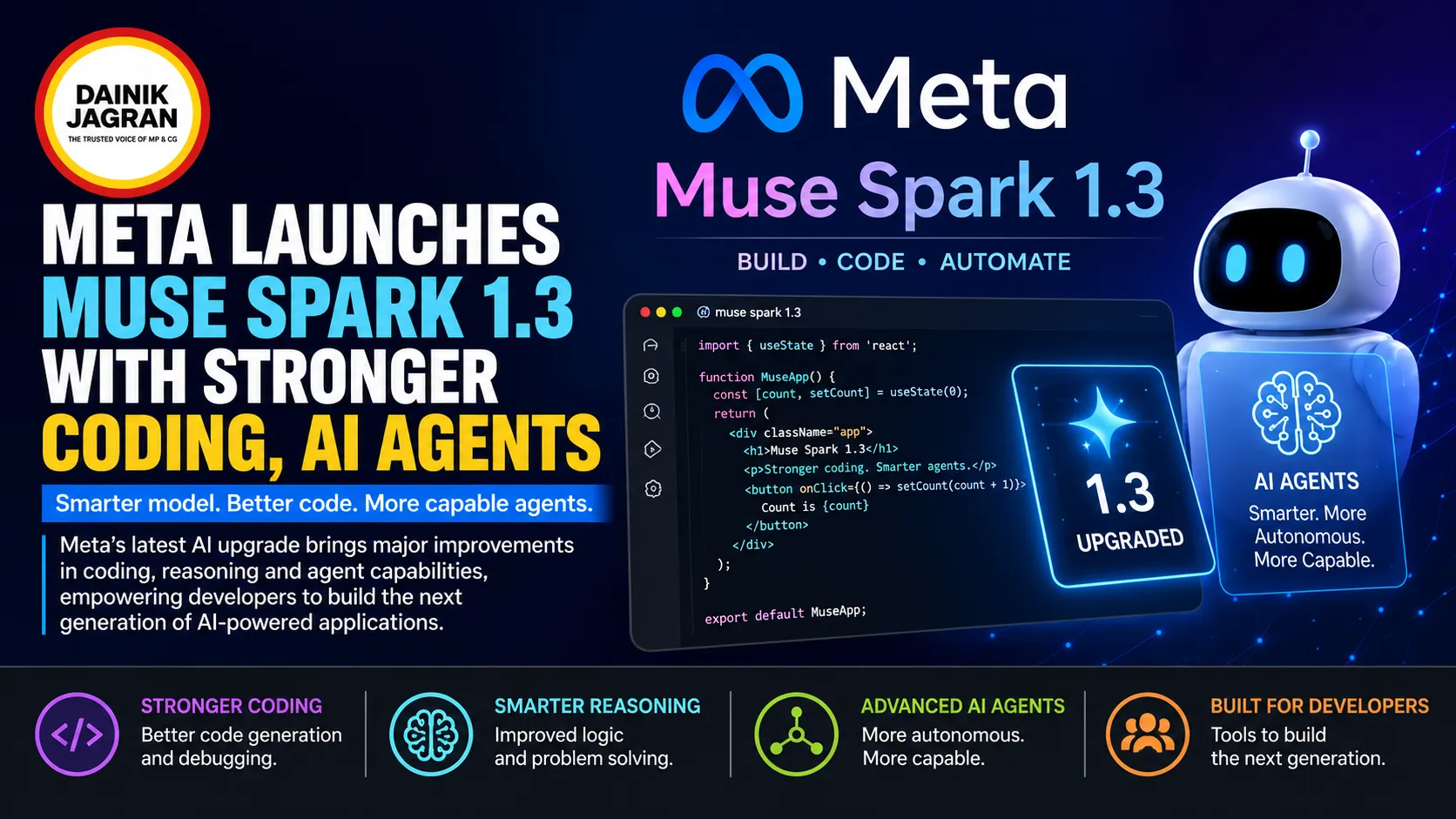
Meta has released Muse Spark 1.3, an upgraded AI agent emphasising improved coding capability, instruction-following and longer-running autonomous task execution.

By Aravind Kumar · Author5 September 2026New
Meta Launches Muse Spark 1.3 With Upgraded Agentic AI and Coding Features

Meta has released Muse Spark 1.3, an updated version of its AI agent that places particular emphasis on improved coding ability, more reliable instruction-following, and the capacity to sustain longer-running autonomous processes without requiring frequent human intervention or correction. The release adds to an increasingly crowded field of agentic AI systems that major technology companies have been racing to bring to market throughout 2026.

The concept behind Muse Spark's latest iteration centres on enhancing multitasking capability, memory retention across extended interactions, tool use proficiency and decision-making autonomy, while simultaneously working to reduce what the company describes as superfluous interactions, essentially unnecessary back-and-forth exchanges that have historically limited how independently AI agents can operate on complex, multi-step tasks.

The release also arrives amid an increasingly intense competitive cycle among major AI labs and technology companies, each racing to demonstrate leadership in agentic capability through a steady cadence of model updates and feature releases that have made 2026 one of the most rapidly iterating years in the AI industry's relatively short history.

Software engineering professionals note that enterprise adoption of agentic coding assistants has historically been constrained less by raw model capability than by reliability concerns around unsupervised execution within production environments, making the specific emphasis on reduced supervision overhead in this release particularly relevant to enterprise technology buyers who have so far limited agentic AI deployment to lower-stakes, closely monitored development workflows rather than fully autonomous production coding tasks.

Agentic AI, systems designed to autonomously plan and execute multi-step tasks rather than simply responding to individual prompts, has emerged as one of the most closely watched frontiers in artificial intelligence development throughout 2026, with major technology companies and well-funded startups alike racing to demonstrate agents capable of reliably completing increasingly complex workflows with minimal human oversight.

Coding has become a particularly important benchmark category for these systems, given both the immediate commercial value of AI-assisted software development and the relatively well-defined, verifiable nature of coding tasks compared with more open-ended domains, making it a favoured proving ground for companies looking to demonstrate tangible improvements in agentic reliability and capability.

Reliability over extended, multi-step task execution has emerged as one of the more difficult technical challenges in agentic AI development, since even highly capable models can accumulate compounding errors across long task sequences, making improvements to memory retention and self-correction capability, areas Meta has specifically highlighted in this release, particularly significant for enterprise customers evaluating whether agentic AI systems can be trusted with genuinely consequential, unsupervised workflows.

Developer surveys tracking AI coding assistant adoption have generally found that trust in autonomous, multi-step code generation lags considerably behind trust in simpler, single-function code completion and suggestion tools, a gap that improvements in memory retention and reduced supervision requirements, as featured in this release, are specifically intended to help close over successive product iterations.

For Meta, continued investment in agentic AI capability sits within a broader competitive context defined by intense rivalry among major AI labs and technology companies, each racing to demonstrate leadership across coding assistance, longer-running autonomous task execution and improved reasoning capability, categories that have become central battlegrounds in the broader competition for enterprise and developer adoption of AI systems.

The real competition in agentic AI has shifted from clever demos to whether an agent can run unsupervised for hours without needing to be corrected.
TIGI Global Tech Desk
ChatGPT Image Sep 5, 2026, 03_20_36 PM.png

The emphasis on reducing unnecessary interactions and improving memory and tool use also reflects a broader industry-wide shift in how agentic AI systems are being evaluated, moving beyond simple benchmark performance on isolated tasks toward more holistic assessments of how reliably an agent can operate independently across extended, real-world workflows that more closely resemble actual enterprise and developer use cases.

Coding assistance in particular has become a favoured proving ground for agentic AI capability given the relatively objective, verifiable nature of software functionality compared with more subjective domains, allowing companies to demonstrate concrete, measurable improvements through standardised coding benchmarks that carry more credibility with technical evaluators than qualitative claims about general reasoning improvement alone.

For enterprise technology leaders and investors evaluating where to deploy AI adoption budgets, Meta's continued investment in agentic capability reinforces coding and software development assistance as one of the clearest near-term commercial use cases for advanced AI systems, a category where measurable productivity gains have already begun materially reshaping how technology teams globally approach software development workflows.

As Muse Spark 1.3 rolls out, its reception among developers and enterprise users will offer an important signal of whether Meta's approach to agentic AI, and its particular emphasis on reduced interaction overhead alongside improved coding capability, can meaningfully differentiate the product within an increasingly crowded and competitive agentic AI landscape.

The broader trajectory of agentic AI development throughout the remainder of 2026 will likely continue to be shaped by this same competitive dynamic, with companies racing to demonstrate ever more reliable, independent task execution capability as the practical, commercial value of genuinely autonomous AI agents becomes an increasingly central battleground across the technology industry.

As the competitive field for agentic AI systems continues to crowd, differentiation increasingly hinges on demonstrated real-world reliability across extended, autonomous task execution rather than benchmark performance on isolated test cases, a shift in evaluation focus that is likely to shape how Meta and its competitors position their next generation of agentic AI releases throughout the remainder of 2026 and into 2027.

Business leaders and policymakers focused on workforce implications of advancing AI capability will likely continue watching releases like Muse Spark 1.3 closely, given the ongoing broader debate about how rapidly improving agentic coding assistance may reshape software engineering labour markets globally, a conversation that carries particular relevance for India given the country's large software services and engineering talent base.

The bottom line for TIGI's readers: Muse Spark 1.3's real test is not benchmark performance but whether enterprises trust it to run unsupervised on production coding tasks for hours at a time.

Enterprise software analysts expect the next meaningful test for Muse Spark's agentic capability to come not from published benchmark scores but from independent case studies documenting sustained, error-free performance across genuinely long-running, multi-step production coding workflows. Until such independently verified case studies accumulate, most enterprise technology buyers are likely to continue treating vendor-reported benchmark improvements with a degree of measured caution.

TagsMetaMuse SparkAgentic AICoding AIArtificial Intelligence

Reader reviews

Sign in to rate and review this article.
Loading reviews…

