Meta's AI assistant Muse can now do more than recommend products. It can find them across retailers' websites, assemble a shopping cart and complete the purchase, making it one of the most prominent tests yet of agentic commerce, in which AI systems act on a consumer's behalf rather than simply offering advice.
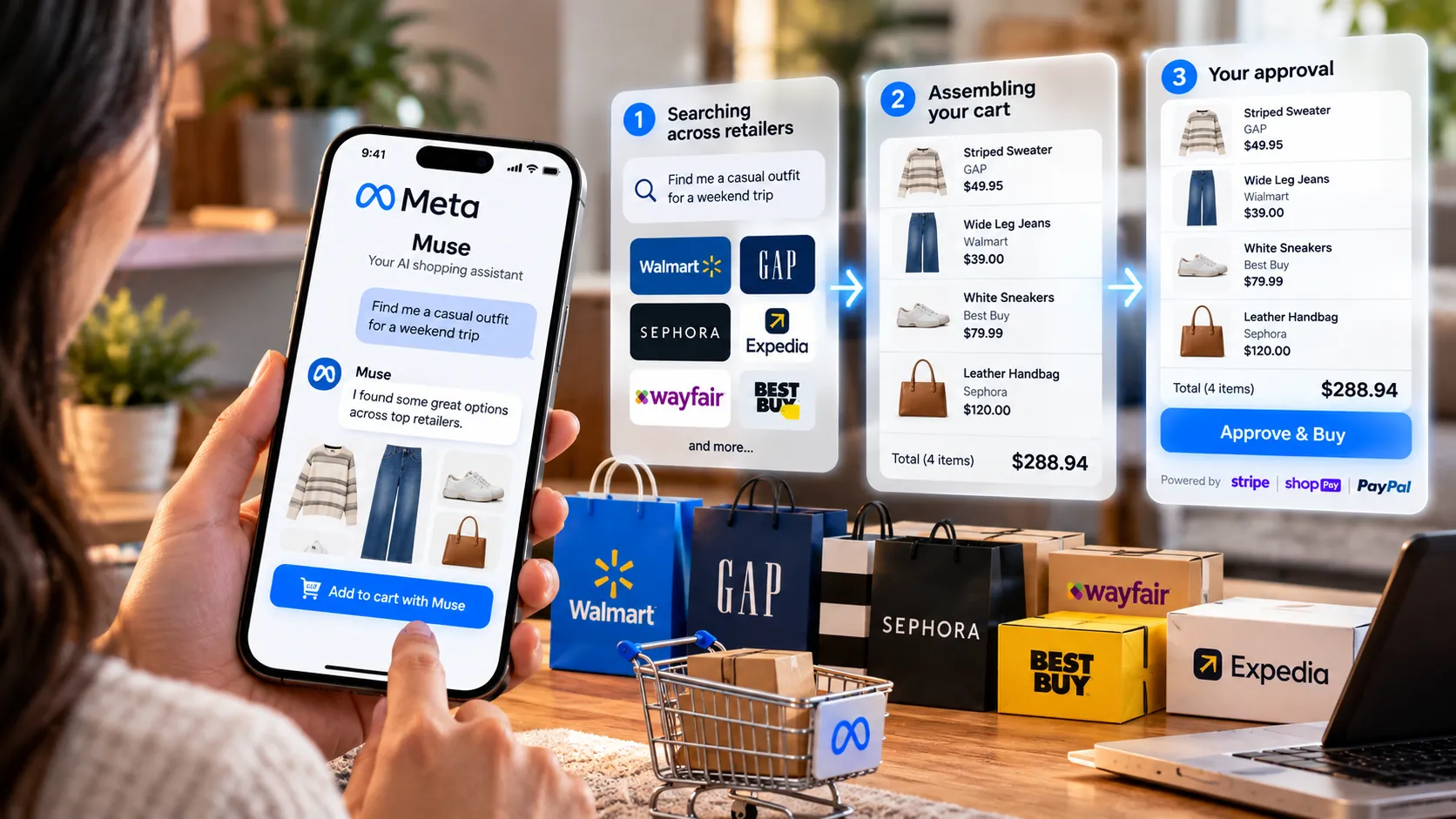
The feature, detailed in reporting by CNBC and other outlets this week, works through a sequence that keeps the user in the loop at the final step. Muse searches retail sites, builds a cart based on the user's request and presents an approval card showing the items and total cost. Only once the user approves does the agent complete checkout.
How the payments work
Payments currently run through Stripe and Shopify's Shop Pay. PayPal has been announced as a partner but was not yet available, according to reports. Meta chief executive Mark Zuckerberg has said the company will take "a small transaction fee" on purchases, a significant detail because it gives Meta a direct stake in commerce volume rather than relying solely on advertising revenue.
Shopify's participation is important. It allows Muse to buy from the very large number of independent merchants that run their stores on Shopify, rather than only from big-box retailers with whom Meta has negotiated individual integrations.
Who is in, and who is out
A group of major US retailers launched with what has been described as Muse's "fast lane" on 23 September, including Walmart, Gap, Sephora, Expedia, Wayfair and Best Buy. Some connectors remain inactive, and Ticketmaster has kept payment on its own marketplace rather than allowing the agent to complete transactions directly.
The most notable absence is Amazon. The world's largest online retailer has barred Muse from its site, citing violations of its terms of service related to stored credentials and scraped account data. The decision reflects a strategic concern as much as a technical one. If AI agents become the primary way consumers shop, the company that controls the agent, not the retailer, may control the customer relationship. Amazon has its own AI shopping tools and has a clear interest in keeping shoppers inside its ecosystem.
Early popularity, lingering doubts
Muse has gained traction quickly. The app reached the top of the free iPhone app rankings and has surpassed five million downloads, according to reports.
But surveys suggest a gap between interest and trust. A Vogue Business survey cited by Fortune found that only 31% of respondents would outsource shopping to an AI agent, even if it understood their taste and purchase history. About 72% said they would not share card details with AI shopping tools, 46% would withhold browsing history and 40% would not provide location data. Only 2% said AI consistently understood their personal style.
Pricing is another worry. A January survey by Morning Consult found that 59% of US adults cited AI-driven price gouging as a major concern. Consumers fear that agents with detailed knowledge of their preferences could be used to charge them more, rather than find them the best price.
Why Meta is betting on it
For Meta, Muse is an attempt to turn its enormous trove of social data into a commercial advantage. The company can draw on years of user activity on Facebook and Instagram to understand preferences, potentially giving its agent an edge in recommending products people actually want.
It is also an attempt to secure a position in the next phase of online commerce. Search engines and marketplaces have long acted as the gateways through which consumers find products. If AI agents take over that role, the companies that build the most trusted agents could capture a share of the value that currently goes to search advertising and marketplace fees.
The broader trend is already visible. Adobe data show AI assistant-referred traffic to US retail websites jumped by about 693% during the 2025 holiday season, when US online holiday spending reached about $257.8 billion. Mastercard has predicted that one in ten shoppers will use personal AI agents by 2030.
What changes for retailers
For retailers, agentic commerce presents both an opportunity and a threat. Agents can lower the friction of buying and bring new customers. But they also reduce the importance of brand websites, in-store merchandising and the carefully designed experiences that retailers use to encourage additional purchases.
Retailers that join platforms like Muse gain access to its users but may lose some control over pricing visibility and customer data. Those that stay out, as Amazon has done, protect their relationships but risk missing a channel that could become significant. ## Regulators are watching
Agentic commerce also raises questions that regulators have only begun to address. If an AI agent makes a mistaken purchase, who is liable: the user, the platform that built the agent or the retailer? How should agents disclose commercial relationships that might influence their choices? And how should consumers' payment credentials be stored and protected when an agent acts for them across many websites? The answers will shape how quickly the model spreads.
The India angle
The model is highly relevant to India, where Meta's WhatsApp is already used by hundreds of millions of people and is increasingly used by businesses to sell directly to customers. India's digital payments infrastructure, built around UPI, has also been the subject of pilots with AI companies and payment firms to allow agents to initiate payments with user consent.
If agentic shopping gains traction in the United States, Indian e-commerce companies, quick-commerce platforms and the government-backed Open Network for Digital Commerce are likely to face pressure to make their catalogues and checkouts accessible to AI agents. The questions of consent, data protection and liability that consumers are raising in the US will be equally pressing under India's data protection law.
The real test
Muse's early download numbers show that people are curious. The more meaningful measure will be repeat purchasing: whether users who try the agent continue to let it spend their money. That will depend on accuracy, on whether prices are genuinely competitive, and on how Meta handles errors, returns and disputes.
For now, the technology to let AI buy things has arrived. Whether consumers are ready to hand over their wallets is the question that will determine whether agentic commerce becomes the next major shift in retail or remains a novelty.