Micron Technology, the largest US maker of memory chips, reported results for its fiscal fourth quarter on 30 September 2026 that comfortably beat Wall Street expectations, and issued guidance that pointed to another sharp increase in revenue as demand for artificial intelligence infrastructure continues to outstrip supply.
Revenue for the quarter ended 3 September reached $54.23 billion, against analysts' average estimate of $51.07 billion, according to LSEG. Adjusted earnings per share were $33.42, compared with expectations of $31.61. On a GAAP basis, the company earned $32.87 per diluted share.
For the current fiscal first quarter, Micron forecast revenue of about $61.5 billion and adjusted earnings of about $38.15 per share, both well above analysts' estimates of roughly $57 billion in revenue and $35.40 in adjusted earnings per share.
A year unlike any other for memory
The full-year numbers capture the scale of the AI-driven boom in memory. For fiscal 2026, Micron reported revenue of $133.19 billion, up from $37.38 billion a year earlier. GAAP net income reached $84.97 billion, or $74.33 per diluted share. Operating cash flow was $89.68 billion, compared with $17.53 billion in the previous year.
Quarterly revenue rose about 31% from the previous quarter and roughly fourfold from a year earlier. Gross margin reached around 87%, an extraordinary level for a company whose industry was historically known for brutal boom-and-bust cycles and thin margins in downturns. The company said data centre revenue had risen about elevenfold from a year earlier.
"Micron delivered record fiscal 2026 results, and we expect an even stronger fiscal 2027," said Sanjay Mehrotra, Micron's chairman and chief executive. "AI is becoming Super Intelligence (SI), and memory enhances this intelligence and the competitiveness of our customers' platforms. We are increasing our investments in technology, products and manufacturing to help drive SI forward with our customers, and our Strategic Customer Agreements provide added confidence in the durability of Micron's financial performance."
Why AI needs so much memory
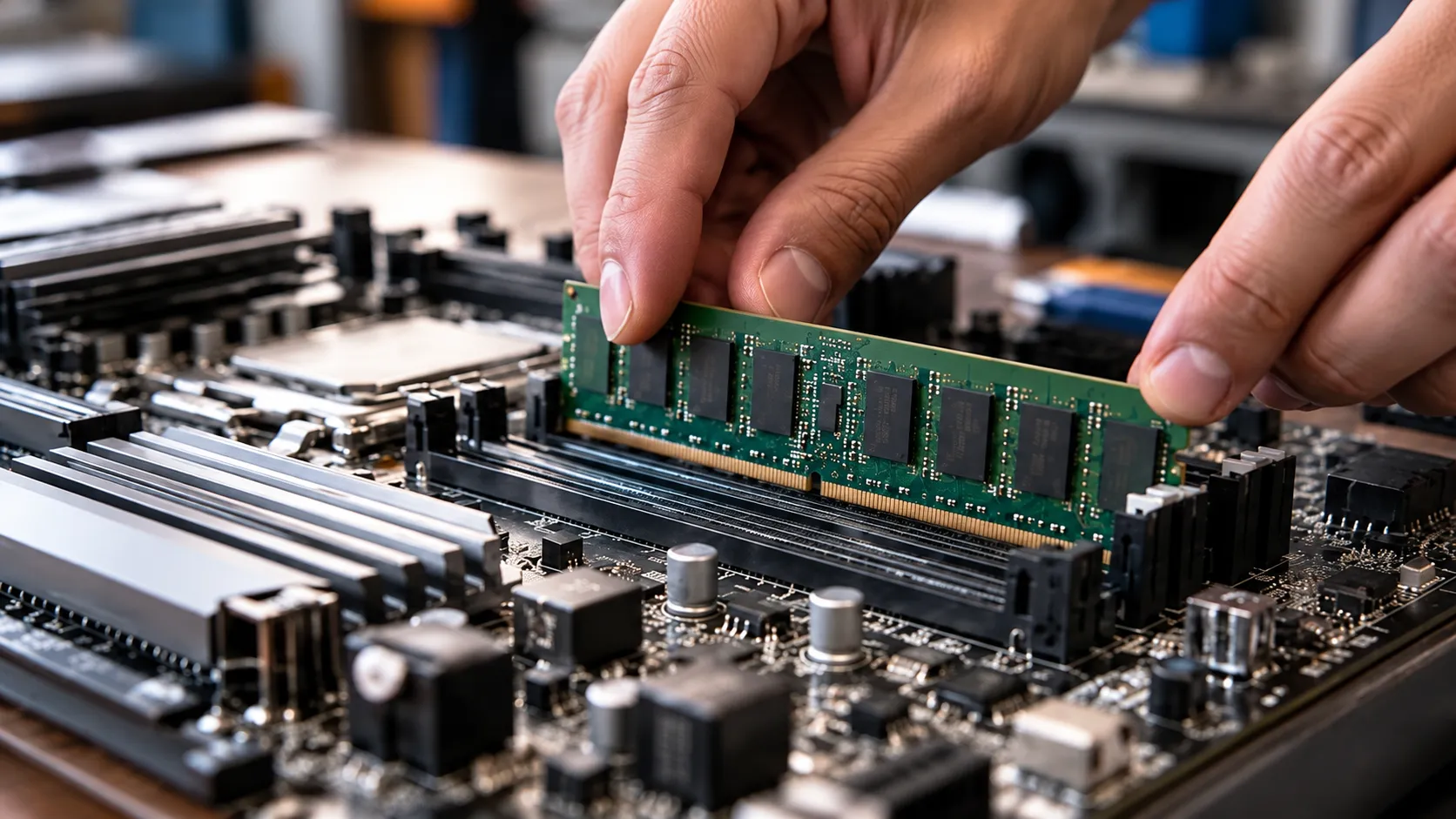
Large AI models require enormous amounts of fast memory. The graphics processors and custom accelerators used to train and run these models are paired with high-bandwidth memory (HBM), a type of stacked DRAM that sits close to the processor and allows data to move at very high speeds. Each new generation of AI accelerator uses more HBM, and data centres also need vast quantities of conventional DRAM and NAND flash storage.
Only three companies make HBM at scale: South Korea's SK Hynix and Samsung Electronics, and Micron. Micron holds the smallest share of the three, but it is the only US-based producer, which has strategic value as Washington encourages domestic chip production.
On the earnings call, Mehrotra said the company had a "strong roadmap for future HBM products" and was working with Nvidia on the industry's "first custom HBM implementation". Custom HBM, tailored to a specific customer's processor design, could deepen ties between memory makers and AI chip designers.
Prices are rising across products
Tight supply has given memory makers strong pricing power. Micron said NAND prices increased by about 30% in the quarter, driven by tight industry conditions. Its Cloud Memory Business Unit, which serves large data centre operators, generated record revenue of $16.3 billion, about 30% of the company's total.
Management also said that even at "floor prices" set in its long-term agreements, it expected margins well above any previous cycle peak, an argument designed to reassure investors who fear the eventual end of the current upswing.
The one blemish: margins
The stock initially moved between gains and losses in extended trading. Investors focused on guidance for a slight decline in gross margin in the current quarter, to about 86.25% on a non-GAAP basis. Chief financial officer Mark Murphy said on the call that the company had decided to increase incentive compensation for employees, which would affect costs.
Even so, the guidance implies another quarter of record profits. Micron's board also declared a quarterly dividend of $0.15 per share, payable on 29 October.
A trillion-dollar memory maker
The scale of Micron's transformation is reflected in its share price. The stock has risen more than 500% over the past year, and the company's market capitalisation has topped $1.2 trillion, placing it among the world's most valuable companies. That would have been almost unthinkable a few years ago, when memory stocks were valued as cyclical commodities.
Its results also matter for the wider market. On 30 September, technology was the only S&P 500 sector to post a gain for September, as investors concentrated money in AI-related companies while rising bond yields hit other sectors. Strong numbers from a key supplier to AI infrastructure reinforce the case that spending by large technology companies on data centres remains robust.
Rival suppliers will be watching closely. SK Hynix and Samsung both report quarterly results later in October, and Micron's strong guidance suggests the entire memory industry is benefiting from the same demand surge. Analysts will compare HBM volumes, pricing and capacity plans across all three companies to judge whether supply is likely to catch up with demand in 2027.
Implications for Asia and India
Micron's results are closely watched in Asia, where much of the memory supply chain is located. They also matter for India, where Micron is building an assembly and test facility in Sanand, Gujarat, one of the flagship projects under India's semiconductor incentive programme. Stronger profits give the company more capacity to invest in new facilities worldwide, including in emerging chip-making locations.
The cycle question
The key question for investors is how long the boom can last. Memory has historically been a highly cyclical industry: shortages lead to price increases and heavy investment, which eventually lead to oversupply and falling prices. Micron and its rivals are now investing heavily in new capacity.
Micron's argument is that this cycle is different, because AI demand is structural and long-term agreements with customers provide more predictable revenue. Mehrotra's comment that the company expects "an even stronger fiscal 2027" signals confidence that demand will keep outpacing supply for at least another year. Whether that confidence proves justified will depend on AI spending by the world's largest technology companies, which shows few signs of slowing for now.