Microsoft has delivered a strong start to its fiscal year, as demand for its Azure cloud platform accelerated on the back of the artificial intelligence boom, easing investor concerns about the returns on the company's massive spending.
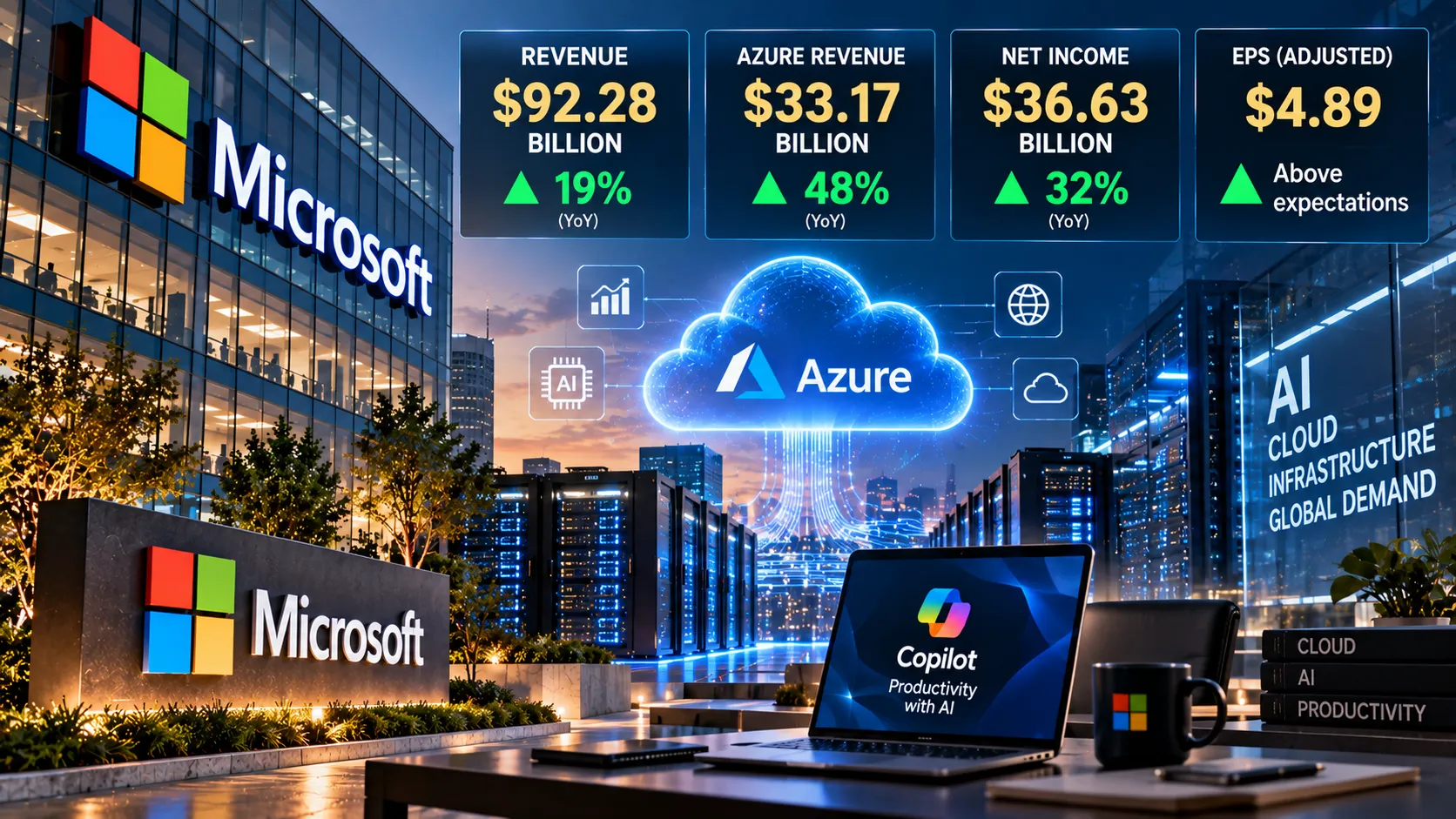
The Redmond, Washington-based company reported revenue of $92.28 billion for its fiscal first quarter, ended September 30, up 19% from a year earlier and above the analyst target of $90.69 billion, according to SiliconANGLE. Adjusted earnings per share were $4.89, ahead of the $4.73 forecast. Net income rose to $36.63 billion from $27.75 billion.
Microsoft shares rose about 4% in after-hours trading on Wednesday, October 28.
Azure in dollars for the first time
For the first time, Microsoft disclosed Azure revenue in dollar terms: $33.17 billion, up more than 48% and above analysts' expectations of $32.32 billion. Azure, Microsoft's cloud computing platform, is the main channel through which the company sells AI computing capacity, including access to models from OpenAI and others.
"We still have demand that exceeds supply," chief financial officer Amy Hood said, according to SiliconANGLE, indicating that Microsoft could grow Azure even faster if it had more data centre capacity.
A new reporting structure
Microsoft now reports two business segments instead of three. Its Agents and Infra segment, which includes cloud and AI services, generated revenue of $76.8 billion, up 25%, above the $75.63 billion target. The Devices and Consumer segment posted revenue of $15.48 billion, down 3%, though above expectations of $15.05 billion.
Sales of devices and Windows licences fell 22%, which chief executive Satya Nadella attributed to higher memory and storage costs, a consequence of the surge in prices for memory chips driven by AI demand.
Spending below expectations
Capital expenditure, including finance leases, was $45.2 billion, up about 30% but below some analyst projections of as much as $50.67 billion. Cash capital spending was $39.37 billion. About 75% of spending was tied to short-lived assets, such as servers and chips, up from 66%.
Free cash flow fell 27% to $18.63 billion, reflecting the heavy investment in AI infrastructure.
Hood noted that Microsoft has not yet borrowed to fund its build-out. "We're fortunate to have access in the debt markets, given where our rates ratings are, and we haven't yet tapped that," she said.
Faster growth ahead
Microsoft's guidance for the December quarter was strong. It expects revenue of $96 billion to $97.1 billion, about 18.8% growth at the midpoint, above expectations of $95.6 billion. Azure growth is expected at 49% to 50% in constant currency, well ahead of the 45.1% analysts had forecast.
Accelerating growth at Azure's scale is unusual and suggests that demand for AI computing continues to outpace supply.
Copilot momentum
Daily users of Copilot, Microsoft's AI assistant, rose 50% from the previous quarter, though Nadella did not disclose the number of paid seats. Hood said the new Microsoft 365 E7 bundle has grown to millions of seats.
Monetising AI through software subscriptions, not just cloud infrastructure, is a key part of Microsoft's strategy. Investors have been watching for evidence that businesses are willing to pay for AI features in Office and other applications.
Easing AI doubts
The results come amid debate about whether massive AI spending will pay off. Apollo's chief economist recently argued that AI has delivered little financial payoff for companies outside technology, and Elon Musk warned that financing for smaller AI cloud companies is tightening.
Microsoft's numbers suggest that, at least for the largest cloud providers, AI is generating substantial and accelerating revenue. The company's ability to grow Azure revenue at nearly 50% while keeping capital spending below expectations was particularly well received by investors.
The contrast with Alphabet
Alphabet, which reported on the same evening, posted stronger cloud growth of 103% but saw its shares fall after its profit missed expectations and free cash flow turned negative. Investors appeared to reward Microsoft for combining strong growth with disciplined spending.
What it means for India
Microsoft is one of the largest technology investors in India, with major data centre investments and a large workforce in Hyderabad and Bengaluru. Strong Azure growth supports continued investment in Indian cloud infrastructure.
For Indian IT services companies, Microsoft's results are a signal of enterprise demand for cloud and AI. Many Indian firms are major Microsoft partners, helping clients migrate to Azure and deploy Copilot. However, the shift of budgets towards AI infrastructure and productivity tools has also contributed to pressure on traditional IT services spending, as Infosys's recent guidance cut illustrated.
The scale of AI investment
Microsoft's capital expenditure of $45.2 billion in a single quarter illustrates the extraordinary scale of investment by technology companies in AI infrastructure. The money is spent on data centres, servers, AI chips, networking equipment and power, and much of it is committed years in advance through long-term leases and supply agreements. Microsoft has said that a large share of its spending goes on long-lived assets such as buildings and land, which will support revenue for many years.
Investors have debated whether such spending will generate adequate returns. Microsoft's strong Azure growth and its guidance for faster growth in the coming quarter provide evidence that demand for AI computing remains robust, and that customers are willing to pay for it.
The OpenAI relationship
Microsoft's partnership with OpenAI remains central to its AI strategy. Microsoft has invested heavily in OpenAI and provides cloud computing capacity for its models, while integrating OpenAI's technology into products such as Copilot and Azure AI services. The relationship has evolved over time, with OpenAI also working with other cloud providers, but Microsoft remains one of its most important partners and benefits from the demand OpenAI's products generate for Azure.
What comes next
Investors will watch whether Microsoft can deliver on its ambitious Azure guidance and how quickly it adds data centre capacity to meet demand. Amazon reports its results on Thursday, offering a further read on cloud demand. For Microsoft, the challenge is to sustain growth while managing the enormous costs of the AI build-out, a balance it appears, for now, to be managing well. Investors will also study Microsoft's commentary on capacity constraints, since the company has said demand for AI computing has at times exceeded the infrastructure it can bring online. Any easing of those constraints would allow Azure growth to accelerate further, as management has guided.