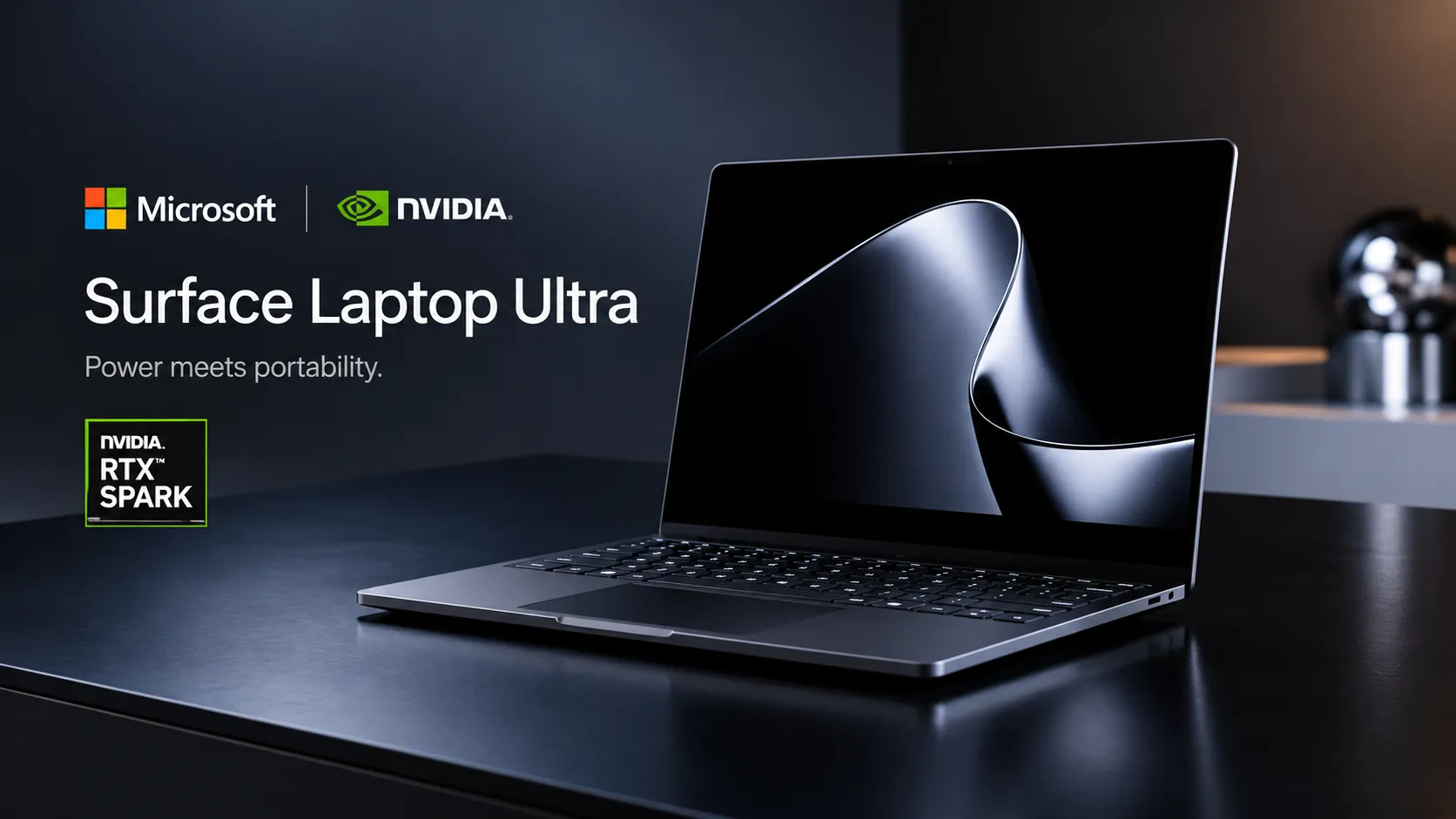
Microsoft has started selling its first Surface computers built on Nvidia silicon, putting a starting price of $2,600 on the Surface Laptop Ultra and $6,000 on a compact developer workstation, as it tries to convince programmers and AI enthusiasts that a Windows machine can handle work many of them now do on Apple's MacBook Pro.
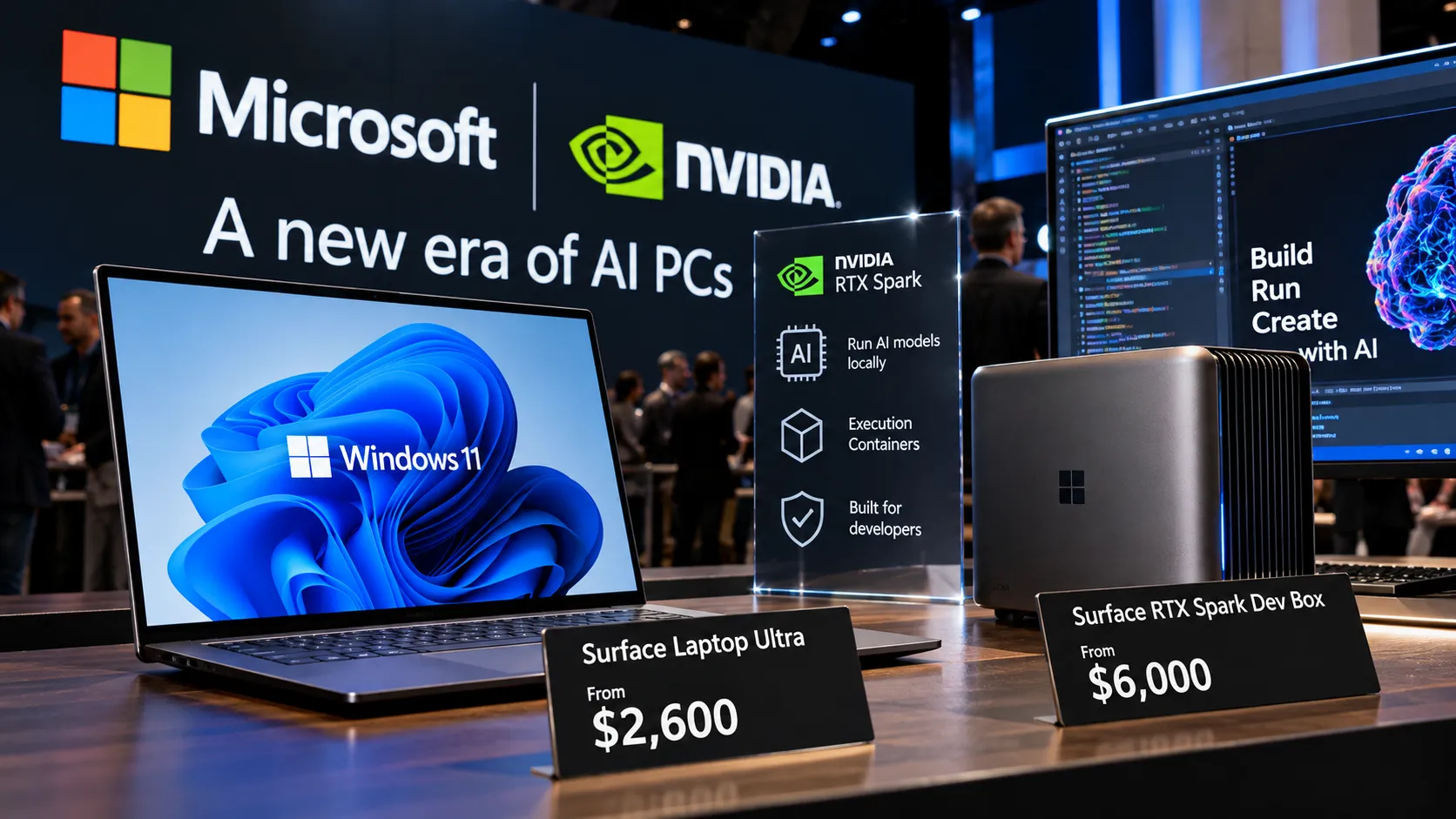
The devices were announced on Wednesday, 7 October, at an event in San Francisco held during the city's Tech Week, TechCrunch reported. Both run on Nvidia's RTX Spark chip and ship with a revamped version of Windows 11 that includes a feature Microsoft calls Execution Containers, intended to make it easier to sandbox AI agents running on a PC.
The launch puts numbers on a partnership that has been building since the summer. In June, Nvidia announced agreements with Microsoft and other PC makers to build Windows machines for AI and agent workloads around RTX Spark, but details at the time were thin. Wednesday's event supplied prices, configurations and, in Microsoft's case, a claim that its most expensive laptop had already sold out.
Two laptops, one workstation and a trade-in offer
The Surface Laptop Ultra comes in two base models. One starts at $2,600; a second, fitted with a more powerful chip, starts at $3,700. Adding memory and storage pushes the price as high as $5,900, and Microsoft said the highest-end configuration is already out of stock.
When Microsoft first detailed the laptop on its Windows blog on 31 May, it called it the most powerful Surface Laptop it had built. The machine has a 15-inch mini-LED PixelSense Ultra touchscreen rated at up to 2,000 nits of peak HDR brightness and 262 pixels per inch, up to 128GB of unified memory shared between processor and graphics, and full support for CUDA, Nvidia's programming platform.
Microsoft and Nvidia rate its AI compute at one petaflop, a theoretical FP4 figure that relies on sparsity, and say it can run models of up to 120 billion parameters locally. Unlike many thin laptops, it keeps a broad set of ports, including HDMI, USB-C, USB-A, an SD card slot and a headphone jack. Let's Data Science, summarising the specifications, put the chip at up to 20 Arm CPU cores and up to 6,144 Blackwell RTX GPU cores.
The second device, the Surface RTX Spark Dev Box, is a desktop workstation starting at $6,000. It comes loaded with Microsoft's developer tooling: Visual Studio Code, the GitHub Copilot command-line interface, Windows Subsystem for Linux and PowerShell 7. When the box was previewed in June, SiliconANGLE reported that it offered up to one petaflop of AI compute and 128GB of unified memory, enough to run models of up to 120 billion parameters when compressed to 4-bit precision.
Microsoft is selling both machines on the idea that AI models can run on the device itself rather than being rented from the cloud, with the processor, graphics, unified memory and upgraded cooling working together. The company describes that local inference as free, although the hardware needed to perform it is anything but cheap.
It is also explicit about whom it wants to win over. Macs are popular with developers and AI-agent enthusiasts, particularly in Silicon Valley, and Microsoft is offering up to $1,000 off to customers who trade in a MacBook Pro. For reference, Notebookcheck noted in September that Apple's 16-inch MacBook Pro starts at $2,999 with an M5 Pro chip, 24GB of memory and 1TB of storage. Microsoft is also marketing the new PCs for content creation, video processing and gaming.
Windows rebuilt around agents
The software announcement may matter more over time than the hardware. Execution Containers, which Microsoft put into preview at its Build developer conference in June, create sandboxed environments in which AI agents run. According to SC Media, developers declare the permissions an agent needs, such as access to particular files or network resources, and the Windows kernel enforces those limits at runtime using lightweight, hypervisor-backed isolation. The system plugs into Microsoft's Defender, Entra, Intune and Purview security and management tools.
Satya Nadella, Microsoft's chief executive, said the feature will be available to all Windows 11 users, and framed it as part of a broader change in how the company thinks about AI software. "One of the things we realized in the last 3-4 years is that just having a model doesn't do much for anything," he said, according to TechCrunch. "You really do need to orchestrate, and you need to have memory outside of the model."
Nadella described a "harnessed layer" able to combine several models with context, memory and the ability to take actions, and said Microsoft is enabling it "not just for our apps but apps for anyone's agent." That, he added, is "what the Windows platform is all about going forward."
Nvidia is building on the same foundation. In a June round-up of Computex announcements, Microsoft said Nvidia's OpenShell runtime for deploying autonomous agents was coming to Windows and was built on Execution Containers. SC Media listed Nvidia, OpenAI, Manus and Hermes among the early ecosystem partners.
For employers, sandboxing speaks to the obvious worry about letting software agents loose on a work laptop. An agent that can open files, browse the web and run code can also do damage if it is misdirected or compromised. Hard, kernel-enforced boundaries around what each agent may touch are Microsoft's answer, and building them into Windows itself, rather than selling them as a separate product, gives the approach reach across a very large installed base.
A crowded field of RTX Spark machines
Microsoft is not the only PC maker shipping RTX Spark hardware. Dell detailed its XPS 16 Creator Edition, which uses the chip and is available for pre-order at Best Buy for $3,800, with delivery later in October. In June, Microsoft said RTX Spark machines would arrive this autumn from Surface, Asus, Dell, HP, Lenovo and MSI, and described the Arm-based chip as developed by Nvidia with MediaTek and Microsoft.
That leaves Microsoft competing with its own hardware partners while relying on them to make the platform succeed. Surface has long served as a showcase for what Windows can do, and the RTX Spark launch follows the familiar pattern: Microsoft sets a high-end reference design and the wider ecosystem fills in other price points.
The pricing makes clear that, for now, these are niche machines for developers, creators and enthusiasts rather than mainstream buyers. Notebookcheck noted that the existing Surface Laptop 8 was listed at $1,585 on Amazon, well below the Ultra's entry price. Microsoft did not say whether the sell-out of the top configuration reflects strong demand or limited supply.
Neither Microsoft's announcement nor the coverage reviewed by TIGI gave pricing or a launch date for India, and Microsoft's May blog post said availability may vary by country and region. For India's large developer community, the more immediate change may be the software: if Execution Containers reach all Windows 11 users, as Nadella said, agent sandboxing will arrive on machines they already own.
The company's next stop is its Ignite conference in San Francisco from 17 to 20 November, according to Thurrott, where enterprise customers will be looking for more detail on how Microsoft intends to manage AI agents across corporate fleets of Windows PCs.