
FundingMarket Data Women5 MIN READ

Midcaps and Smallcaps Suffer Their Worst Week in 20 Months as Brent Nears $115 and ₹20.6 Trillion Is Wiped Off Indian Stocks

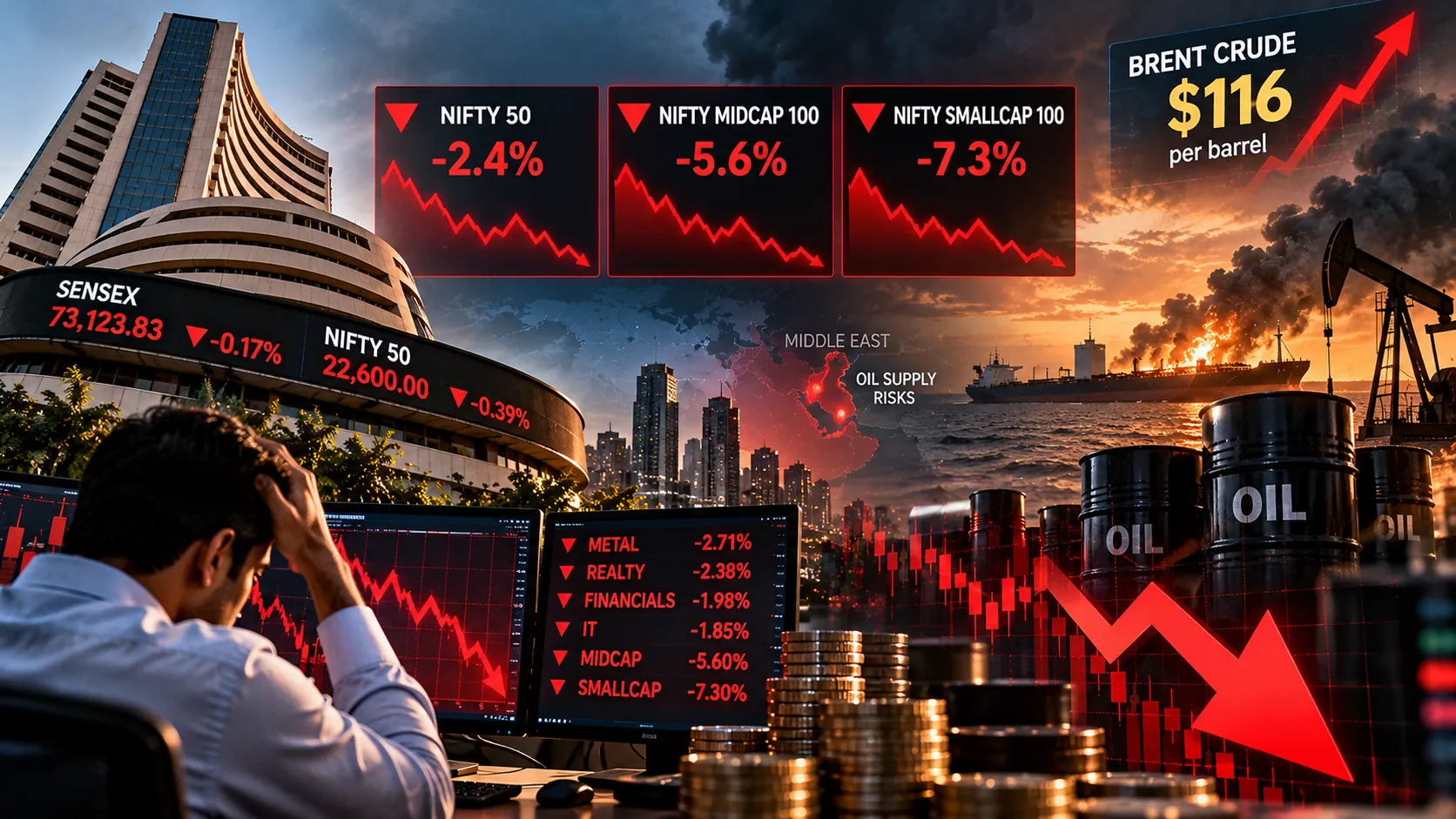
Indian equities ended a holiday-shortened week sharply lower on October 23, with the Nifty Midcap 100 down 5.6% and the Nifty Smallcap 100 down 7.3%, their steepest weekly falls since February 2025. The Sensex closed at 73,123.83 and the Nifty 50 at 22,600 as Brent crude climbed towards $115 a barrel and listed companies lost about ₹20.6 trillion in market value.

By Shaym Kumar · Author26 October 2026New
Midcaps and Smallcaps Suffer Their Worst Week in 20 Months as Brent Nears $115 and ₹20.6 Trillion Is Wiped Off Indian Stocks

Indian stock markets ended one of their most punishing weeks in nearly two years on Friday, October 23, as a relentless rise in oil prices and escalating tensions in West Asia drove investors out of the riskiest corners of the market.

The Nifty Midcap 100 index fell 5.6% and the Nifty Smallcap 100 dropped 7.3% over the holiday-shortened week, their steepest weekly declines since February 2025, Business Standard reported. The benchmark indices held up better but still lost ground: the Nifty 50 fell 2.4% for the week and the Sensex 2%.

On Friday alone, the Sensex slipped 125.56 points, or 0.17%, to close at 73,123.83, while the Nifty 50 fell 87.65 points, or 0.39%, to 22,600. The broader market was hit far harder, with the Nifty Midcap 100 down 2.2% and the Nifty Smallcap 100 down 2.9% on the day. The Nifty Metal index fell 2.71% and the Nifty Realty index 2.38%, according to Kotak Neo.

A brutal breadth

The scale of the selling was visible in market breadth. On the National Stock Exchange, only 317 stocks rose on Friday while 2,368 fell, and half of all listed stocks lost more than 2.6%.

The total market value of listed companies fell by about ₹7 trillion on Friday and by ₹20.6 trillion over the week. Companies ranked 101 to 500 by market value, the midcap and smallcap segment, accounted for ₹8.9 trillion of the weekly loss.

Among Nifty 50 stocks, Eternal, Apollo Hospitals, ONGC, Asian Paints and TCS were the top gainers on Friday, while Shriram Finance, Adani Enterprises, JSW Steel, Jio Financial Services and Adani Ports were among the biggest losers.

Oil is the main culprit

The central driver of the sell-off was crude oil. Brent December futures traded at about $114.29 a barrel in the Indian afternoon and reached $115 by Friday evening, up from $109.9 a week earlier. By later in the evening, Brent was trading around $116, a more than five-month high, according to Business Standard.

Prices have been pushed higher by attacks on Saudi Arabia by Yemen's Houthi movement, Iranian claims of strikes on tankers in the Gulf and fears of wider disruption to supply through the Strait of Hormuz. Somil Mehta of Mirae Asset Sharekhan said Brent could reach $118 in the coming days.

"The primary pressure on domestic markets is stemming from rising crude oil prices and global macroeconomic factors," Mehta said, emphasising that the weakness reflected external forces rather than a deterioration in domestic fundamentals.

India imports nearly 90% of its crude oil needs, making it one of the most exposed major economies to oil price shocks. Higher crude raises inflation, widens the trade deficit, pressures the rupee and squeezes the profits of fuel retailers and other energy-intensive businesses.
c8c83416-5154-4f5f-80fb-1904c50c3b65.png

Why smaller stocks fell hardest

Valuations explain much of the divergence between large and small companies. The Nifty Midcap 150 trades at about 27 times earnings and the Nifty Smallcap 250 at 34 times, compared with 19.4 times for the Nifty 50, according to Business Standard. When risk appetite fades, stocks with the richest valuations tend to fall furthest.

Smaller companies are also more vulnerable to higher input costs and tighter financial conditions, and their shares are less liquid, which can amplify price moves when investors rush to sell.


“The primary pressure on domestic markets is stemming from rising crude oil prices and global macroeconomic factors.”
— Somil Mehta, Mirae Asset Sharekhan

Brokers and wealth managers, whose earnings depend heavily on retail trading activity, were among the worst hit. Motilal Oswal Financial Services and KFin Technologies fell 5.2% each on Friday, 360 ONE WAM dropped 4.8% and Angel One fell 4.2%.

Volatility rises

Market volatility has climbed. The India VIX, a gauge of expected near-term volatility, rose 6.32% on Friday to 16.76 and is up nearly 14% over five sessions.

Dharmesh Shah of ICICI Securities placed support for the Nifty at 22,100 to 21,700 and resistance at 23,000 to 23,100, adding that a close above 23,500 would be needed to signal a trend reversal. Mehta said midcap and smallcap indices had breached key support levels, pointing to a bearish near-term outlook.

Other headwinds

Beyond oil, several factors are weighing on sentiment. Indian government bond yields have risen for ten straight weeks, their longest losing streak in about three decades, with the benchmark 10-year yield settling at 7.47%. India's foreign exchange reserves have fallen by $65 billion in six weeks from their September peak as the central bank has defended the rupee, which closed at 94.94 per dollar on Friday.

The second-quarter earnings season has produced mixed results. Infosys cut its full-year revenue growth forecast, while several commodity and financial companies reported weaker numbers. The Financial Stability and Development Council, chaired by Finance Minister Nirmala Sitharaman, warned on Friday about risks from the AI boom and rising global bond yields.

The bright spot: primary markets

The primary market offered a contrast. Jio Platforms' record ₹30,213 crore IPO closed on Friday with subscriptions of 22.19 times, led by overwhelming institutional demand. Zetwerk and Tonbo Imaging also made their stock market debuts during the week, with Tonbo listing at a 66% premium. Strong demand for quality IPOs suggests institutional investors still have appetite for Indian equities at the right price.

What it means for investors

For retail investors who have poured money into midcap and smallcap funds in recent years, the week is a sharp reminder of the risks of high valuations. Financial advisers typically recommend that investors maintain diversified portfolios, avoid concentrating in high-risk segments and continue systematic investments rather than reacting to short-term volatility.

For long-term investors, corrections can create opportunities to buy quality companies at more reasonable valuations, but timing the bottom is notoriously difficult while geopolitical risks remain unresolved.

What comes next

The direction of oil prices will remain the dominant factor for Indian markets. Any escalation in the Gulf could push crude higher and extend the sell-off, while a diplomatic breakthrough could trigger a sharp rebound. Investors will also watch the US Federal Reserve's policy meeting next week, Jio Platforms' listing on October 28 and further second-quarter results.

Until there is greater clarity, analysts expect volatility to stay elevated, with smaller stocks likely to remain the most vulnerable. Market strategists also noted that retail participation, which has supported Indian equities through earlier bouts of foreign selling, could weaken if losses in smaller stocks persist.

TagsSensexNifty 50Nifty Midcap 100Nifty Smallcap 100Indian stock marketBrent crudeoil pricesIndia VIXmarket capitalisationDalal Streetbroking stocksAngel OneMotilal OswalvaluationsWest Asia conflictrupeeMirae Asset SharekhanICICI Securitiesmarket crashinvestors

Reader reviews

Sign in to rate and review this article.
Loading reviews…
