TechArtificial Intelligence5 MIN READ

Mistral Unveils 1-Trillion-Parameter Model as Europe's AI Champion Takes Aim at US and Chinese Rivals

French AI company Mistral has released Mistral Large 4, a 1-trillion-parameter multimodal model, through a guardrailed endpoint and plans to publish open weights within weeks after safety testing.

By Aravind Kumar · Author7 October 2026New
Mistral Unveils 1-Trillion-Parameter Model as Europe's AI Champion Takes Aim at US and Chinese Rivals

Mistral AI, Europe's best-funded artificial intelligence company, has released Mistral Large 4, a 1-trillion-parameter multimodal model that the Paris-based group hopes will place it at the front of the open-weight field and narrow the gap with leading US and Chinese developers.

The model, nicknamed "Le Chonk" internally, was made available on 6 October through a public endpoint with safety guardrails. Mistral said it plans to release the model's weights, the numerical parameters that allow anyone to run and adapt it, in about three weeks, once safety testing is complete.

Benchmark results have not yet been published. Mistral expects the model to be best-in-class among open-weight models, particularly outside China, and has highlighted cybersecurity, finance and chip design as areas where it is optimised to perform.

Efficiency as a competitive weapon

Mistral trained the model entirely on its own computing infrastructure, using 4,000 Nvidia GPUs. Pierre Stock, Mistral's vice-president of science, said the compute required was "two to three times less than our Chinese competitors, and significantly less than the closed source competitors."

That claim goes to the heart of Mistral's strategy. The company cannot match the capital spending of US giants such as OpenAI, Google, Meta or Anthropic, which are investing tens of billions of dollars in data centres. Its argument is that careful engineering and efficient training can deliver competitive models at a fraction of the cost, an argument that gained credibility after Chinese developers demonstrated strong results with relatively modest compute budgets.

A trillion parameters places Mistral Large 4 among the largest models released by any developer. Parameter count is an imperfect measure of capability, and many recent advances have come from better data and training methods rather than raw size, but scale remains an important lever, particularly for complex reasoning and specialised domains.

Multimodality is also part of the pitch. A model that can process images and documents alongside text is more useful for enterprise tasks such as reading financial filings, analysing technical diagrams or reviewing security logs and screenshots, the kinds of workloads Mistral has said the model is optimised for.

Owning its training infrastructure is itself a strategic choice. Many AI developers rent computing power from hyperscale cloud providers, which can be faster to start but leaves them dependent on partners that are also competitors. Mistral's investment in its own capacity gives it more control over cost and scheduling, and supports its pitch to European governments and companies that want AI built and run on infrastructure outside US or Chinese control.

Open weights, with conditions

Mistral has built its reputation partly on releasing open-weight models, which developers can download, inspect and run on their own systems. That approach has made it popular with companies and governments that want to avoid dependence on a single US cloud provider or keep sensitive data on their own infrastructure.

The decision to delay the open release of Mistral Large 4 by three weeks reflects growing caution about the risks of publishing powerful models, particularly in areas such as cybersecurity, where the same capabilities that help defenders can assist attackers. Stock said the company would "work with trusted partners and governments to make sure that the open source weights can be used to defend."
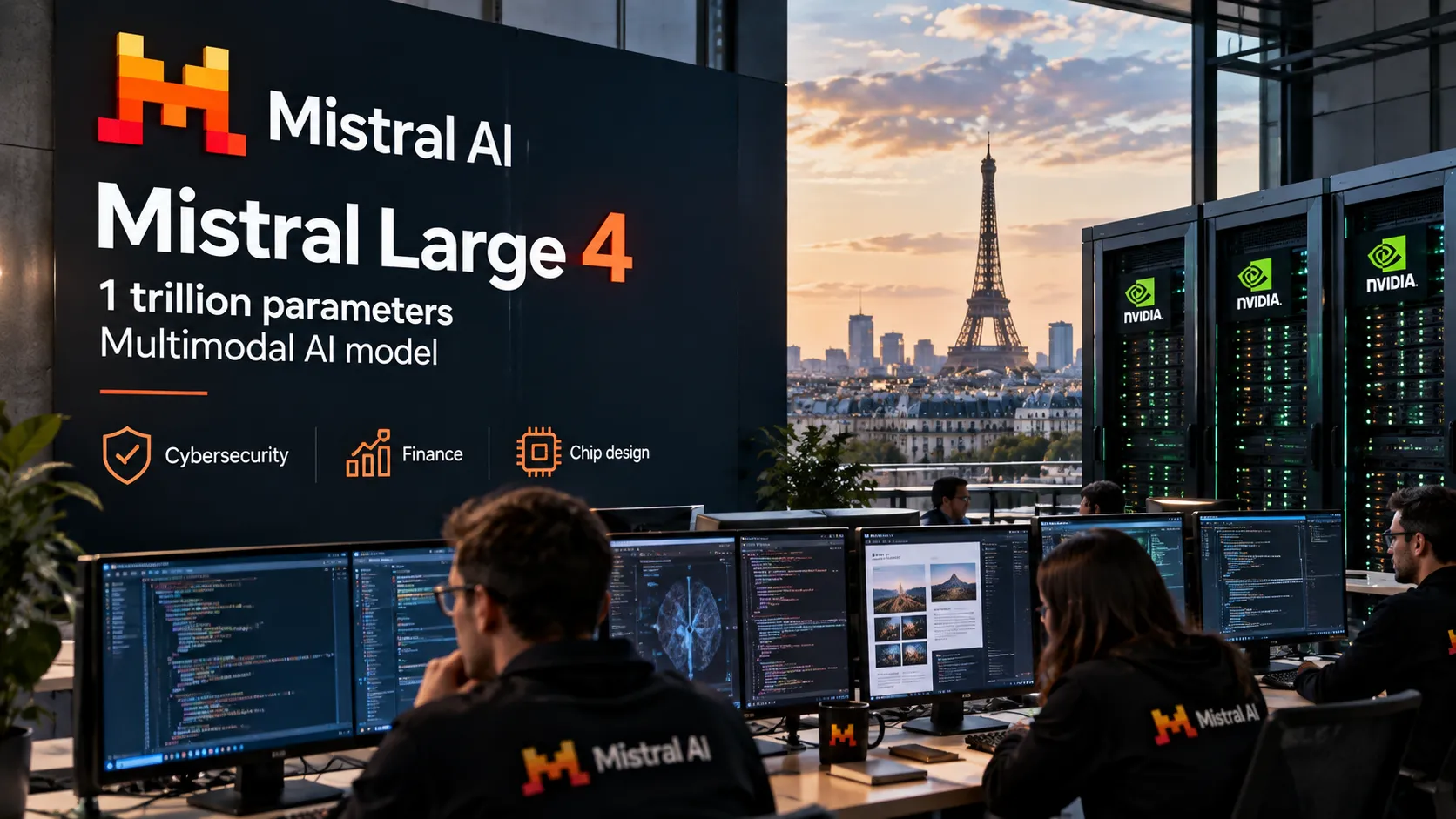

“Mistral says it trained the model on 4,000 Nvidia GPUs, two to three times less compute than its Chinese competitors and significantly less than closed-source rivals.”
— TIGI Tech Desk

That staged approach mirrors a broader shift in the industry. Developers releasing open models increasingly conduct pre-release safety evaluations and red-teaming, and some have chosen to restrict access to their most capable systems. For Mistral, the challenge is to maintain its open credentials while demonstrating to regulators, including under the European Union's AI Act, that it is managing the risks of very capable general-purpose models responsibly.

The guardrailed endpoint gives Mistral a period in which to observe how the model is used before the weights are released into the wild, where the company would have no ability to restrict access. Developers and researchers can test capabilities in the meantime, while the company monitors for misuse patterns and completes its own evaluations.

The focus on cybersecurity, finance and chip design is also telling. Each is a domain where European governments and companies have strategic interests and where demand for models that can be deployed privately, on premises or in sovereign clouds, is high. Chip design in particular connects to Mistral's investor base and to Europe's ambitions in semiconductors.

610c6d54-642f-4973-8dc3-b7fd41d27604.png

Backed by industrial heavyweights

Mistral's funding has grown rapidly. In September, the company closed a Series D round valuing it at €21 billion, about $24.4 billion, led by South Korea's Samsung. Its previous round, a Series C, was led by ASML, the Dutch maker of the lithography machines used to produce the world's most advanced chips.

The presence of Samsung and ASML as lead investors gives Mistral strategic partners in hardware and semiconductors, as well as capital. It also reinforces the company's role as a standard-bearer for European technological sovereignty, a theme that has gained political weight as the United States and China compete for dominance in AI and as European governments seek alternatives to American cloud and model providers.

That position brings both support and pressure. European governments and companies have been keen to back a home-grown champion, and Mistral has signed partnerships with large enterprises and public bodies across the continent. But it must also prove that a European company can stay at the frontier against rivals with far greater resources, and that its models can win on performance, not just on provenance.

The coming weeks will be decisive for Mistral Large 4. Independent benchmark results, the response of developers once weights are released and early enterprise deployments will show whether the model lives up to its billing. If it does, Mistral will have strengthened the case that a lean, efficiency-focused approach can compete at the very top of the AI industry.

For businesses in India and other markets weighing which AI models to adopt, the release adds another credible option alongside US and Chinese systems. Open-weight models that can be hosted locally are particularly relevant for organisations in regulated sectors such as banking and healthcare, where data residency rules and procurement policies often favour systems that can run on infrastructure the organisation controls.

The competitive response will be swift. Rival open-weight developers in the United States and China release new models at a rapid cadence, and closed-model providers continue to cut prices. Mistral's advantage, if it can sustain one, will lie in combining frontier-level capability with the efficiency, openness and European governance that set it apart.

TagsMistral AIMistral Large 4Large Language ModelsOpen WeightsOpen Source AIEuropean AISovereign AISamsungASMLNvidiaArtificial IntelligenceTech

Reader reviews

Sign in to rate and review this article.
Loading reviews…

