TechFintech5 MIN READ

MobiKwik Posts Its Highest-Ever Profit of ₹11.8 Crore as Payments Volumes Hit a Record and Lending Rebounds

MobiKwik reported a record net profit of ₹11.8 crore for the September quarter, its fourth consecutive profitable quarter, compared with a ₹28.6 crore loss a year earlier. Platform GMV rose 35% to a record ₹59,677 crore and loan disbursals jumped 34%, and shares rose nearly 10% on November 2 as the fintech co-founded by Upasana Taku and Bipin Preet Singh extended its turnaround.

By Aravind Kumar · Author3 November 2026New
MobiKwik Posts Its Highest-Ever Profit of ₹11.8 Crore as Payments Volumes Hit a Record and Lending Rebounds

MobiKwik, the Indian digital payments and lending company co-founded by Upasana Taku and Bipin Preet Singh, reported its highest-ever quarterly profit, extending a turnaround that has seen the fintech swing from heavy losses to consistent profitability in the space of a year.

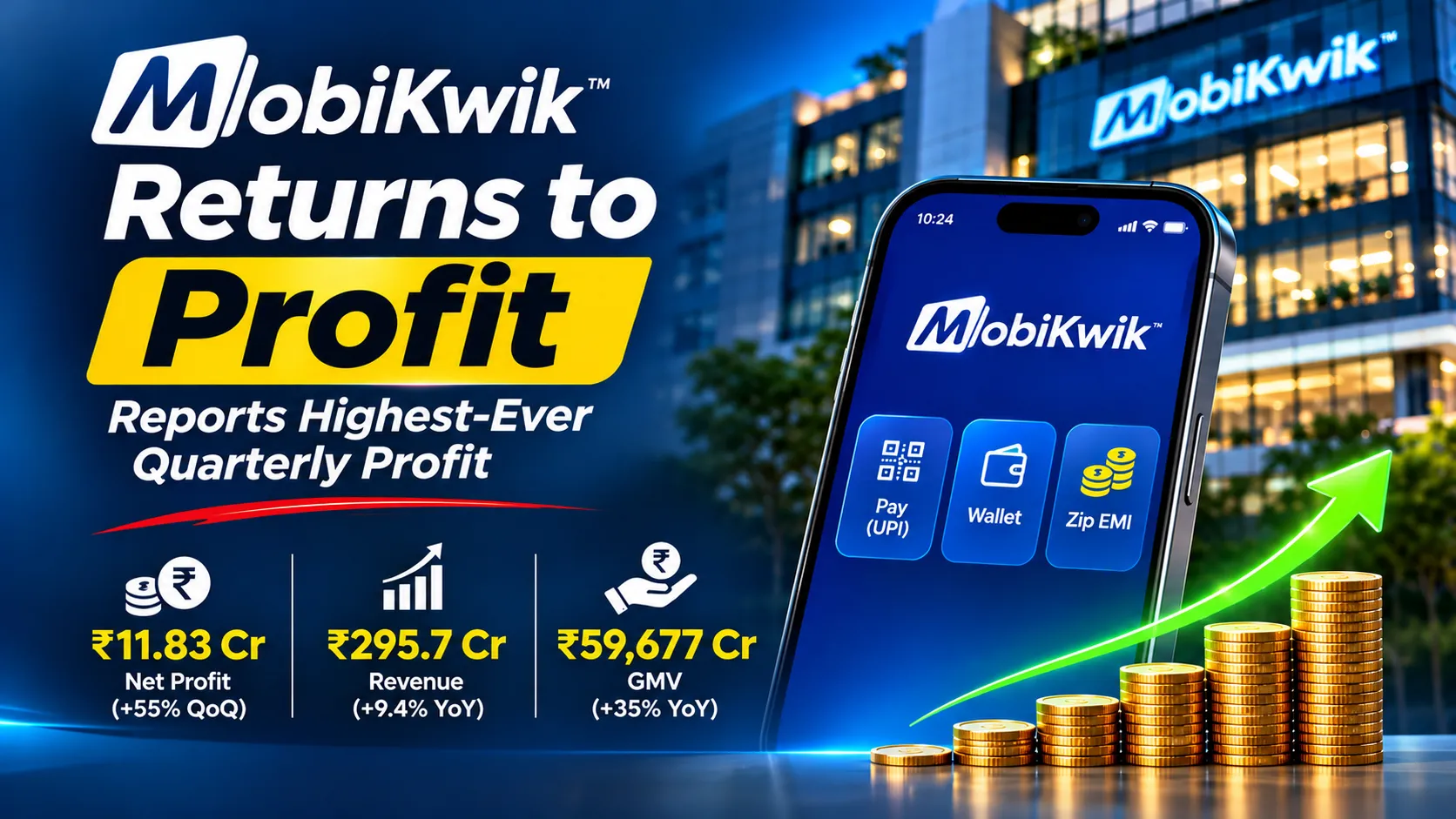
The Gurugram-based company posted a net profit of ₹11.83 crore for the July-September quarter, the second quarter of the 2026-27 financial year, compared with a net loss of ₹28.62 crore a year earlier, according to company disclosures reported by Lapaas Voice and StartupTalky. It was MobiKwik's fourth consecutive profitable quarter, and its profit rose 55% from ₹7.62 crore in the previous quarter.

Revenue from operations rose 9.4% to ₹295.7 crore from ₹270.2 crore a year earlier, and 5.1% from the previous quarter. MobiKwik's shares rose nearly 10% on Monday, November 2, after the results.

A swing in operating profit

The improvement was driven by a sharp turnaround in operating performance. EBITDA before other income was ₹15.62 crore, compared with a loss of ₹15.49 crore a year earlier, giving an EBITDA margin of 5.3%, compared with negative 5.7%, according to the figures reported by Lapaas Voice. Including other income, EBITDA was ₹22.68 crore.

A key factor was a reduction in payment processing charges, the fees MobiKwik pays to banks and networks to process transactions. These fell to ₹119.5 crore, or 40.4% of revenue, from ₹134 crore, or 49.6% of revenue, a year earlier.

For the first half of the financial year, MobiKwik posted a net profit of ₹19.45 crore, compared with a loss of ₹70.54 crore in the first half of the previous year.

Payments at a record

MobiKwik's platform gross merchandise value (GMV), the total value of transactions processed, rose 35% to a record ₹59,677 crore. Consumer payments GMV rose 27% to ₹46,375 crore, and merchant payments revenue rose 150% from a year earlier.

The company has 196.3 million registered users. Payments are a highly competitive business in India, dominated by UPI apps such as PhonePe, Google Pay and Paytm, and margins on UPI transactions are thin because the government has mandated zero merchant discount rates on most UPI payments. MobiKwik has sought to build profitable payment businesses around its wallet, payment gateway and merchant services.

The results came as UPI recorded a new high of 25.47 billion transactions in October, according to National Payments Corporation of India data.

Lending rebounds

MobiKwik's lending business, which offers consumer credit under its Zip EMI brand in partnership with banks and non-bank lenders, also showed a strong recovery. Loan disbursals rose 34% from a year earlier to ₹1,082.6 crore, and 47% from ₹736.7 crore in the previous quarter, according to Multibagg.

Financial services revenue rose to ₹86.9 crore from ₹61.3 crore a year earlier, and the gross margin on financial services rose to 65.7% from 41.8%. Lending-related expenses fell 16% to ₹29.83 crore, or 2.76% of digital credit GMV, compared with 4.42% a year earlier. The share of repeat borrowers rose to 59% from 40%, and the number of major lending partners rose to 11 from six.

MobiKwik had scaled back lending sharply after the Reserve Bank of India tightened rules on unsecured consumer credit and on partnerships between fintechs and lenders. Its rebound suggests that it has adapted its model to the new regulatory framework.

AI at the core

MobiKwik highlighted its use of artificial intelligence across its business. The company said 92% of its code is now AI-generated, 91% of customer queries are handled by a large language model-based help system, and 55% of early loan collections are facilitated through AI, according to Lapaas Voice. Its AI-powered collections platform improved collection rates by 33%, and AI has helped the company bring products to market 55% faster.

“The company recorded its fourth consecutive profitable quarter.”
— TIGI Fintech Desk

These claims, if sustained, illustrate how fintech companies are using AI to reduce costs and improve efficiency, which are crucial in a low-margin business.

A founder-led turnaround

MobiKwik was founded in 2009 by husband-and-wife team Bipin Preet Singh and Upasana Taku. Taku, the company's co-founder, is one of India's most prominent women fintech entrepreneurs and was recently named among the country's leading self-made women entrepreneurs in Hurun's rankings.

The company listed on Indian stock exchanges in December 2024 after a long and difficult journey to the public markets, including an earlier IPO attempt that was shelved in 2022. Its listing was strongly received, but the shares later fell as the company reported losses amid regulatory changes and a one-time fraud-related charge.

The return to consistent profitability is a significant milestone for a company that has had to reinvent its business several times as India's payments landscape has changed, from the dominance of wallets in the mid-2010s to the rise of UPI.

The fintech sector

MobiKwik's results come as India's listed fintech companies are increasingly focused on profitability. Paytm has also returned to profit after a period of heavy losses and regulatory setbacks, while PB Fintech, the parent of Policybazaar, has faced pressure from proposed changes to insurance commission rules.

The broader sector faces several challenges, including thin margins on UPI payments, tighter regulation of digital lending and intense competition. Companies are increasingly seeking to make money from financial services such as lending, insurance and wealth management, where margins are higher.

Women in fintech

Taku's role at MobiKwik is notable in an industry where women remain underrepresented among founders and senior leaders. Women-led and women-co-founded startups receive a small share of venture capital funding in India, according to industry data, and the success of companies such as MobiKwik and Nykaa, founded by Falguni Nayar, serves as an example for aspiring women entrepreneurs.

The road to scale

MobiKwik's scale gives it a foundation to build on. With 196.3 million registered users and 1.74 million activated credit users, the company has a large base to which it can cross-sell lending, payments and other financial products. Its engaged user base of about 96 million, of whom 33 million have shared PAN details, is an important pool for credit underwriting.

The company's growing network of lending partners, which rose to 11 from six a year earlier, also reduces its dependence on any single lender and gives it more capacity to scale disbursals while keeping loans on partners' balance sheets.

23b608ea-efe4-4870-8be5-4da138186d02.png

What comes next

MobiKwik's challenge will be to sustain profitability while growing in a competitive market. Investors will watch the growth of its lending business, the quality of its loan portfolio, and its ability to expand merchant payments and other higher-margin services. Regulatory developments, including any changes to UPI pricing or digital lending rules, will also have a significant impact on its prospects.

With four consecutive profitable quarters, MobiKwik has shown that its turnaround has momentum. The coming quarters will show whether it can translate that momentum into sustained, profitable growth.

TagsMobiKwikfintechdigital paymentsUPIUpasana TakuBipin Preet Singhwomen foundersZip EMIdigital lendingQ2 FY27 resultsIndian stocksprofitabilitypayment gatewaymerchant paymentsAI in fintechIndian fintechnew-age tech stocksconsumer creditwomen in fintechinvestors

Reader reviews

Sign in to rate and review this article.
Loading reviews…

