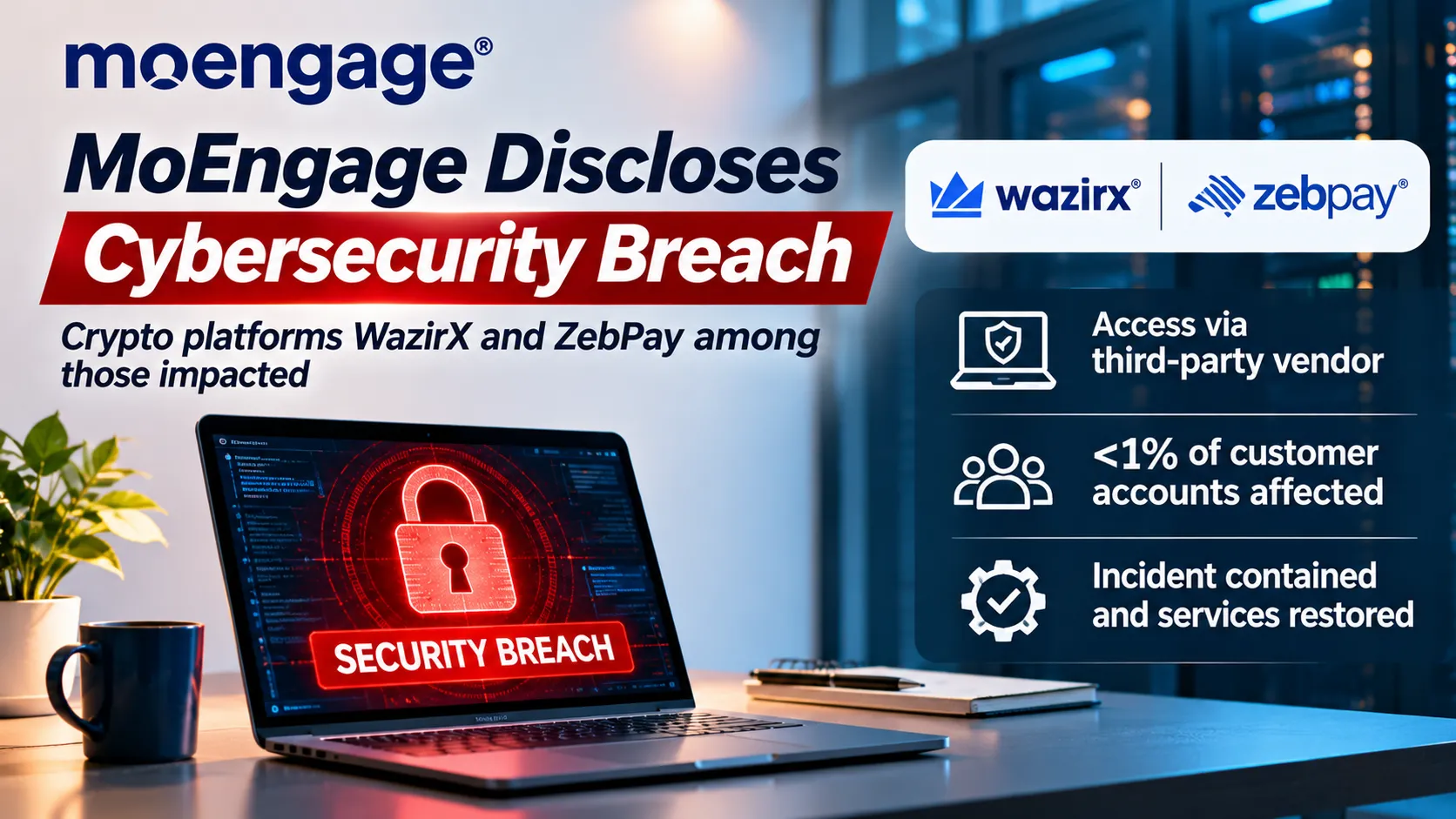
MoEngage, one of India's best-known software-as-a-service companies, has disclosed a cybersecurity breach in which an attacker gained access to part of its cloud infrastructure through a compromised third-party vendor account. Cryptocurrency exchanges WazirX and ZebPay were among the platforms impacted, according to reports updated on November 23.
The breach was first reported on November 21. MoEngage said it identified and contained the incident in late October, hired independent cybersecurity experts to verify its findings, remediated the breach and strengthened its security controls.
"Fewer than 1% of our customer accounts were affected, and we have notified each of them directly," the company said. It added: "There was no disruption to our services as a result of this incident."
The company has not publicly specified what data was accessed. Some customers reportedly had difficulty accessing the platform for nearly seven days, according to an Economic Times report, a claim MoEngage has denied.
Who is MoEngage
MoEngage was founded in 2014 by Raviteja Dodda and Yashwanth Kumar. The company provides customer engagement software that helps brands send personalised messages to their users through push notifications, emails, SMS, in-app messages and other channels. Its platform uses data about customer behaviour to decide what message to send, when and through which channel.
The company is headquartered in Bengaluru and San Francisco and claims to serve more than 1,350 enterprise customers across 75 countries. Its clients include consumer apps, banks, retailers, telecom companies and fintech platforms.
MoEngage is also preparing for a potential public listing in India. In January 2026, the National Company Law Tribunal approved a reverse merger of its US parent, MoEngage Inc, into its Indian arm, MoEngage India Private Limited. Such "reverse flipping" has become common among Indian startups preparing for domestic listings.
How the attack happened
The breach is an example of a third-party, or supply chain, attack. Rather than breaking directly into MoEngage's systems, the attacker reportedly compromised an account belonging to one of the company's vendors and used it to access a limited part of MoEngage's cloud environment.
Third-party attacks have become one of the most significant cybersecurity risks for technology companies. Modern software businesses rely on many vendors for cloud hosting, analytics, customer support, development tools and other services. Each vendor connection can become a potential entry point for attackers.
Because platforms like MoEngage sit at the centre of their customers' communication with end users, they handle sensitive information such as contact details and behavioural data. A breach at such a platform can therefore affect many downstream companies at once.
Crypto exchanges in the spotlight
The involvement of WazirX and ZebPay has drawn particular attention. Indian crypto exchanges have faced a difficult few years, marked by heavy taxation, regulatory uncertainty and security incidents. WazirX suffered a major hack in July 2024, in which attackers stole a large amount of crypto assets, leading to a prolonged restructuring process that significantly damaged user trust.
Any security incident linked to crypto platforms is therefore likely to be closely scrutinised by users. It is not yet clear what information belonging to WazirX or ZebPay users may have been exposed through the MoEngage breach. There has been no indication that customer funds on the exchanges were affected, since MoEngage provides marketing and engagement services rather than trading infrastructure.
Regulatory implications
The breach comes as India strengthens its data protection framework. The Digital Personal Data Protection Act requires organisations that handle personal data to implement reasonable security safeguards and to notify affected individuals and the Data Protection Board in the event of a breach. Companies that fail to comply can face significant penalties.
India's cybersecurity agency, CERT-In, also requires organisations to report certain cyber incidents within tight timelines. How MoEngage and its affected customers handle their notification obligations will be closely watched.
For companies like MoEngage, which process data on behalf of their clients, responsibilities may be shared between the platform and its customers. Clarifying those responsibilities is an important part of incident response.
Implications for the IPO
The timing is sensitive for MoEngage. Companies preparing for public listings face heightened scrutiny of their governance, risk management and security practices. Investors will want to understand how the breach occurred, how quickly it was detected and contained, and what has been done to prevent a repeat.
The company's statement that fewer than 1% of customer accounts were affected and that there was no service disruption is intended to reassure customers and investors. A well-handled incident response can sometimes strengthen confidence by demonstrating the maturity of a company's security processes.
However, the gap between the incident's containment in late October and its public disclosure in November, along with conflicting reports about service access, may raise questions. Clear communication will be important as the company prepares its listing documents.
A broader warning for SaaS companies
The MoEngage breach is part of a broader pattern of attacks targeting SaaS platforms and their vendors. Attackers increasingly see such platforms as valuable targets because a single breach can provide access to data from many organisations.
Security experts recommend that SaaS companies tightly control vendor access, use strong authentication, monitor unusual activity and limit the data that vendors can reach. Customers of SaaS platforms are also being urged to assess their vendors' security practices and to minimise the personal data they share with third parties.
Lessons for Indian startups
India's SaaS sector has grown into a global force, with companies such as Freshworks, Zoho, Chargebee and MoEngage serving customers around the world. As these companies grow, they become more attractive targets for cybercriminals.
For founders and technology leaders, the incident underlines the importance of investing in security from an early stage, particularly in third-party risk management. Building trust with enterprise customers increasingly depends on demonstrating robust security practices, certifications and incident response capabilities.
For The Impactful Global Indian's readers, including the many diaspora professionals working in cybersecurity and SaaS, the MoEngage breach is a timely reminder that even well-established technology companies can be exposed through their supply chains.
The coming weeks may bring more details about the scope of the breach and its impact on affected customers. For now, MoEngage maintains that the incident was contained, limited in scope and did not disrupt its services.