StartupsUnicorns Tech5 MIN READ

Moody's Raises Outlook on Oyo Parent Prism to Positive as Earnings More Than Double Ahead of Its ₹6,650 Crore IPO

Moody's Ratings has changed its outlook on Prism, the parent of hotel platform OYO, to positive from stable while keeping its B2 rating, citing FY26 EBITDA of ₹2,630 crore, more than double the previous year, and the company's first positive free cash flow. OYO plans a ₹6,650 crore IPO.

By Nisha Omkumar · Author19 October 2026New
Moody's Raises Outlook on Oyo Parent Prism to Positive as Earnings More Than Double Ahead of Its ₹6,650 Crore IPO

OYO's long journey from cash-burning hotel startup to profitable travel company has won a significant endorsement from one of the world's largest credit rating agencies. Moody's Ratings has revised its outlook on Prism, OYO's parent company, to positive from stable, while affirming its B2 corporate family rating, according to a report on October 18.

The upgrade in outlook reflects a sharp improvement in the company's earnings and cash flow, and comes as OYO prepares for an initial public offering of about ₹6,650 crore. A positive outlook signals that Moody's could raise the rating itself over the next 12 to 18 months if the company continues on its current path.

Moody's said it expects Prism to "sustain stronger earnings and free cash flow generation over the next 12-18 months," supporting further debt reduction while liquidity remains very good, according to Sweta Patodia, an assistant vice president at the agency.

Earnings more than double

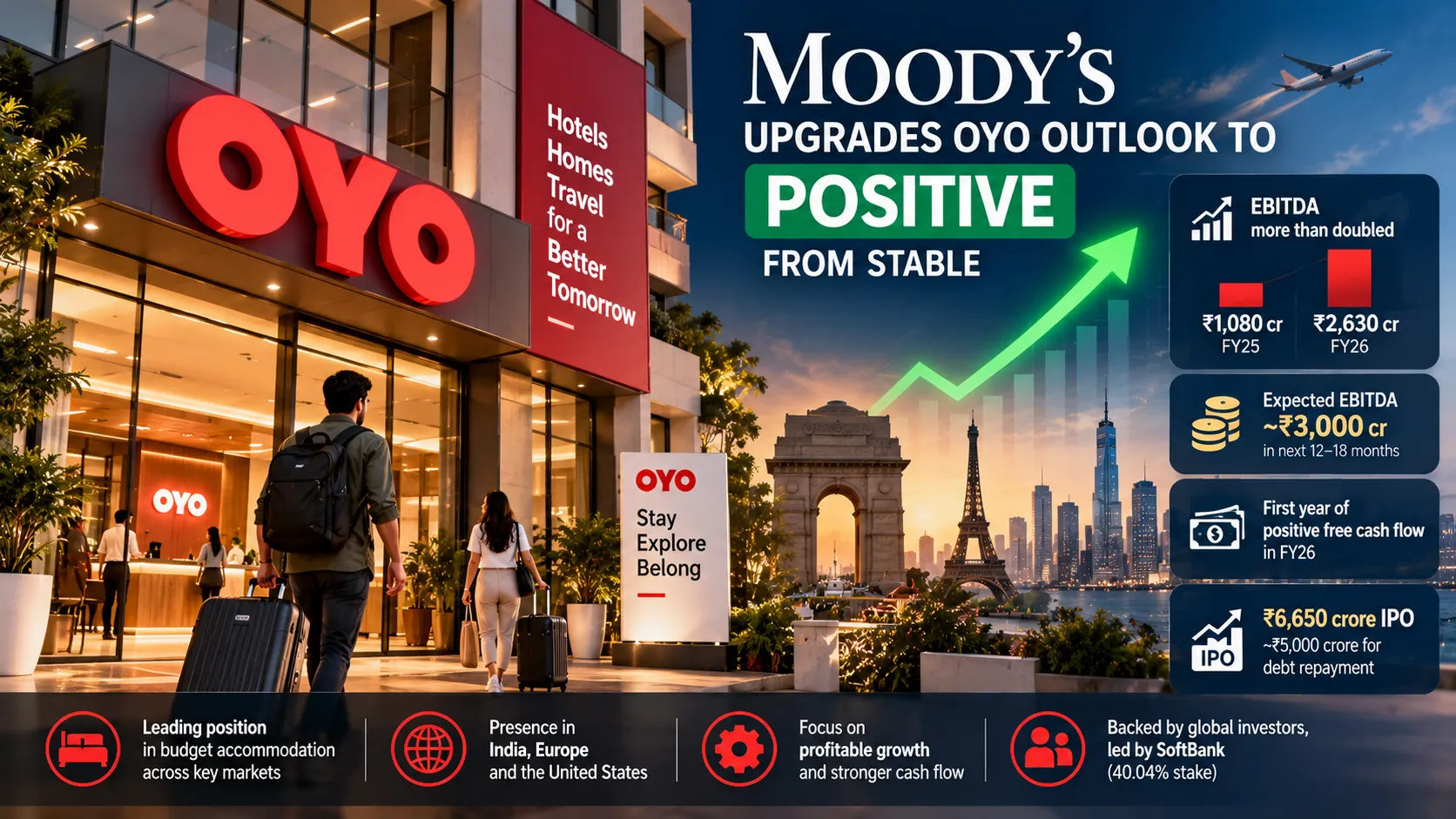
The rating action follows a strong financial year. Prism's EBITDA more than doubled to ₹2,630 crore in FY26 from ₹1,080 crore in FY25. Moody's expects EBITDA to rise further to about ₹3,000 crore, or roughly $315 million, over the next 12 to 18 months, driven largely by the addition of new storefronts, the hotels and homes operating under OYO's brands.

Perhaps more significant for creditors, FY26 was the first year in which Prism generated positive free cash flow after several years of cash burn. Moody's attributed that to higher earnings and smaller outflows of working capital. It expects free cash flow to remain positive for the next one to two years, with operating cash flow sufficient to cover near-term needs, including planned capital spending.

The B2 rating reflects OYO's leading position in budget accommodation across its key markets and its geographic diversification across India, Europe and the United States. B2 remains a sub-investment-grade, or high-yield, rating, indicating that the company is still considered speculative, but the positive outlook marks a clear improvement in its credit profile.
532b529e-4564-461c-a53d-a3f6fedeaf1d.png

The IPO and debt reduction

OYO plans to raise about ₹6,650 crore through its IPO, with roughly ₹5,000 crore earmarked for repaying debt. Moody's said that if the listing proceeds as planned, it would accelerate the company's deleveraging. However, because the timing and execution of the IPO are uncertain, its base-case forecasts exclude both the proceeds and the planned debt repayment.

The company has attempted to go public before. OYO filed draft papers for a much larger IPO in 2021, at the height of the startup boom, but delayed its plans as market conditions deteriorated and investors became more critical of loss-making technology companies. Since then, it has focused on cutting costs, improving the quality of its hotel network and restructuring its debt.

Who owns OYO

OYO was founded in 2013 by Ritesh Agarwal, then a teenager, and was originally known as Oravel Stays. Agarwal holds a 30.52% stake in the company. SVF India Holdings (Cayman), a subsidiary of Japan's SoftBank Group, is the largest shareholder with 40.04%.

SoftBank's Vision Fund backed OYO heavily during its rapid global expansion in the late 2010s, when the company expanded into China, the United States, Europe and other markets, at one point valued at around $10 billion. That expansion proved costly, and the company retreated from several markets during the pandemic, when travel collapsed.


“Will sustain stronger earnings and free cash flow generation over the next 12-18 months.”
— Sweta Patodia, Assistant Vice President, Moody's Ratings, on Prism

The turnaround since then has relied on a narrower focus on its strongest markets, particularly budget hotels and vacation homes in India, Europe and the United States, and on improving profitability per property rather than growth at any cost.

Why a rating outlook matters

For a company preparing to list, a positive outlook from an international rating agency provides independent validation of its financial improvement. It can lower borrowing costs, improve access to debt markets and reassure potential investors about the sustainability of its earnings.

For bondholders and lenders, the most important factor is the shift to positive free cash flow. Companies that generate their own cash are less dependent on raising new capital and better able to service and repay debt. Combined with IPO proceeds earmarked for debt repayment, that could significantly reduce OYO's leverage.

However, risks remain. The travel industry is sensitive to economic cycles, fuel prices and geopolitical events, and competition in budget accommodation is intense, from online travel agents and hotel chains to platforms offering homes and alternative stays. High oil prices and conflict in the Middle East have raised travel costs in 2026, and some airlines have suspended routes in the region.

India's travel boom

OYO's improvement also reflects strong growth in Indian domestic travel. Rising incomes, improved road and air connectivity, and the popularity of religious, leisure and weekend tourism have driven demand for budget accommodation in smaller cities and towns as well as major metros. Listed travel platform ixigo, for example, reported a record ₹63 crore quarterly profit last week, and its shares jumped 13% on October 19.

For OYO, which has a large network of budget hotels across India, that demand provides a strong base for growth as it prepares to face public market investors.

From cash burn to cash generation

OYO's path to profitability has involved difficult choices. The company cut thousands of jobs during the pandemic, exited unprofitable markets and properties, and renegotiated arrangements with hotel owners. It has also focused on improving the quality of its listed properties and expanding higher-margin segments such as premium hotels and vacation homes in Europe.

The company has also refinanced its debt in recent years, reducing its interest burden. Moody's B2 rating and positive outlook reflect those efforts, as well as the improvement in operating cash flow. For potential IPO investors, the key question will be whether OYO can keep growing its earnings while maintaining the financial discipline that has driven its turnaround.

What to watch

The next milestones for OYO will be regulatory approval for its IPO, the pricing of the offer and investor demand. A successful listing would mark a remarkable turnaround for a company that only a few years ago was seen as a symbol of the excesses of the startup boom.

For India's startup ecosystem, OYO's progress is a reminder that companies can rebuild after painful setbacks by focusing on profitability and cash flow. With Moody's now signalling a possible upgrade, OYO enters its IPO phase with stronger financials and greater credibility than at any point in its 13-year history.

TagsOYOPrismMoody'sRitesh AgarwalSoftBankIPOcredit ratinghospitalityhotelstravelEBITDAfree cash flowunicornIndian startupsdeleveragingbudget hotelsSweta Patodiastartup IPOIndia travelOravel Stays

Reader reviews

Sign in to rate and review this article.
Loading reviews…
