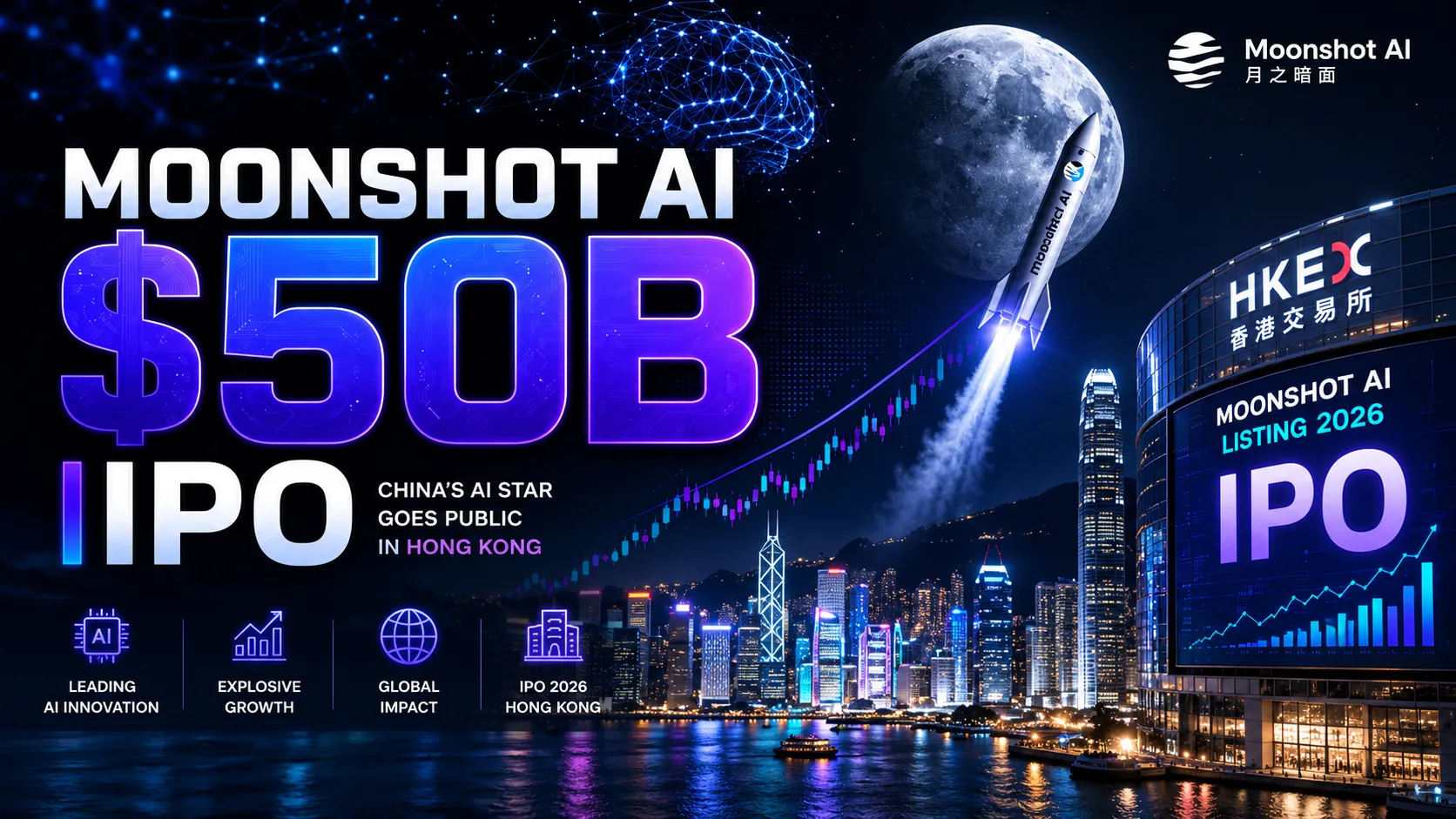
China's Moonshot AI is reportedly preparing for an initial public offering on the Hong Kong Stock Exchange at a valuation approaching $50 billion, according to people familiar with the company's plans. If confirmed, the listing would rank among the largest AI-sector public offerings globally to date, and would mark a significant milestone in the maturation of China's fast-growing cohort of frontier AI model developers, several of which have raised substantial private funding in recent years but have yet to test public market appetite at scale.
Moonshot AI has emerged as one of the most closely watched companies within China's competitive large language model landscape, building foundation models that have positioned it among the country's leading challengers in a sector where domestic competition has intensified sharply as multiple well-funded Chinese AI labs race to develop models capable of matching the capabilities of leading Western counterparts. A successful IPO at the reported valuation would validate the company's position at the top tier of that competitive field.
The choice of Hong Kong as a listing venue reflects a broader pattern among Chinese technology companies navigating an increasingly complex set of considerations around where to raise public capital, given ongoing regulatory and geopolitical friction affecting Chinese company listings on US exchanges. Hong Kong has increasingly positioned itself as the preferred venue for major Chinese technology listings, offering access to international capital while remaining within a regulatory framework more closely aligned with Beijing's preferences for how its most strategically significant technology companies raise public funding.
A Moonshot AI listing would also provide investors with a rare direct public-market vehicle for exposure to China's frontier AI development race, an area that has, until now, been accessible primarily through private funding rounds available only to a limited pool of venture capital and strategic investors. Public market investors seeking exposure to Chinese AI development have had comparatively few pure-play options, making a listing of this scale and profile likely to attract significant institutional interest.
The reported valuation of nearly $50 billion would place Moonshot AI among the most highly valued AI companies globally outside of the small handful of dominant US labs that have raised record-setting private funding rounds over the past year. That scale reflects both the substantial capital that has flowed into China's domestic AI sector as the country pursues technological self-sufficiency amid export restrictions on advanced chips, and growing investor conviction that several Chinese AI labs have closed much of the capability gap with leading international competitors.
For China's broader AI industry, a successful Moonshot AI listing could establish an important benchmark for how public markets value frontier AI companies within the Chinese regulatory and competitive context, potentially opening the door for other well-capitalised Chinese AI labs to pursue similar public listing strategies rather than remaining reliant on successive private funding rounds. Such a shift would mark a notable evolution in how China's AI sector accesses growth capital going forward.
Analysts covering the sector caution that AI company valuations, both public and private, remain subject to considerable volatility given the rapid pace of technological change and intense competitive pressure across the industry globally. A Hong Kong listing would expose Moonshot AI to the discipline of quarterly public reporting and market scrutiny in a way that private funding rounds, negotiated directly with a limited set of investors, do not, potentially testing the durability of the company's reported valuation once subjected to broader public market price discovery.