Chinese stocks have further to fall before they hit bottom, according to Morgan Stanley, adding to the gloom hanging over Asian markets as investors retreat from technology and growth stocks.
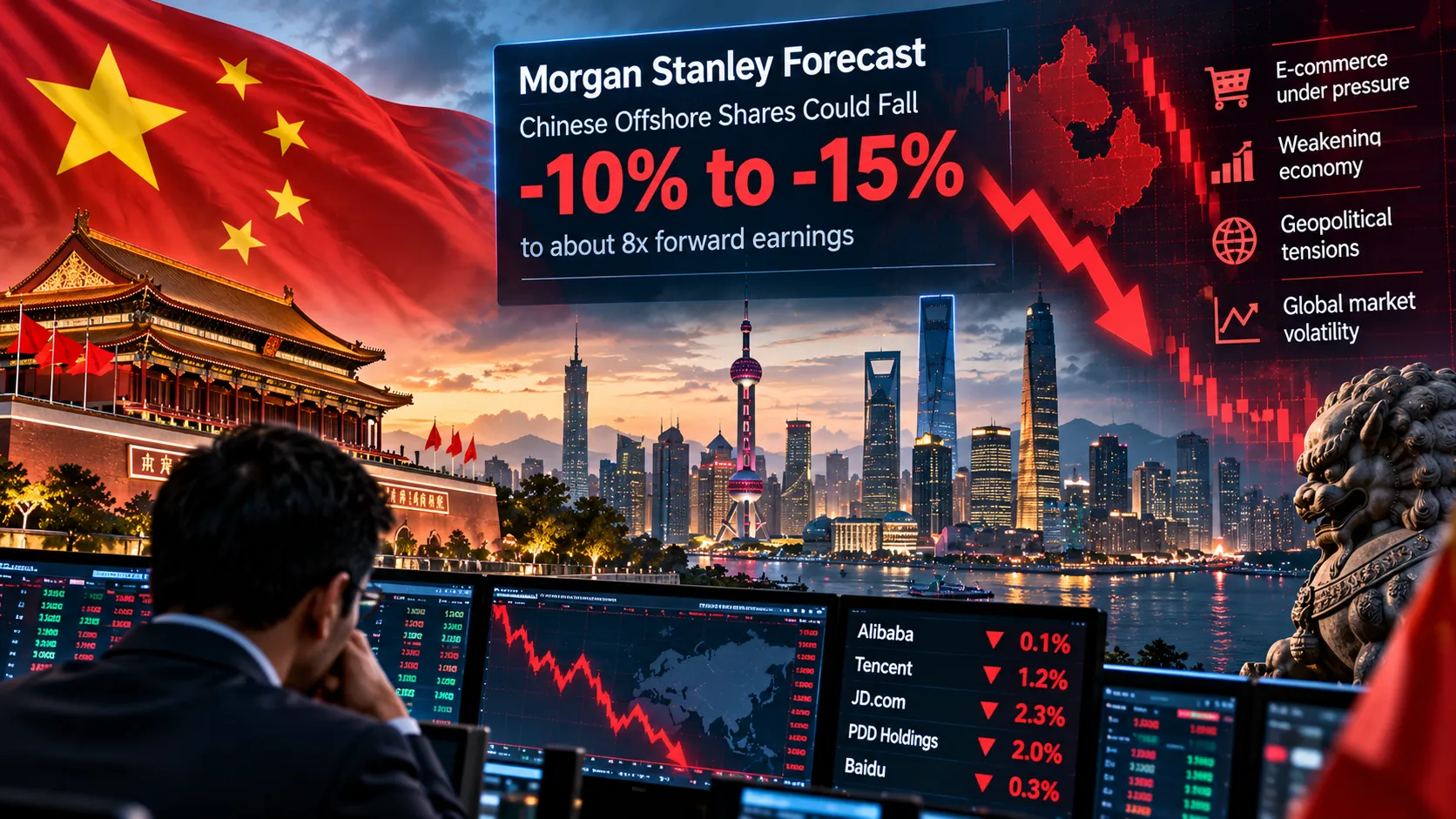
Morgan Stanley strategists said Chinese offshore shares, those listed in Hong Kong and the United States, may fall another 10-15% to reach about eight times 12-month forward earnings, a level they described as the historical bottom for valuations, according to a Bloomberg report cited by Stocktwits on Monday, October 26.
Mainland-listed stocks, traded in Shanghai and Shenzhen, could see a similar de-rating to about 10-11 times forward earnings, the strategists said.
Why Morgan Stanley is cautious
The strategists cited several concerns: what they called a "trust tax," pressure on e-commerce, a weakening macroeconomic environment and elevated global market volatility. They said recent developments had worsened the negative momentum in Chinese equities.
The "trust tax" refers to the discount investors apply to Chinese assets because of uncertainty about government policy, regulatory interventions, geopolitical tensions and corporate governance. Past crackdowns on technology, education and property companies have made investors wary of sudden policy shifts that can wipe out shareholder value.
E-commerce under pressure
China's e-commerce sector, home to giants such as Alibaba, JD.com and PDD Holdings, has faced intense competition, including costly price wars and heavy spending on instant delivery services. Slowing consumer spending in China has added to the pressure on margins.
E-commerce companies make up a large share of offshore Chinese indices, so their weakness weighs heavily on overall market performance. Alibaba shares fell 0.1% and Baidu 0.3% in overnight trading ahead of Monday's session.
A weakening economy
China's economy has struggled with a prolonged property slump, weak consumer confidence, deflationary pressures and trade tensions with the United States. Government stimulus measures have provided support but have not fully restored confidence.
The global environment has added to the difficulties. High oil prices raise costs for China, the world's largest crude importer, and US restrictions on technology and investment continue to tighten. The US Treasury last week proposed adding biotechnology to its curbs on American investment in Chinese technology, prompting Beijing to warn of countermeasures.
Onshore bear market
Onshore Chinese equities are already in a bear market, and the global retreat from AI-related stocks has added to the pressure. South Korea's Kospi, another market heavily exposed to the AI trade, has fallen more than 35% from its June peak.
Despite its cautious outlook, Morgan Stanley still favours mainland-listed stocks over offshore shares, citing government support for the domestic market and greater exposure to artificial intelligence and innovation companies. Beijing has used state-backed funds to support onshore equities during periods of stress.
The yuan paradox
In a notable contrast, China's currency has been strong. The yuan traded at its strongest level against the dollar since mid-2022 on Monday, reflecting China's large trade surplus and policy guidance. A strong currency typically supports foreign investment, but it has not been enough to offset concerns about corporate earnings and policy risk in equities.
What it means for India
For Indian investors, China's market troubles have mixed implications. In the past, weakness in China has sometimes led global emerging market funds to increase allocations to India, which has been seen as an alternative growth story with more predictable policy.
However, India is currently facing its own challenges, including high oil prices, a weak rupee and heavy foreign selling. Foreign investors have withdrawn ₹48,056 crore from Indian equities in October. If Chinese stocks fall to historic lows, some global investors may see value there, competing with India for emerging market allocations.
India also stands to benefit from the "China plus one" strategy, as companies diversify manufacturing and supply chains away from China, a trend reinforced by US restrictions.
Valuation versus value
Morgan Stanley's call raises a classic investment question: when does a cheap market become a buying opportunity? At about eight times forward earnings, Chinese offshore stocks would be trading at levels that have historically marked bottoms. Investors who bought at such levels in the past have sometimes earned strong returns when sentiment recovered.
But low valuations can persist if the underlying concerns, such as policy uncertainty and economic weakness, are not resolved. The "trust tax" suggests that investors require a significant discount to hold Chinese assets, regardless of earnings.
The policy wildcard
Chinese authorities have repeatedly stepped in to support markets during sell-offs, through measures such as directing state-backed funds to buy shares, cutting interest rates, easing property restrictions and encouraging companies to buy back shares. These interventions have sometimes sparked sharp rallies, as in late 2024, when a stimulus package lifted Chinese stocks dramatically in a matter of days.
Investors betting on further declines must weigh the possibility of renewed policy support. At the same time, the effects of previous interventions have often faded, as underlying economic problems persisted. Morgan Stanley's preference for mainland stocks reflects its view that government support is more likely to be directed at the onshore market.
The AI angle in China
Chinese technology companies have invested heavily in artificial intelligence, developing their own large language models and AI applications. Some investors see China's AI sector as an underappreciated opportunity, particularly after Chinese developers produced competitive models at lower cost. But US restrictions on advanced chips constrain the computing power available to Chinese companies, and the global retreat from AI stocks has weighed on their valuations.
What comes next
The direction of Chinese stocks will depend on economic data, government policy, corporate earnings and US-China relations. Additional stimulus or signs of a consumer recovery could improve sentiment, while further escalation of trade and technology tensions could deepen the sell-off.
Investors will also watch the global AI trade and central bank decisions this week, which could influence risk appetite across Asian markets, as well as earnings from Chinese technology companies in the weeks ahead. The relative performance of Chinese and Indian markets has swung significantly over the past few years. Indian equities outperformed strongly as foreign investors favoured India's growth story, while Chinese stocks lagged amid regulatory crackdowns and economic weakness. More recently, China's AI-driven rally and India's oil-related challenges narrowed that gap. Morgan Stanley's cautious view on China suggests that, for now, the bank does not see Chinese stocks as a compelling alternative despite their low valuations, and global fund managers will weigh both markets carefully.