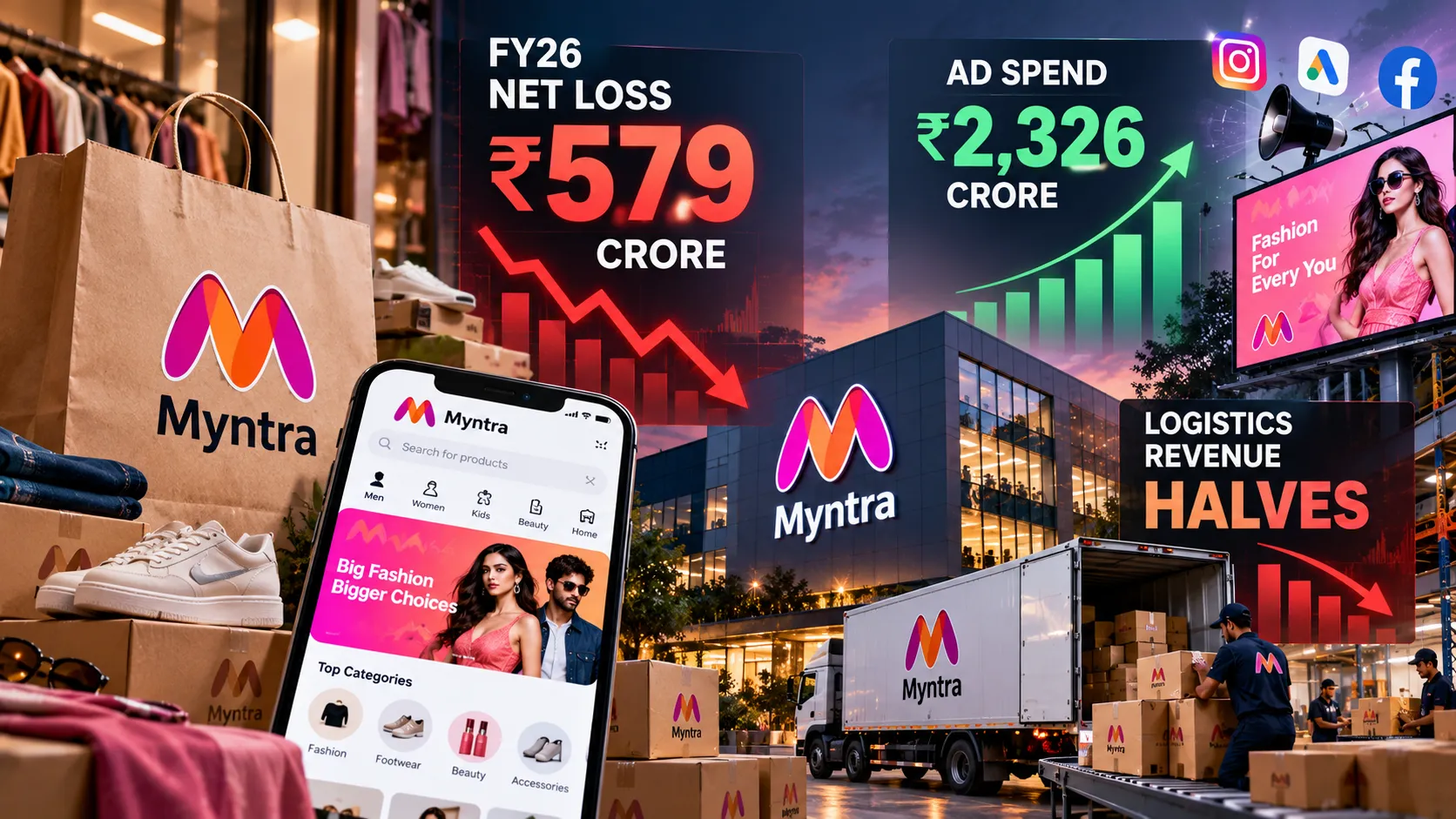
Myntra, India's largest online fashion marketplace, spent more than ₹2,300 crore on advertising in the 2025-26 financial year as competition for shoppers intensified, while a sharp drop in logistics revenue and restructuring costs pushed the company back into a loss.
The Flipkart-owned platform spent ₹2,326.5 crore on advertising and business promotion in FY26, up 10.5% from the previous year, according to an analysis of its regulatory filings reported on October 20. That represented about 40.4% of its total expenses.
Revenue from operations fell 13.5% to ₹5,242.5 crore from ₹6,063.8 crore, and the company reported a net loss of ₹579.4 crore, compared with a net profit of ₹548.5 crore in FY25, according to the filings.
Behind the revenue decline
The headline fall in revenue was driven by a steep drop in logistics and shipping revenue, which fell 53.2% to ₹1,119.2 crore from ₹2,390.5 crore. Changes in how logistics services are structured and billed, rather than a collapse in demand, appear to account for much of the decline.
Excluding logistics and shipping, Myntra's revenue rose 12% to ₹4,123.3 crore from ₹3,673.3 crore, a better indicator of the health of its core marketplace business.
Within that, advertising revenue was the standout. Income from advertising services rose 35.2% to ₹1,236.4 crore from ₹914.5 crore, making up about 23.6% of operating revenue. Marketplace and collection services revenue grew 3% to ₹2,657.3 crore, while other operating revenue rose 28.6% to ₹229.6 crore.
The rise of retail media
Myntra's advertising income reflects one of the most important trends in e-commerce worldwide: retail media. Brands pay platforms to promote their products in search results, on category pages and through sponsored placements, reaching shoppers at the moment they are ready to buy.
For marketplaces, advertising is highly profitable because it uses existing traffic and requires little additional cost. Amazon has built one of the world's largest advertising businesses on this model, and Indian platforms including Flipkart, Myntra, Nykaa and quick commerce apps have followed. Fashion brands, particularly digital-first labels, rely heavily on such advertising to stand out among thousands of competitors.
At the same time, Myntra spends heavily on its own marketing to attract and retain customers. Its ₹2,326.5 crore advertising and promotion budget nearly doubles the advertising revenue it earned, highlighting how expensive customer acquisition remains in Indian e-commerce.
Why the company swung to a loss
Total expenses were broadly stable at ₹5,757.7 crore, compared with ₹5,726 crore a year earlier. Direct expenses, including logistics charges, fell 14% to ₹1,841 crore, while other expenses, which include advertising and business promotion, rose 12.8% to about ₹3,060 crore. Employee benefit expenses increased 3.7% to ₹776.9 crore.
Myntra recorded a loss before tax of ₹441.9 crore, compared with a profit before tax of ₹411 crore in FY25. The swing reflected restructuring costs linked to the company's move of its holding structure from Singapore to India and a deferred tax charge of about ₹137.5 crore, according to the filings. Its FY25 profit had been boosted by a deferred tax credit.
The company's EBITDA loss was about ₹435 crore, according to the analysis.
A crowded fashion market
Myntra operates in one of the most competitive segments of Indian e-commerce. It faces Reliance's Ajio, Nykaa Fashion, Tata's Tata Cliq, Meesho's value-focused marketplace, Amazon, and a growing number of direct-to-consumer brands selling through their own websites and stores. Quick commerce companies have also begun offering fashion and accessories with rapid delivery.
Competition has pushed platforms to invest in discounts, celebrity endorsements, influencer marketing and loyalty programmes. Myntra's large advertising budget reflects that environment, as well as its efforts to expand in smaller cities and towns.

Strong festive start
Despite the loss, Myntra's recent trading has been robust. Its Big Fashion Festival, which began on October 8, saw demand reach four times business-as-usual levels in the first 24 hours, according to the company. Tier 2 and Tier 3 cities accounted for more than half of opening-day orders, and demand in eastern India reached seven times normal levels ahead of Durga Puja, led by West Bengal, Assam and Bihar.
Myntra said its customer base grew about 30% during the calendar year and that it is targeting 100 million monthly active users.
The Flipkart connection
Myntra's results feed into those of its parent, Flipkart Group, which reported consolidated revenue of about ₹1.46 lakh crore in FY26, up 18%, and a consolidated loss of ₹8,468 crore, slightly narrower than a year earlier. Flipkart, majority-owned by Walmart, has been moving its corporate structure to India as it prepares for a long-awaited initial public offering.
The redomiciling of entities from Singapore to India, which contributed to Myntra's restructuring costs, is part of that process. Several Indian startups have moved their holding companies back to India in recent years to list on domestic exchanges, a trend known as "reverse flipping."
The economics of fashion e-commerce
Fashion is one of the most competitive and challenging categories in e-commerce. High return rates, often well above those in other categories, add significant logistics costs, as customers order multiple sizes or styles and send back what does not fit. Inventory management is complex because trends change quickly, and heavy discounting during sales events compresses margins.
Platforms have sought to improve profitability by building higher-margin revenue streams such as advertising, private labels and services for brands, including logistics and marketing. They have also invested in technology to reduce returns, such as better size recommendations and virtual try-on tools. The balance between growth investment and profitability has become a key focus for investors in Indian e-commerce, as companies prepare for public listings.
What to watch
Investors and analysts will watch whether Myntra can return to profitability as one-time restructuring costs fade, and whether its advertising business continues to grow faster than its marketing spend. The festive season, typically the most important period of the year for fashion retail, will be crucial for its FY27 performance.
For India's e-commerce sector, Myntra's results illustrate both the opportunity and the cost of competing in fashion: a large and growing market, high-margin advertising revenue, and an unrelenting need to spend to win customers. Myntra's performance will also be a bellwether for the wider fashion e-commerce sector, as rivals backed by deep-pocketed conglomerates and global platforms compete for the same young, digitally savvy shoppers.