
MUMBAI, Oct 8 NABVENTURES, the venture capital arm of India's National Bank for Agriculture and Rural Development (NABARD), has announced the first close of its second fund at ₹450 crore, against a target corpus of ₹1,500 crore that includes a greenshoe option.
NABARD is the anchor investor. The fund will invest in start-ups working across agritech, food and agribusiness, rural fintech, climate-smart solutions, and agricultural supply chains and logistics — sectors that sit at the centre of India's rural economy but have struggled to attract private venture capital over the past three years.
The first close arrives at a pointed moment. Funding for Indian agritech start-ups has fallen sharply from its 2021–22 peak, and a well-capitalised, state-backed investor committing fresh money to the sector could help steady a segment that many generalist venture funds have quietly stepped back from.
Key facts at a glance
• Fund: NABVENTURES Fund II
• First close: ₹450 crore
• Target corpus: ₹1,500 crore, including a greenshoe option
• Anchor investor: NABARD
• Focus areas: agritech, food and agribusiness, rural fintech, climate-smart solutions, supply chain and logistics
• Existing vehicles: Fund I and AgriSURE
• Portfolio so far: 23 companies, including Unnati, Eggoz, Beyond Snack and Jai Kisan
• Sector backdrop: agritech funding of about $202 million across 36 deals in 2025, down about 25% from 2024
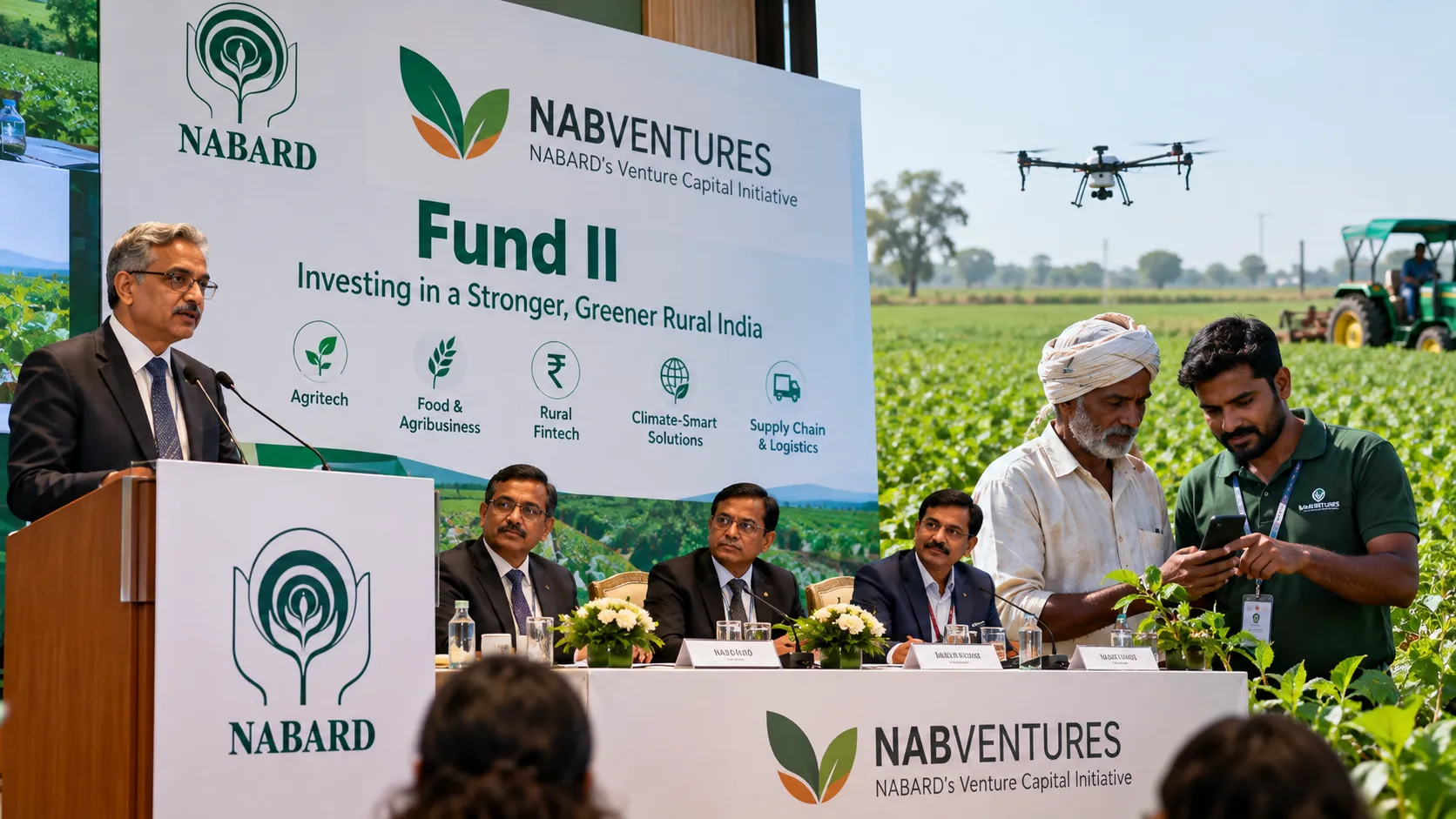
A fund built for rural India
NABARD chairman Dr Shaji Krishnan V said the new fund reflects the institution's commitment to innovation that advances sustainability, climate resilience, financial inclusion and rural livelihoods. That framing matters. Unlike a conventional venture fund, which is judged almost entirely on financial returns, NABVENTURES operates with a dual mandate: generating returns while also strengthening the rural economy that NABARD was created to serve.
NABVENTURES was incorporated on April 23, 2018, as a wholly owned subsidiary of NABARD. It already manages Fund I and AgriSURE, the Agri Fund for Start-ups and Rural Enterprises, which was set up to back early-stage ventures in agriculture and allied sectors. Across these vehicles it has built a portfolio of 23 companies, including farmer-services platform Unnati, egg brand Eggoz, healthy-snacking company Beyond Snack and rural lender Jai Kisan.
Fund II widens that remit. Its focus on rural fintech recognises that access to affordable credit, insurance and payments remains one of the largest barriers for small farmers and rural enterprises. The inclusion of climate-smart solutions reflects growing recognition that Indian agriculture is on the front line of climate change, exposed to erratic monsoons, heat stress and water scarcity.
The funding drought in agritech
The data underline why a dedicated fund is needed. Indian agritech start-ups raised about $202 million across 36 deals in 2025, according to Inc42 data, down roughly 25% from $269 million in 2024. That is a fraction of the $728 million raised in 2021 and $840 million in 2022, when investor enthusiasm for digitising the farm-to-fork value chain was at its height.
Several factors drove the retreat. Business models that relied on heavy discounting or on aggregating fragmented farm produce proved harder to scale profitably than many investors expected. Thin margins, long working-capital cycles and operational complexity in rural logistics weighed on returns. As the wider venture market tightened, many funds shifted towards sectors with clearer paths to profitability.