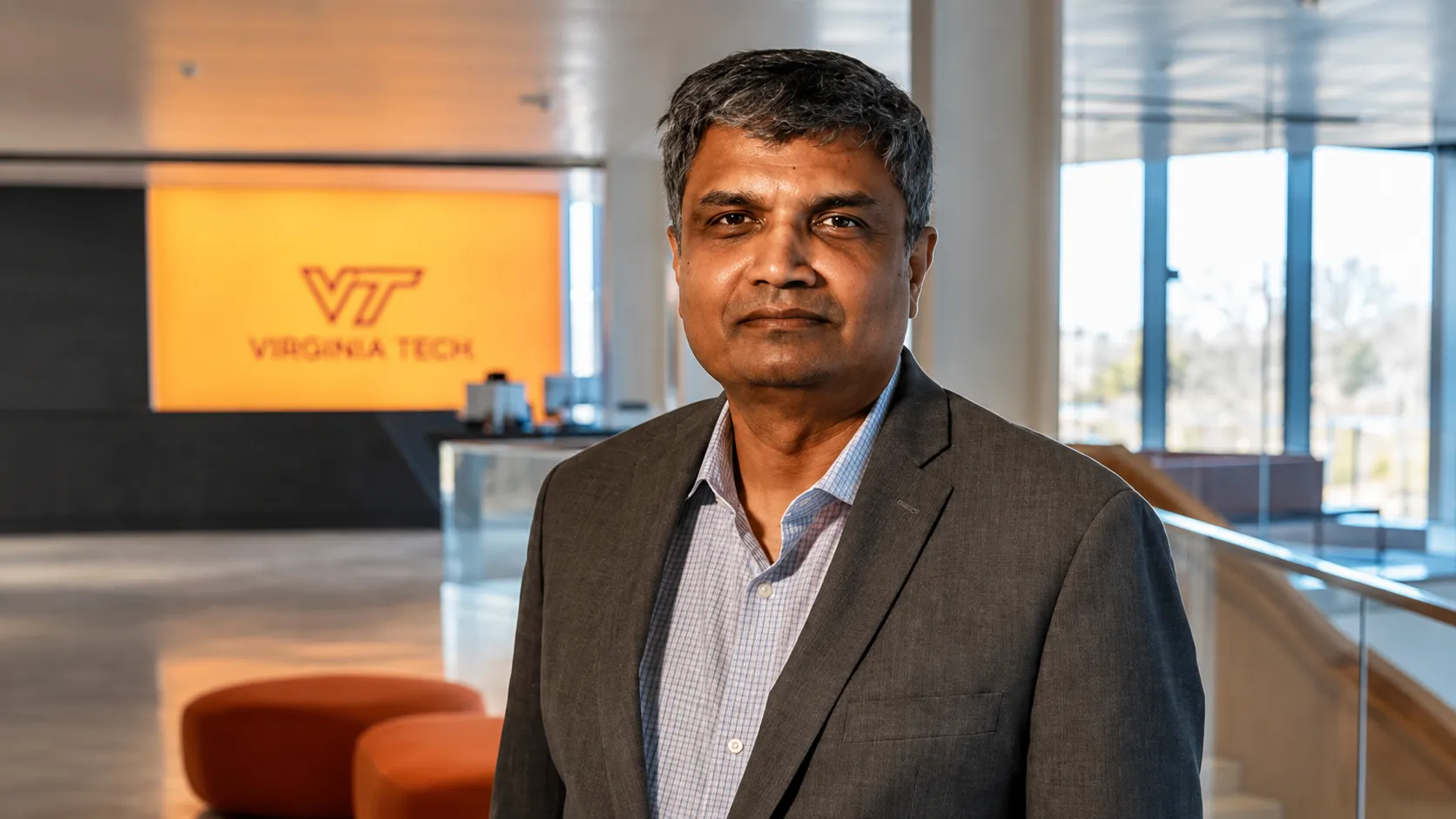
Naren Ramakrishnan, an Indian American professor whose research sits at the intersection of artificial intelligence and urban analytics, has been elected a fellow of the 2026 Virginia Academy of Science, one of the oldest and most respected scientific societies in the United States. The recognition, announced August 18, 2026, honours Ramakrishnan's work developing computational systems capable of anticipating complex, real-world events by analysing large-scale patterns embedded in urban and social data — a research area that has grown steadily in strategic importance as governments and corporations alike seek predictive tools for everything from public health to infrastructure planning.
The recognition arrives as Virginia's technology and research sector continues to expand, with the state increasingly positioning itself as a significant hub for applied AI research given its proximity to federal research funding agencies and a growing concentration of university and private-sector AI talent across the greater Washington DC metropolitan region.
Founded in the late nineteenth century, the Virginia Academy of Science elects fellows on the basis of sustained, distinguished contribution to scientific research within the state, drawing from fields spanning the physical, biological and computational sciences. Ramakrishnan's election places him among a select group of researchers recognised for work that bridges traditional academic boundaries, combining machine learning, complex-systems theory and social science methodology into a distinctive interdisciplinary research programme centred on predictive urban analytics.
His research group has built systems designed to detect early signals of significant societal events — ranging from disease outbreaks to civil unrest and economic disruption — by processing vast quantities of publicly available data through AI models trained to recognise subtle precursor patterns. This line of work sits within a broader field known as computational social science, an area that has attracted growing government and philanthropic funding as policymakers seek tools capable of providing earlier warning of complex, fast-moving crises than traditional forecasting methods allow.

The Virginia Academy of Science's broader mission has historically emphasised connecting academic scientific research with practical applications relevant to the state's economic and public policy priorities, a mission that aligns closely with Ramakrishnan's own research orientation toward translating complex predictive models into tools usable by non-specialist government stakeholders. His election reflects the Academy's continued efforts to recognise scientists whose work bridges this gap between rigorous methodology and practical civic application.
Ramakrishnan's career reflects a pattern increasingly visible among Indian-origin academics in American computer science departments: a shift from narrowly technical machine learning research toward applied, socially consequential AI systems designed to inform real-world policy and planning decisions. Colleagues describe his research group as having developed a reputation for translating complex predictive models into tools that public health officials, urban planners and government analysts can meaningfully use, a translation gap that many computational social science research programmes struggle to bridge.
The Virginia Academy of Science's decision to elect Ramakrishnan comes amid growing academic and policy interest in how AI-driven predictive systems might be responsibly deployed within public institutions, an area fraught with methodological and ethical complexity given the risks of algorithmic bias and false-positive predictions in sensitive domains such as public safety and health surveillance. Ramakrishnan's research has, according to peers, placed particular emphasis on model interpretability and uncertainty quantification, addressing precisely the kinds of concerns that have made many public institutions cautious about deploying predictive AI tools without rigorous safeguards.
Ramakrishnan's research group has also increasingly collaborated with public health agencies and urban planning departments across Virginia, providing a direct pipeline between academic predictive modelling research and practical government application. This applied orientation, colleagues note, has distinguished his laboratory from more theoretically focused computational social science programmes, and is understood to have been a significant factor in the Academy's decision to recognise his work specifically for its urban analytics applications.
Her fellow Academy members noted that Ramakrishnan's work exemplifies precisely the kind of scientifically rigorous yet practically deployable research the institution seeks to recognise each year.
For Virginia's academic community, and for the broader Indian American scientific diaspora, the recognition adds to a growing list of honours accumulated by Indian-origin computer scientists working at the interface of AI and public policy. Community organisations tracking Indian-origin academic achievement in Virginia and across the broader mid-Atlantic region point to Ramakrishnan's election as part of a wider pattern in which Indian-origin faculty have moved into leadership roles within state scientific academies, a level of institutional recognition that extends beyond the university department level into broader civic scientific infrastructure.
Ramakrishnan has also been active in mentoring graduate students working across AI, data science and computational social science, several of whom have gone on to build their own research careers within both academia and government analytics agencies. His election to the Academy is expected to raise the visibility of Virginia's broader computational social science research community, an area state science leaders have identified as strategically important amid growing national investment in AI research infrastructure.
The Academy's fellowship committee specifically cited Ramakrishnan's contributions to bridging what researchers often describe as the 'last mile' problem in computational social science — the gap between technically sophisticated predictive models and the practical, interpretable tools that government agencies and public institutions can confidently deploy in real-world decision-making contexts.
As artificial intelligence continues to reshape how governments and institutions approach complex prediction and planning challenges, Ramakrishnan's election to the Virginia Academy of Science reflects both individual scientific distinction and a broader institutional recognition of the value AI-driven social science research now holds within American public life. For the Indian American academic community, the honour adds further weight to a long and deepening record of contribution to the computational sciences shaping how the United States understands and anticipates complex societal change.
As Ramakrishnan's research continues to influence how Virginia's public institutions approach predictive analytics, his election to the Academy is expected to strengthen the state's broader positioning as a hub for applied AI research with direct relevance to public policy and governance challenges.
For Virginia's growing AI research community, the Academy's recognition of Ramakrishnan reinforces the state's ambitions to be seen as a serious hub for applied, policy-relevant artificial intelligence research, distinct from the more commercially oriented AI research clusters concentrated in California and other major technology hubs.


