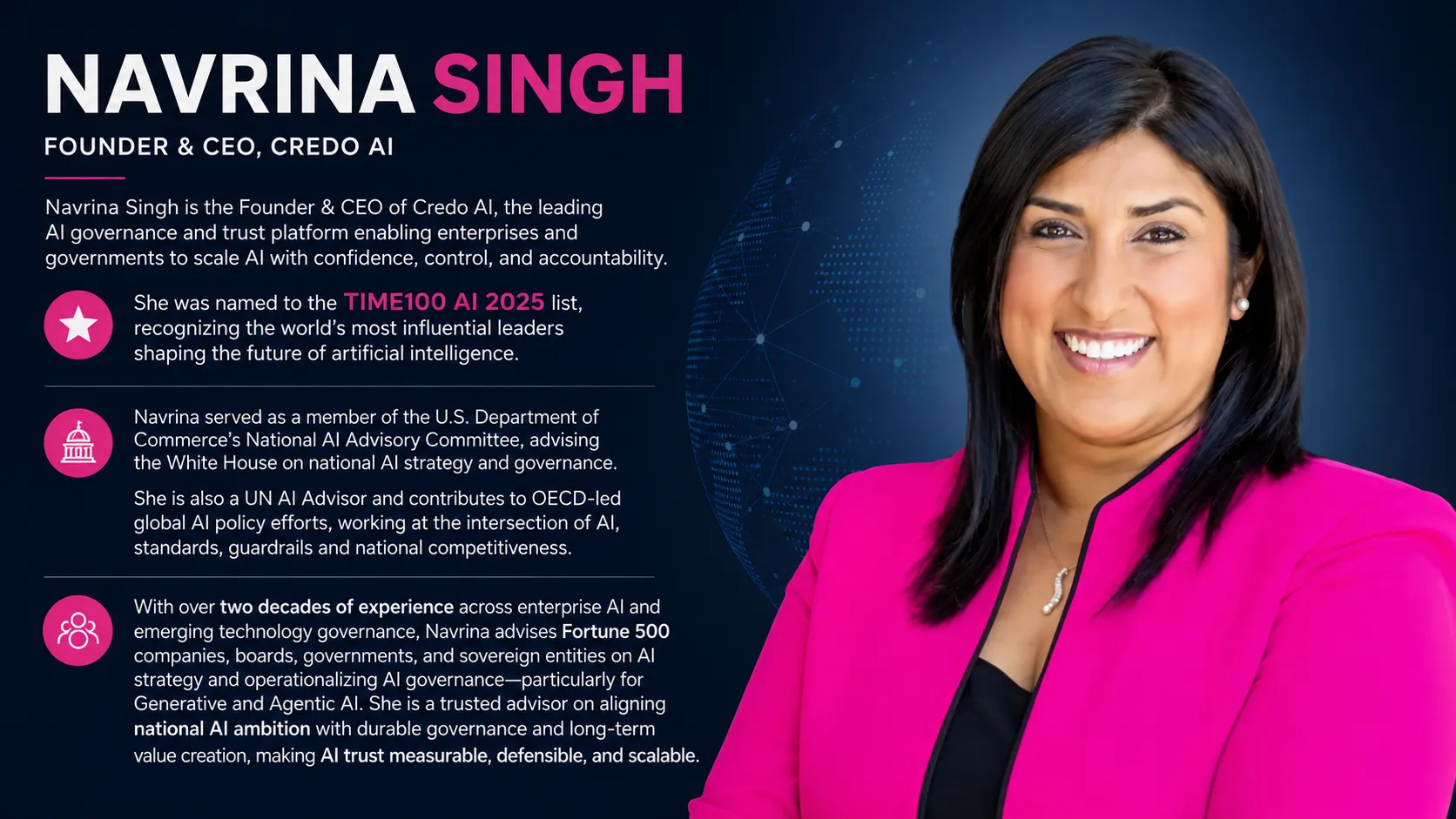
The Wisconsin Alumni Association has named Navrina Singh, founder and chief executive of the AI governance company Credo AI, as a recipient of its 2026 Luminary Award, one of the association's highest honours reserved for graduates whose careers have achieved distinguished impact within their respective fields. The recognition places Singh, a University of Wisconsin-Madison alumna, among a select group of honourees celebrated each year for work that the association describes as reflecting the university's broader mission of producing graduates who go on to shape their industries and communities in lasting ways.
Singh's career trajectory places her at the centre of one of the more consequential emerging fields within the broader artificial intelligence industry: the governance, auditing and responsible deployment of AI systems within enterprise and public-sector environments. Founded in 2020, Credo AI has built its business around helping large organisations navigate the increasingly complex regulatory, ethical and operational risks associated with deploying artificial intelligence systems at scale, offering software tools that allow enterprises to assess, monitor and document AI system behaviour against internal policy standards and an increasingly fragmented global regulatory landscape spanning the European Union's AI Act, sector-specific American regulatory guidance, and a growing patchwork of state-level AI legislation within the United States itself.
That business proposition has grown considerably more urgent, and considerably more commercially significant, over the five years since Credo AI's founding, as the rapid enterprise adoption of large language models and generative AI systems following the widespread commercial availability of tools such as ChatGPT has forced corporate legal, compliance and risk management functions to grapple with AI governance questions that, prior to 2023, had remained largely theoretical concerns confined to academic and policy circles. Singh has positioned Credo AI at the centre of that shift, building relationships with major enterprise customers and regulatory stakeholders that have established the company as one of the more prominent voices in ongoing policy discussions around how AI governance frameworks should be structured, both within individual companies and at the level of national and international regulation.
Before founding Credo AI, Singh built a substantial career within established technology companies, including a lengthy tenure at Qualcomm where she held senior roles spanning product management and corporate development, giving her direct exposure to the hardware and systems engineering considerations that underpin large-scale technology deployment — experience that has informed her approach to AI governance as a discipline requiring not just policy and legal expertise, but genuine technical fluency in how AI systems are actually built, trained and deployed within production environments. That combination of deep technical grounding and policy engagement has made Singh a frequently sought voice in broader public discussions about AI regulation, including engagement with policymakers and industry bodies grappling with how to balance innovation incentives against the genuine risks that unmanaged AI deployment can pose across areas ranging from algorithmic bias in hiring and lending decisions to broader questions of AI system reliability and accountability in high-stakes applications.

Singh's connection to the University of Wisconsin-Madison, where she completed her undergraduate education, has remained an active part of her professional identity even as her career has taken her through some of the technology industry's most consequential companies and, ultimately, into founding her own venture. The Wisconsin Alumni Association's Luminary Award specifically recognises graduates whose post-university careers have achieved distinguished national or international impact, and the association's selection of Singh for the 2026 honour reflects growing recognition within American higher education circles of AI governance as a legitimate and increasingly critical professional field in its own right, rather than a niche compliance function of secondary importance relative to core AI research and product development.
That recognition carries particular significance for the University of Wisconsin-Madison's own institutional positioning within the broader landscape of American universities producing graduates who go on to shape the technology industry. While Wisconsin has not historically been counted among the small handful of universities most closely associated with Silicon Valley's founder pipeline — a group typically dominated by institutions such as Stanford, MIT, Berkeley and a handful of other coastal research universities — Singh's honour offers the university a prominent example of a graduate who has built genuinely category-defining influence within one of technology's most consequential emerging sub-fields, doing so from a Midwestern public university whose contribution to the broader technology ecosystem often receives less attention than that of its more frequently cited coastal peers.
For the Indian-American diaspora specifically, Singh's recognition adds to a body of examples illustrating the community's increasingly prominent role not merely in building artificial intelligence systems, but in shaping the governance, regulatory and ethical frameworks that will determine how those systems are deployed and held accountable across enterprise, government and consumer applications. That dimension of diaspora influence within the AI industry has historically received considerably less attention than the more widely covered narrative of Indian-origin executives leading major AI research organisations and technology companies, even though the practical, day-to-day work of building governance infrastructure — audit tools, compliance frameworks, risk assessment methodologies — will likely prove just as consequential in determining how safely and equitably artificial intelligence systems are actually deployed across the economy over the coming decade.
Singh has spoken publicly on multiple occasions about the specific challenges facing companies attempting to operationalise responsible AI principles in practice, noting that the gap between high-level ethical commitments — the kind of broad principles many companies have adopted in public statements about responsible AI development — and the concrete technical and organisational processes required to actually implement and verify those commitments remains one of the central unsolved problems facing the industry. Credo AI's product strategy has been built substantially around closing that gap, offering enterprises structured tooling to translate abstract governance principles into auditable, measurable organisational processes, an approach that has resonated particularly strongly with large enterprises operating in heavily regulated sectors such as financial services and healthcare, where AI deployment decisions carry direct legal and regulatory exposure.
The commercial category Credo AI occupies has attracted growing venture investment interest over recent years, as enterprise customers across financial services, healthcare, insurance and government contracting have increasingly treated AI governance tooling as a required component of responsible AI deployment rather than an optional add-on. That shift has been reinforced by a steadily expanding regulatory landscape: the European Union's AI Act introduced binding obligations for certain categories of AI system deployment, a number of American states have advanced their own AI-specific legislation addressing issues ranging from algorithmic discrimination to transparency requirements for automated decision-making systems, and federal agencies overseeing specific sectors — financial services regulators and healthcare oversight bodies among them — have issued sector-specific guidance addressing AI risk management that companies operating in those industries must now factor into their compliance planning. Companies such as Credo AI have positioned themselves as the practical infrastructure layer helping enterprises navigate that increasingly complex and fragmented regulatory patchwork.
Singh's own public commentary on AI governance has frequently emphasised a theme that distinguishes her perspective from some other prominent voices in the field: rather than framing AI governance primarily as a constraint on innovation, she has consistently argued that robust governance infrastructure ultimately enables faster, more confident enterprise AI adoption by giving risk-averse corporate decision-makers the assurance mechanisms they need to deploy AI systems in higher-stakes applications. That framing has resonated particularly well with enterprise customers whose primary barrier to more aggressive AI adoption has often been internal risk management and legal concerns rather than any lack of enthusiasm for the underlying technology's potential business value, and it has helped position Credo AI's product suite as a growth enabler rather than merely a defensive compliance tool within the sales conversations the company conducts with prospective enterprise customers.
Within the broader Indian-American technology community, Singh's career has increasingly been cited as a reference point for a specific and still relatively underrepresented professional path: the founder-operator building infrastructure and tooling companies focused on AI safety, governance and responsible deployment, as distinct from the more heavily covered category of Indian-origin founders and executives building the underlying AI models and consumer-facing applications themselves. Industry observers argue that this governance and safety infrastructure layer is likely to grow substantially in commercial importance over the coming years as AI regulation matures globally, suggesting that Singh's specific career trajectory may prove an increasingly common, rather than unusual, path for the next generation of diaspora technologists entering the AI industry.
Looking ahead, industry analysts tracking the AI governance sector expect continued consolidation and growth across the category over the next several years, as regulatory requirements mature further and enterprise procurement processes increasingly formalise AI governance tooling as a standard component of technology purchasing decisions, comparable to how cybersecurity tooling evolved from a specialised concern into a near-universal enterprise procurement requirement over the preceding two decades. Companies positioned early and credibly within the category, as Credo AI has been under Singh's leadership since 2020, stand to benefit considerably from that maturation, both commercially and in terms of the kind of sustained industry and institutional recognition — including honours such as the Wisconsin Alumni Association's Luminary Award — that tends to accrue to founders whose early strategic bets are subsequently validated by broader market and regulatory developments.
The University of Wisconsin-Madison's broader alumni network within the technology sector has also grown increasingly visible over recent years, even as the institution continues to be less frequently cited than a handful of peer research universities in mainstream coverage of Silicon Valley's talent pipeline. University administrators point to a steadily expanding roster of graduates holding senior positions across major technology companies and high-growth startups as evidence that the institution's computer science, engineering and business programmes have quietly built a talent pipeline whose influence within the technology industry considerably exceeds what more casual observers, focused primarily on the small number of universities most closely associated with Silicon Valley's founding mythology, might assume. Singh's Luminary Award recognition adds a prominent and timely data point to that broader institutional narrative, arriving at a moment when artificial intelligence governance has moved decisively from a peripheral academic concern to a central commercial and regulatory priority across the global technology industry.
Singh has also been notably active in mentorship and community-building efforts aimed at increasing the representation of women and diaspora professionals within the AI governance and broader AI policy fields, participating in a range of industry working groups, advisory panels and speaking engagements aimed specifically at expanding the pipeline of professionals equipped to work at the intersection of technical AI systems and governance policy. That mentorship dimension of her work has been cited by several of the professional and alumni organisations that have recognised her contributions in recent years, including the Wisconsin Alumni Association, as an important complement to her direct commercial achievements through Credo AI — reflecting a broader trend in which award and recognition bodies increasingly weigh candidates' contributions to field-building and talent development alongside their individual commercial or technical accomplishments when selecting honourees for awards of this kind.

For the broader ecosystem of AI governance startups that has emerged alongside Credo AI over recent years, Singh's continued visibility and recognition also carries a category-legitimising effect that benefits competitors and complementary companies alongside her own venture, in much the same way that early, high-profile recognition of pioneering founders in other now-mainstream technology categories — cybersecurity and cloud infrastructure among them in earlier decades — has historically helped establish the credibility and investor confidence needed for an entire category of company to attract sustained capital and enterprise customer attention. That category-level effect is likely to prove at least as significant to the field's long-term trajectory as the fortunes of any single company within it, Credo AI included.
As artificial intelligence governance continues to solidify into a distinct and increasingly well-resourced professional field, Singh's Luminary Award recognition offers a useful marker of how far the discipline, and her own career within it, has travelled in a relatively short period. What began as a niche concern raised primarily by academic ethicists and a small number of specialised advocacy organisations has, within the space of several years, become a mainstream enterprise priority backed by dedicated regulatory frameworks, corporate compliance budgets and, increasingly, formal institutional recognition of the kind the Wisconsin Alumni Association has now extended to one of the field's most prominent founders. For current and prospective University of Wisconsin-Madison students considering their own paths into the technology industry, Singh's honour offers a concrete example of a career built not around the most heavily trodden path of AI model development, but around the equally consequential, and arguably still comparatively underserved, work of ensuring that the AI systems reshaping the global economy actually function safely, fairly and accountably as they scale.


