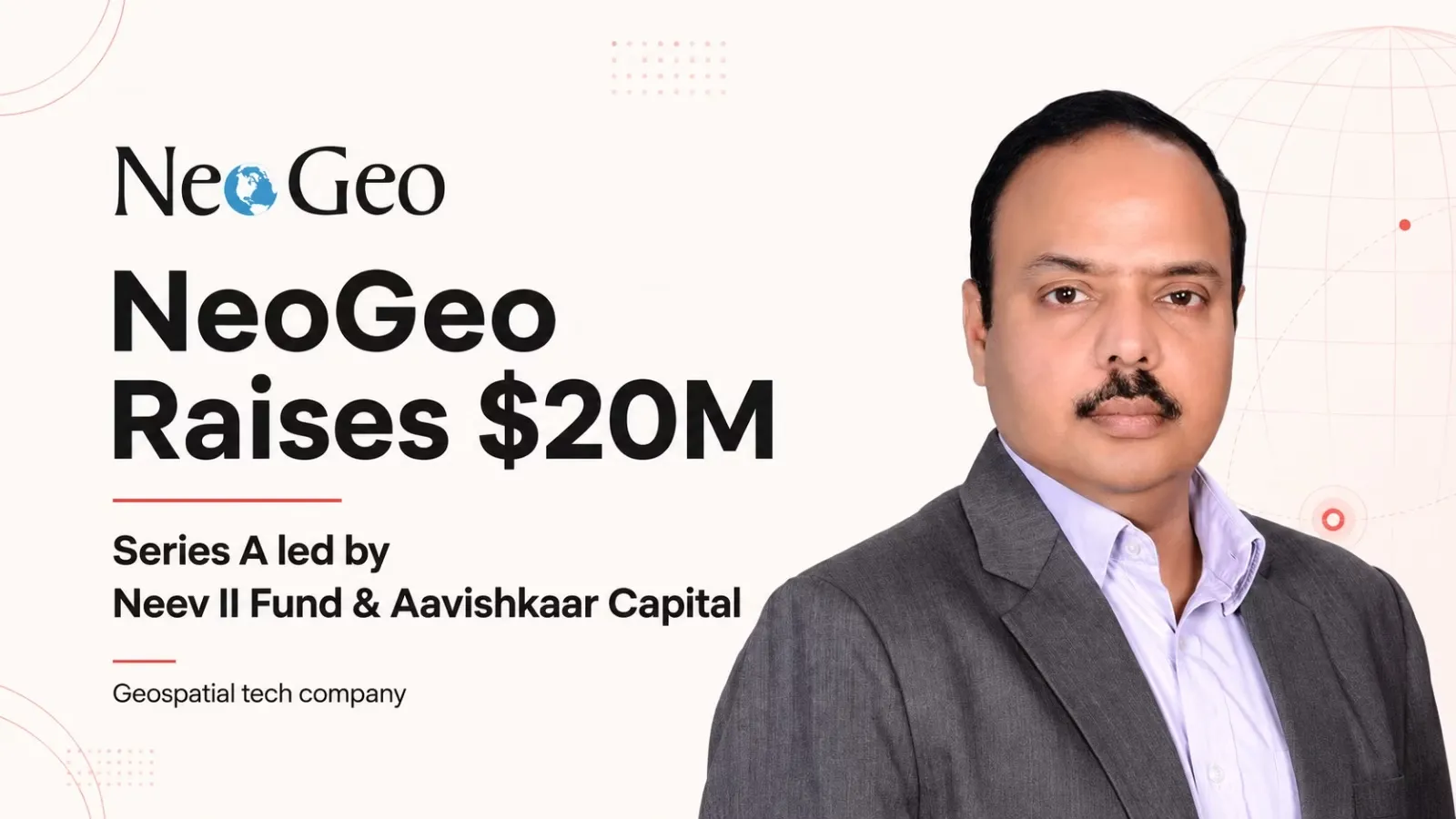
India's geospatial technology sector has produced a fresh signal of investor confidence this week, with NeoGeo, a Bengaluru-headquartered mapping and location-intelligence platform, announcing a $20 million Series A financing round. The round was led jointly by Neev II Fund and Aavishkaar Capital, two investors with a track record of backing deep-technology and infrastructure-adjacent businesses across South Asia. The financing marks one of the more significant early-stage rounds in India's geospatial category this year, a sector that has historically attracted less venture capital than consumer internet or fintech, despite its growing relevance to logistics, agriculture, urban planning and defence-adjacent applications.
The deal underscores a wider truth about India's 2026 funding environment: capital continues to flow, but increasingly toward founders who can demonstrate a defensible technical moat rather than simply a large addressable market.
NeoGeo's platform combines satellite imagery, drone-captured data and proprietary machine-learning models to build high-resolution digital maps that can be layered with real-time analytics. Enterprise customers use the company's tools to plan infrastructure corridors, monitor agricultural yields, track deforestation and optimise last-mile logistics networks — use cases that have become increasingly commercially viable as India's own space and remote-sensing ecosystem has matured under liberalised space-sector policy. Company executives say the fresh capital will be deployed across three broad priorities: expanding the core product suite to cover higher-resolution analytics layers, scaling the engineering and data-science team, and — notably — establishing a commercial presence outside India for the first time.
The round also lands amid growing government emphasis on indigenous space and geospatial capability as a matter of strategic, not just commercial, importance. India's civil and defence establishments have both signalled increasing reliance on domestically developed satellite and analytics infrastructure for applications ranging from border monitoring to disaster response, creating a natural anchor customer base for companies like NeoGeo even as they pursue overseas commercial growth. This dual domestic-and-international demand base gives the company a diversified revenue foundation that is comparatively rare among early-stage Indian deep-tech start-ups, many of which remain dependent on a single customer segment during their first several years of commercial operation.
The decision to target the Middle East and the Americas reflects a broader pattern among Indian deep-tech companies that have built cost-efficient, technically rigorous products domestically and are now looking to export that capability to markets willing to pay a premium for geospatial accuracy. Gulf states, in particular, have been investing heavily in smart-city infrastructure and water-resource management, both of which lean on the kind of high-frequency satellite analytics NeoGeo specialises in. In Latin America, agribusiness and mining companies represent an early beachhead, sectors where India-built geospatial tooling has already demonstrated cost advantages relative to European and North American incumbents.
For India's satellite-data and remote-sensing ecosystem more broadly, the round arrives at a moment of accelerating commercial activity, with several domestic space-tech companies now moving from government-contract-dependent business models toward diversified commercial customer bases spanning agriculture, insurance, urban planning and logistics. NeoGeo's positioning as a company that layers proprietary analytics on top of raw imagery, rather than simply reselling satellite data, reflects a broader trend among Indian geospatial start-ups to capture more value further up the analytics stack, where margins and defensibility tend to be considerably higher than in raw data provision alone.
Investors backing the round pointed to NeoGeo's capital efficiency and its ability to sign long-duration enterprise contracts as differentiating factors in a funding environment where investors have grown more selective about early-stage technology bets. Neev II Fund and Aavishkaar Capital have both previously backed companies operating at the intersection of data infrastructure and public-good outcomes, a thesis that aligns with NeoGeo's positioning as an enabler of climate monitoring, disaster response and resource planning rather than a purely commercial mapping tool. The round also reflects a wider theme visible across India's 2026 funding landscape: capital is increasingly concentrating around teams that can demonstrate technical depth and a credible, near-term path to revenue rather than growth metrics alone.
India's own space-sector liberalisation, which opened satellite launch, remote sensing and geospatial data licensing to private players over the past several years, has been a critical enabler for companies like NeoGeo. Where geospatial start-ups once had to navigate a tightly controlled regulatory environment around satellite imagery and mapping data, current policy allows domestic companies to build, license and export high-resolution geospatial products with far greater flexibility. This liberalisation has coincided with falling costs for satellite tasking and drone deployment, allowing companies to build increasingly sophisticated analytics layers without the capital intensity that once made geospatial technology the preserve of government agencies and large defence contractors alone. NeoGeo's ability to raise a $20 million round at this stage reflects investor confidence that this policy tailwind will continue.
Looking at India's deep-tech investment landscape over the past eighteen months, geospatial and remote-sensing companies have moved from a niche, government-contract-dependent category toward one increasingly recognised by mainstream venture investors as commercially durable. Comparable transactions in adjacent categories — including agri-tech analytics and climate-risk modelling start-ups — have similarly drawn larger, more institutionally credible investor syndicates over the same period, suggesting a structural re-rating of the sector rather than an isolated data point tied to NeoGeo alone. For founders across India's broader deep-tech ecosystem, the round offers a reminder that patient, technically rigorous product development, sustained over several years before a headline fundraising announcement, remains a viable path to attracting serious institutional capital, even in categories that have historically struggled to command venture attention comparable to consumer-facing software businesses.
For India's broader geospatial and deep-tech ecosystem, NeoGeo's raise offers a template that other founders are likely to study closely — building domain expertise domestically, proving commercial traction with enterprise and government customers, and only then pursuing international expansion once unit economics are established. As global demand grows for climate-resilient infrastructure planning and precision resource management, Indian geospatial start-ups appear positioned to compete on both technical capability and cost, a combination that investors are increasingly willing to fund at scale.
Whether NeoGeo can convert its early domestic traction into sustained international revenue will depend heavily on execution across unfamiliar regulatory and commercial environments, a transition that has proven difficult for other Indian technology exporters in the past. For now, the company's Series A stands as a data point in a broader narrative: Indian deep-tech founders building genuinely differentiated technical capability, rather than replicating existing global products for local markets, are increasingly able to attract serious institutional capital — and increasingly expected, in turn, to demonstrate that capability can travel beyond India's borders.