Indian equities extended their recovery on Monday, November 9, with the Nifty 50 touching its highest level in nine months, as investors who had shunned India during the global artificial intelligence boom began to return in force.
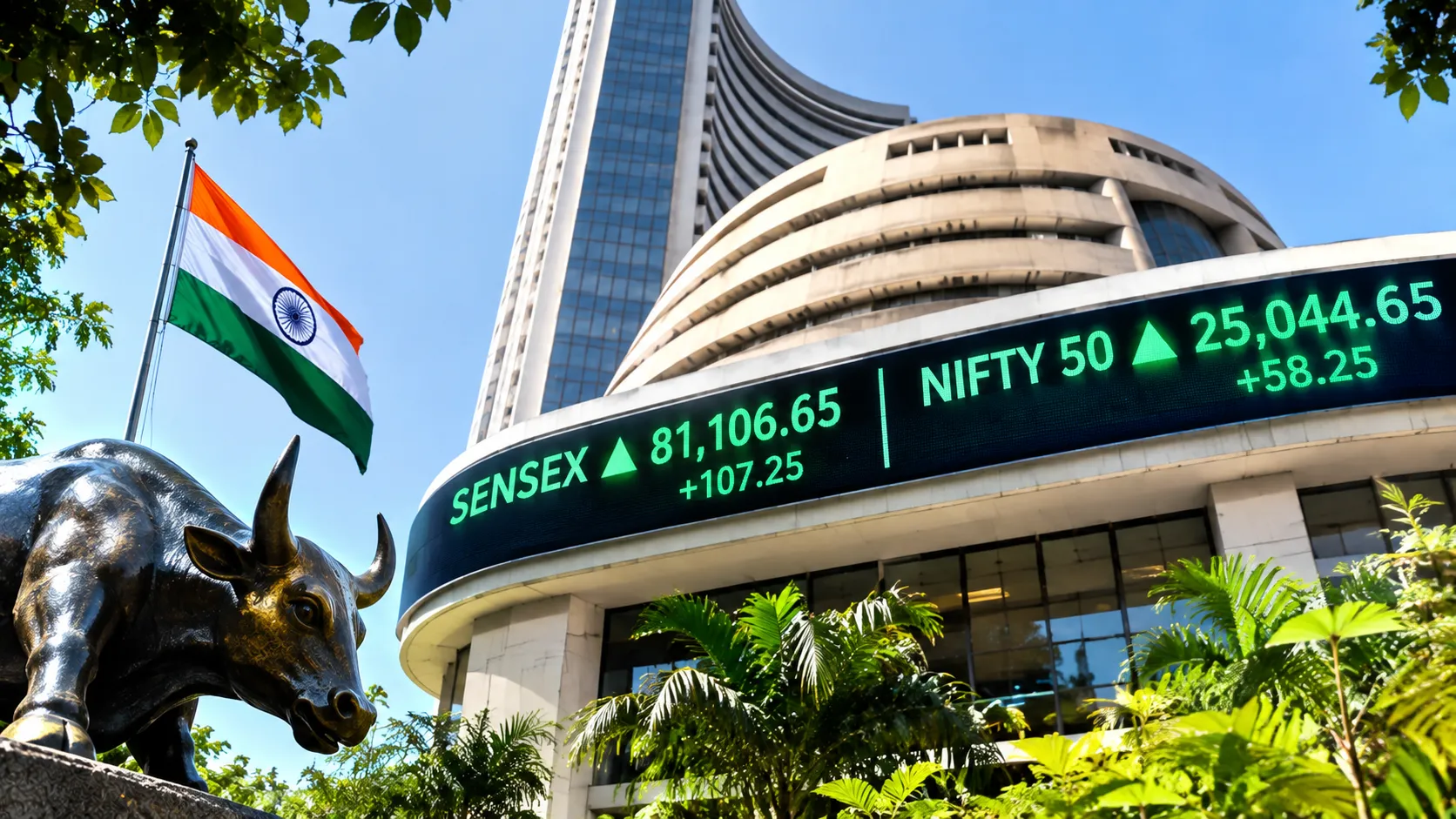
The Nifty 50 rose 58.25 points to close at 25,044.65, after hitting a nine-month high during the session, according to CNBC-TV18 and India IPO's daily market update. The BSE Sensex gained 107.25 points to 81,106.65. The Nifty Bank index jumped 891 points to 59,741, and the Nifty Midcap index rose 334 points to 61,023.
Indian markets were closed on Tuesday, November 10, for Diwali Balipratipada.
PSU banks and defence lead
Public sector banks were the standout performers. The Nifty PSU Bank index rose about 3%, with Bank of India, Bank of Baroda, Punjab National Bank and Union Bank of India each gaining roughly 4% to 5%, according to CNBC-TV18.
State-owned banks have reported strong earnings in recent quarters, with healthy loan growth, improving asset quality and rising profits. State Bank of India, the country's largest lender, reported a 14% rise in second-quarter profit earlier this month.
Defence stocks also rallied. Bharat Dynamics and Cochin Shipyard rose about 4% each, while Data Patterns jumped 9%, according to CNBC-TV18. Indian defence companies have benefited from rising government spending, a growing order pipeline and the push for domestic manufacturing of military equipment.
Easing crude oil prices also supported the market. Brent crude fell 5.2% to $93.27 a barrel, according to India IPO, after US President Donald Trump said fresh strikes on Iran were unlikely while talks continue. As a major oil importer, India benefits significantly from lower oil prices.
Foreign money returns
The rally reflects a significant shift in foreign investor sentiment. Foreign portfolio investors put about ₹38,971 crore into Indian equities in the previous week, according to India IPO. They also invested roughly ₹8,000 crore in Fully Accessible Route (FAR) government securities in the first week of November, and the 10-year government bond yield fell about 4 basis points to 7.1529%.
FPIs made record purchases of Indian IT stocks in October, worth $1.42 billion, or ₹13,514 crore, according to India IPO.
Bloomberg described the trend in a November 9 newsletter headlined "Foreign Funds Pile Into India as AI Trade Falters."
Brokerages turn bullish
Several global brokerages have upgraded their views on India. HSBC upgraded India to "overweight," Citi set a Nifty target of 28,000 by the end of 2027, and Jefferies turned bullish, according to India IPO.
The upgrades mark a reversal from much of the past year, when global investors reduced their exposure to India in favour of markets with greater exposure to AI, such as Taiwan, South Korea and the United States. India's weight in the MSCI Emerging Markets index fell from a peak of 20% in July 2024 to 10.7% in September 2026, according to NewsBytes, as AI-heavy markets surged.
Why the AI trade matters for India
The global AI trade has faltered in recent weeks. A sharp sell-off in chip and AI infrastructure stocks, triggered partly by fears that the results of the US midterm elections will slow the construction of data centres, wiped trillions of dollars off global markets. Fortune cited a Reuters estimate of $2.5 trillion for the rout in AI and tech stocks the previous week.
India, with relatively few listed AI hardware companies, missed much of the AI rally but has also been less exposed to its reversal. As investors take profits on crowded AI trades, some are reallocating money to markets with more diversified economies and strong domestic growth, such as India.
Indian IT services companies have also benefited. A slowdown in AI infrastructure spending could free up corporate technology budgets for other projects, while Indian IT companies are building AI services practices.
Volatility rises
Despite the rally, market volatility has increased. The India VIX, a measure of expected volatility, jumped 68% in three weeks to 17.5 on November 10, according to India IPO. Higher volatility reflects uncertainty about the global outlook, oil prices and US policy.
Some analysts remain cautious about whether the rotation into India will last. In earlier commentary, Santosh Meena, head of research at Swastika Investmart, described India's resilience as "a short-term rotation rather than the start of a durable leadership shift," according to Outlook Business.
The rupee
The rupee has also stabilised. It was Asia's third-best-performing currency in the 2026-27 financial year so far, up 0.97% against the US dollar, according to India IPO. Foreign inflows support the rupee by increasing demand for the currency.
Domestic fundamentals
India's economic fundamentals remain relatively strong. Corporate earnings for the September quarter have been solid in many sectors, including banking, autos and consumer goods. Government capital spending is rising: central public sector enterprises' capital expenditure reached ₹5.03 trillion in April-October, up 13%, about 60% of the full-year target, according to India IPO. Festive season demand has been robust, with UPI transactions surging during Diwali.
However, inflation remains a concern. India IPO noted that retail inflation for October may have exceeded the Reserve Bank of India's upper tolerance limit of 6%, which could limit the central bank's ability to cut interest rates.
Diaspora investors
For non-resident Indians and global Indian investors, the rally is a reminder of the opportunities in India's markets. Rising foreign interest and a stable rupee can boost returns for overseas investors, and many NRIs have increased their investments in Indian equities and mutual funds in recent years.
Bank stocks in focus
The rally in public sector banks reflects improving fundamentals. State-owned lenders have cleaned up their balance sheets after years of bad loans, raised capital and returned to steady profitability, allowing several to increase dividends. Their valuations remain lower than those of private sector banks, which has attracted investors looking for value. Strong credit demand from retail borrowers and small businesses, along with government spending on infrastructure, has supported loan growth.
Defence stocks, meanwhile, have been supported by a steady flow of orders from the armed forces and rising export ambitions, as the government pushes to make India a major supplier of military equipment.
What comes next
Markets will reopen on Wednesday, November 11. Investors will watch India's October inflation data, foreign fund flows, oil prices and the US inflation report due on November 10. Whether India's outperformance continues will depend partly on the trajectory of the global AI trade, and partly on whether domestic earnings and economic growth live up to investors' rising expectations.