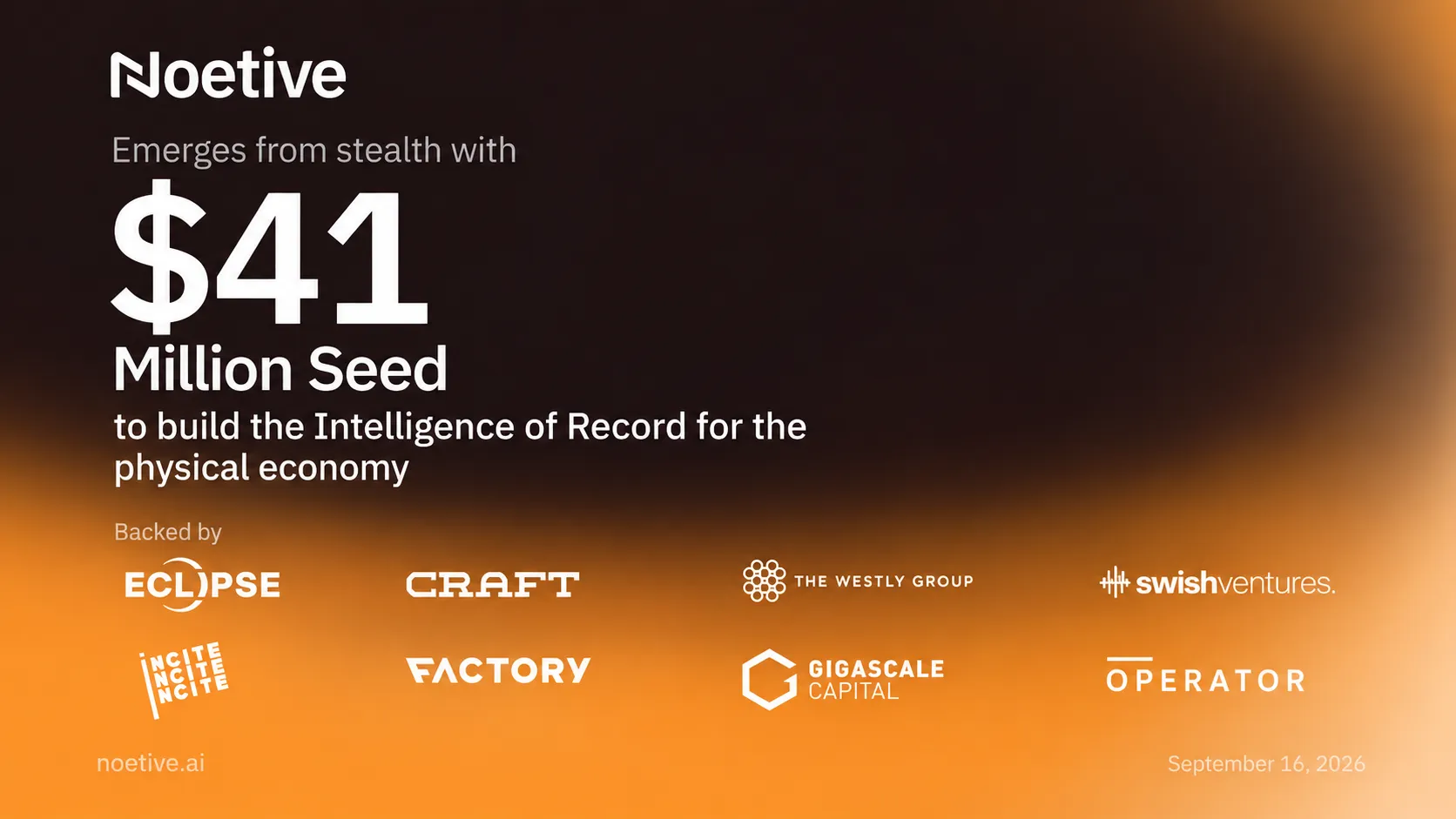
Noetive, an AI startup building what it describes as the "intelligence of record" for the physical economy, emerged from stealth on September 16, 2026 with $41 million in seed funding led by Eclipse, the venture firm known for its full-stack approach to backing industrial technology companies. The round drew participation from Craft Ventures, The Westly Group, Swish Ventures, Factory, Incite Ventures, Gigascale Capital, Operator Partners and Liquid 2 Ventures, alongside a striking roster of individual technology-industry backers including Meta Chief Technology Officer Andrew Bosworth and Airbnb Chief Technology Officer Ahmed Al-Dahle. The involvement of two sitting CTOs at major technology companies, investing personally rather than through their employers, has drawn outsized attention to a round that is, in absolute dollar terms, a mid-sized seed raise by 2026 standards.
Noetive was founded by Amir Frenkel, a former vice president of generative AI at Meta, and Dan Barak, previously a product executive at Netlify. The company's thesis is that AI has transformed information work — the software-mediated tasks that live natively on the internet — but has largely failed to transform the far larger physical economy, which the company estimates at roughly $30 trillion globally. Frenkel has argued publicly that most AI products to date were designed for information work, while running a factory floor or a distribution network requires coordinating thousands of constantly shifting variables: materials, machinery, labour, supplier networks and real-world conditions that do not reduce neatly to text the way software workflows do.
The company's founding story is itself unusual. Eclipse hired Frenkel from Meta earlier this year specifically to serve as the firm's first chief AI officer, and Noetive took shape inside Eclipse from there, with the venture firm helping recruit the founding team around him rather than simply writing a cheque into an externally formed company. That model — venture-firm-as-company-builder — has become more common among specialist industrial-technology investors who argue that the domain expertise required to build credible physical-economy AI products is scarce enough that firms need to actively assemble founding teams rather than wait for them to emerge organically. Eclipse's own positioning as a "full-stack" industrial investor, integrating hardware, software and data expertise while working with senior operators from companies like Tesla, Amazon Robotics and Northvolt, reflects the same underlying belief.
At the core of Noetive's technology is what the company calls a self-improving AI model, or "brain," designed to understand the spatial and operational behaviour of physical environments including factories, logistics sites, construction sites, energy facilities and data centres. Software agents built on top of that core model are intended to run alongside a customer's existing tools rather than replacing them outright, taking on complex operational problems end-to-end. The company is also developing what it describes as a universal sensing pod, designed to feed real-time physical data — from equipment states to environmental conditions — into its AI system, addressing a persistent challenge in industrial AI: that many physical environments lack the sensor infrastructure needed to give software systems adequate visibility into what is actually happening on the ground.
Noetive says it already has design partners across manufacturing, logistics, energy and data-centre operations using early versions of its system. One early customer, food and beverage manufacturer Steuben Foods, has told reporters that Noetive's software could increase capacity on an existing production line by 10 to 15 percent — an early but meaningful data point for a company whose central pitch is that better coordination of physical operations, rather than additional capital expenditure on new equipment, can unlock substantial efficiency gains for manufacturers operating with fixed physical infrastructure.
Eclipse founder and chief executive Lior Susan has framed the opportunity starkly, describing the $30 trillion physical economy as a sector that "has largely been left behind" by the AI wave that has transformed software and information industries over the past several years. That framing places Noetive within a broader category of "physical AI" startups that has attracted growing venture interest throughout 2026, as investors search for the next major application layer for large-scale AI models beyond the conversational and coding-assistant use cases that dominated the technology's earlier commercial phase. Whether Noetive's world-model approach proves durable against a physical economy defined by legacy systems, safety-critical operations and enormous variation across industries will be the central test of the thesis its backers — including two of the technology industry's most prominent sitting CTOs — have chosen to underwrite with this seed round.
The seed round also arrives at a moment when venture investors across Silicon Valley have grown increasingly focused on what many now describe as ‘physical AI’ — a category encompassing robotics, industrial automation and world-modelling systems designed to operate in and reason about real-world environments, as distinct from the purely digital, language-centric applications that dominated the initial wave of generative AI investment. Noetive's positioning at the intersection of world models and industrial operations places it alongside a small but growing cohort of startups attempting to prove that the same scaling laws that transformed language models can be applied to systems that must understand physical space, equipment behaviour and operational sequencing — domains where data is far scarcer and more heterogeneous than the text corpora that trained earlier generations of large language models.
That data scarcity is arguably Noetive's central technical challenge. Unlike language models, which could be trained on vast, pre-existing corpora of internet text, physical-economy AI systems require real-world sensor data, operational logs and facility-specific context that often does not exist in usable form until a company like Noetive builds the sensing infrastructure to capture it. The company's parallel investment in a universal sensing pod reflects an implicit acknowledgment of this constraint: without adequate real-time data from the physical environments it aims to model, even the most sophisticated world model will struggle to deliver the kind of operational insight its early design partners are evaluating. Whether Noetive can solve the data-acquisition problem quickly enough to validate its broader platform ambitions will likely determine whether this $41 million seed round is remembered as the starting point of a category-defining industrial AI company or one of many ambitious physical-AI bets that struggled to bridge the gap between compelling vision and operational reality.