Nokia, the Finnish telecommunications equipment maker, reported third-quarter profit well above analysts' expectations on Thursday, October 22, as demand for networking gear from artificial intelligence data centres helped offset a slower market for traditional mobile network equipment.
Adjusted operating income rose to €605 million ($680 million), compared with an average analyst estimate of €454 million compiled by Bloomberg, Reuters reported. Net sales rose 10% to €5.2 billion, slightly above forecasts.
The profit was helped by the delivery of part of a backlog of data centre equipment. Sales in mobile infrastructure, Nokia's core telecom business, rose 5% to €2.9 billion, beating the €2.8 billion analysts had expected.
Restructuring costs rise
Nokia also said full-year restructuring charges could reach €1.1 billion, up from a previous forecast of €800 million. The company has been reshaping its business since unveiling a new strategy last year, divesting several units and focusing on areas with stronger growth prospects.
Despite the earnings beat, Nokia shares slipped about 1% in Helsinki trading on Thursday morning. A UBS basket of European stocks seen as beneficiaries of AI fell 2.9%, reflecting broader weakness in technology shares.
The AI data centre opportunity
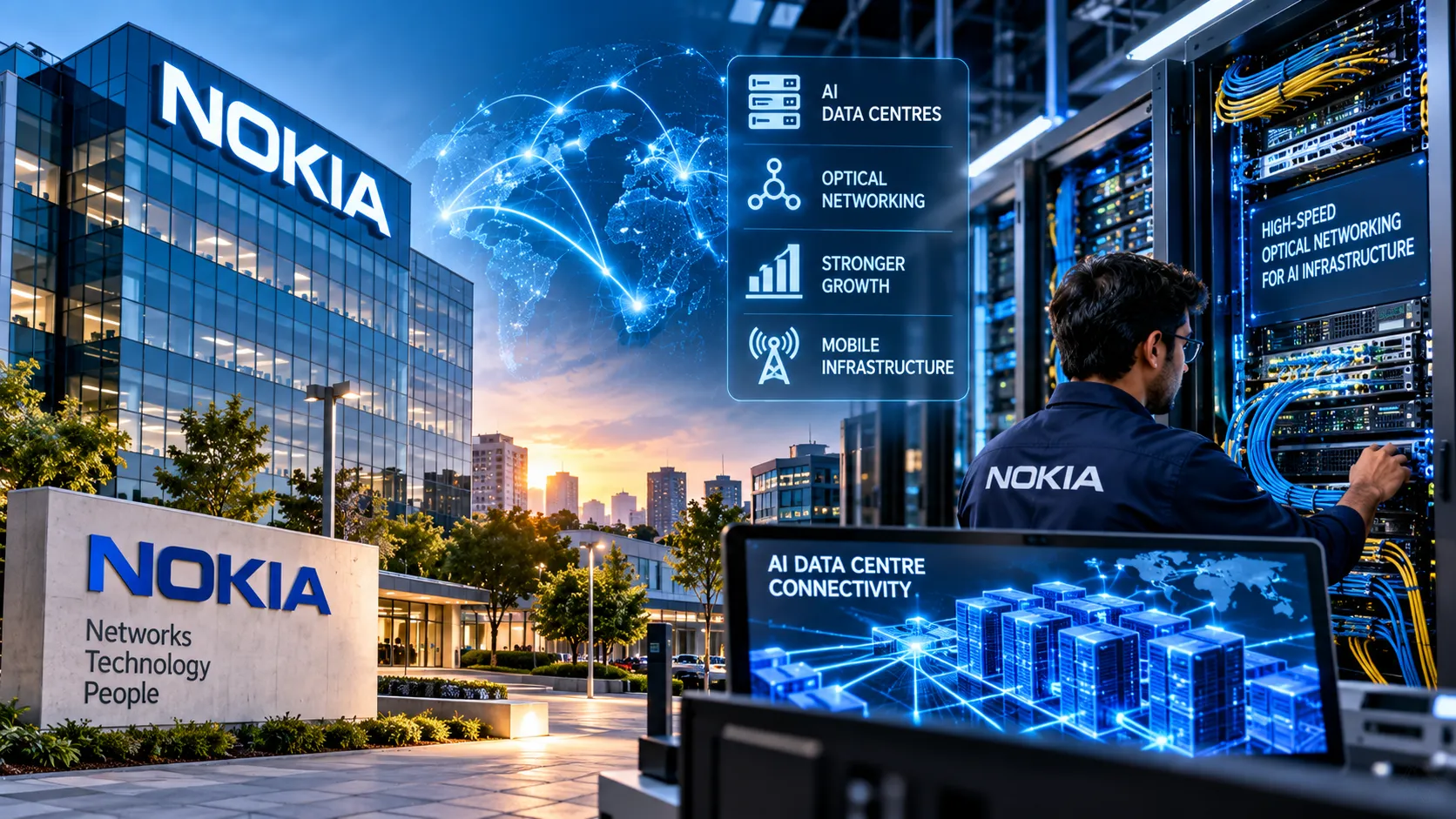
Under chief executive Justin Hotard, who took over last year, Nokia has repositioned itself to benefit from the AI boom. The centrepiece of that strategy was the acquisition of Infinera, a US maker of optical networking equipment, which gave Nokia a stronger position in the high-speed optical connections that link data centres and the servers within them.
AI data centres require enormous bandwidth to move data between thousands of chips working together on training and running models. That has created strong demand for optical transceivers, switches and routers, the kinds of equipment Nokia now supplies.
Nokia said Infinera would be fully integrated by the end of 2026 and is expected to deliver €200 million in cost synergies. It expects its optical and IP networking business could grow as much as 30% in 2027. A second facility in San Jose, California, for optical network equipment is expected to be fully operational by the end of October.
Supply chain constraints
Hotard pointed to supply shortages as a factor shaping the market. "I do believe we're seeing customers become more diligent about recognising supply shortages," he said. He noted constraints in "other parts of the semiconductor supply chain," as demand from AI infrastructure has strained the availability of components.
Shortages of memory chips, optical components and other parts have affected many companies building AI infrastructure. For equipment makers, constraints can delay deliveries but also strengthen pricing, as customers seek to secure supplies.
Working with Nvidia
Nokia is also working with Nvidia on mobile network equipment that uses Nvidia's advanced chips. The collaboration is part of a broader push to bring AI capabilities into telecom networks, allowing operators to run AI workloads at the edge of their networks and improve network efficiency.
AI-native radio access networks are seen as a potential way for telecom operators to generate new revenue from their infrastructure, though commercial adoption is at an early stage.
A tough telecom market
Nokia's traditional business of selling mobile network equipment to telecom operators has faced challenges. Operators have slowed spending after the initial 5G rollout in many markets, and competition with Ericsson, Huawei, ZTE and Samsung remains intense. Equipment makers have responded by cutting costs and seeking growth in adjacent markets.
The better-than-expected mobile infrastructure sales in the quarter suggest some stabilisation, but the AI-driven optical and networking business is increasingly the growth engine.
What it means for India
India is an important market for Nokia. The company has long supplied network equipment to Indian telecom operators, including Bharti Airtel, Reliance Jio and Vodafone Idea, and operates a major manufacturing facility near Chennai, which produces equipment for India and export markets. It also has large research and development operations in India.
India's own data centre boom adds to the opportunity. CBRE estimates that India's data centre sector has attracted $173 billion in investment since 2021, driven by cloud adoption, data localisation and AI. The growth of AI data centres in India could create demand for the optical and networking equipment that Nokia supplies.
Europe's AI beneficiaries
Nokia is one of several European companies that investors view as beneficiaries of the AI infrastructure boom. Others include chip equipment maker ASML, power and electrical equipment makers such as Schneider Electric and Siemens Energy, and cooling and data centre infrastructure suppliers. Their share prices have been sensitive to shifts in sentiment about AI spending.
The decline in a UBS basket of European AI beneficiaries on Thursday reflected broader market weakness, as rising oil prices and geopolitical tensions weighed on equities globally. Despite strong results, companies tied to the AI theme have been volatile as investors weigh the durability of demand.
Nokia's transformation
Nokia's history is one of repeated reinvention. Founded in 1865 as a paper mill, it became a conglomerate before rising to dominate the global mobile phone market in the 2000s. After losing that position to Apple and Android smartphone makers, it sold its handset business to Microsoft in 2014 and refocused on network equipment, acquiring Alcatel-Lucent in 2016.
The shift towards AI data centre networking represents another strategic pivot, as the company seeks growth beyond the cyclical telecom equipment market.
What comes next
Investors will watch Nokia's progress in integrating Infinera, the growth of its optical business and the trajectory of telecom spending. The restructuring charges, while larger than expected, are part of a plan to focus the company on higher-growth areas.
For the broader technology industry, Nokia's results add to evidence that demand for AI infrastructure remains strong, even as investors question whether the spending boom can be sustained. For India, Nokia's growing focus on optical and data centre networking aligns with the country's own expansion of digital infrastructure. As Indian telecom operators upgrade networks and data centre operators build capacity, equipment suppliers with strong positions in both telecom and data centre networking could benefit. Nokia's Chennai manufacturing base positions it to serve that demand locally. Investors will also look for updates on the Nvidia collaboration and on telecom operators' spending plans, which together will shape whether Nokia can sustain its improving momentum into 2027.