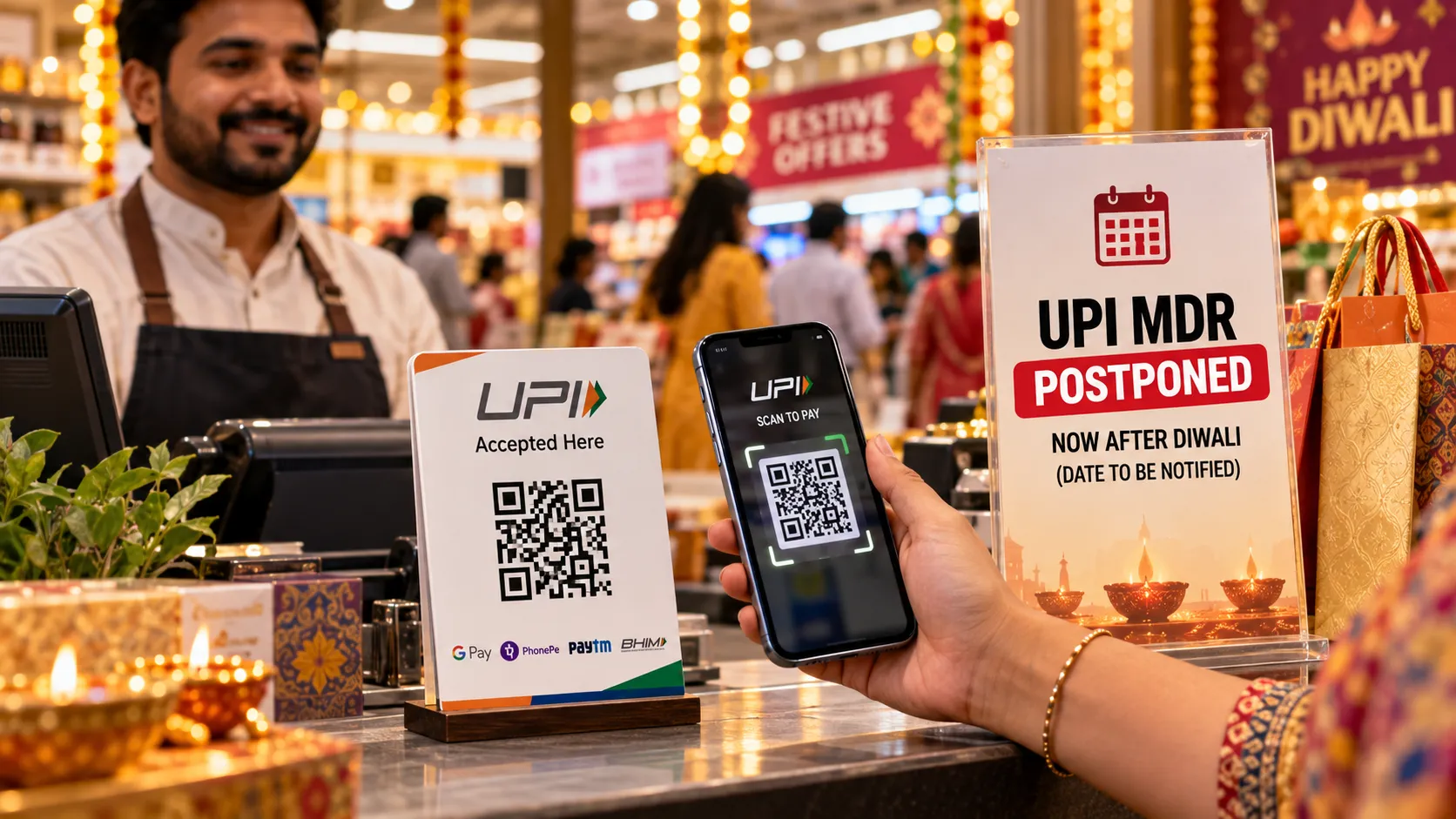
India's merchants have won a reprieve. The National Payments Corporation of India (NPCI) has postponed the introduction of a merchant discount rate (MDR) on select Unified Payments Interface transactions. The fee was due to take effect on October 15 and has now been pushed back until after Diwali.
NPCI's UPI and Services Steering Committee said the MDR on select person-to-merchant (P2M) transactions "shall be implemented immediately post Diwali on a date to be notified separately." The decision was reported on October 13. NPCI cited the festive season as the reason and did not set a new date.
The move defuses, at least for now, one of the most contentious changes to India's flagship digital payments system since it launched in 2016. It also leaves the payments industry facing continued uncertainty over when, and in what form, the long-debated fee will finally arrive.
What was due to change
Under a circular issued on September 15, NPCI set out a new pricing framework for UPI. Merchants would pay an MDR of 0.4% on P2M transactions above ₹2,000, capped at ₹300 for transactions of ₹75,000 or more. Consumers would not be charged. Person-to-person transfers and most everyday merchant payments below the ₹2,000 threshold would remain free.
The framework included separate rates for specific categories. Payments for essential services such as railways, telecom, fuel and insurance would carry a flat fee of ₹5 per transaction above ₹2,000. Capital-markets payments, including mutual fund and stockbroking transactions, would attract 0.02%, capped at ₹300.
NPCI also specified how the revenue would be shared across the payments chain: 40% to the customer's bank, 30% to payment gateways, 20% to the UPI app and 10% to the app's sponsoring bank. The stated aim was to create a sustainable revenue model for the digital payments ecosystem, which has operated under a zero-MDR regime for UPI since 2020.
Why the fee sparked a backlash
The proposal ran into strong resistance from traders and opposition politicians. Retail associations argued that small businesses had been encouraged for years to adopt digital payments and should not now be penalised for doing so. Opposition parties described the levy as a tax and warned that merchants would pass the cost on to consumers through higher prices.
The timing made matters worse. The original October 15 start date fell at the beginning of India's peak festive shopping season, when a large share of purchases, from electronics to jewellery and household goods, exceed the ₹2,000 threshold. Traders warned that the fee would squeeze already thin margins during the most important sales period of the year.
Around 20 trade leaders met Finance Minister Nirmala Sitharaman on September 30 to raise their concerns. A planned protest under the banner of a "No UPI Day" was called off after that meeting. Industry bodies, fintech companies and payment firms also asked NPCI for more time to implement the new pricing structure, pointing to the operational complexity of applying different rates to different merchant categories.
The Confederation of All India Traders (CAIT) welcomed the deferral as "timely and pragmatic," saying the charges could have placed "an avoidable burden on merchants operating on thin margins."
The economics behind the debate
At the heart of the dispute is a question that has hung over UPI for years: who pays for the infrastructure behind hundreds of millions of daily transactions?
UPI has become one of the world's most successful real-time payment systems, processing an average of about 802 million transactions a day in September. Under the zero-MDR regime, banks and payment apps earn no direct fee on most of these transactions, even though they bear the cost of running the systems, managing fraud and handling customer complaints. The government has provided incentive payments to partly compensate the ecosystem, but participants have argued for years that these are insufficient as volumes keep rising.
Payment companies say a modest MDR on larger merchant transactions would fund investment in resilience, cybersecurity and innovation, and make the business of acquiring merchants commercially viable. NPCI has estimated that the proposed fee would apply to only about 4% of merchant transactions, leaving more than 95% of person-to-merchant payments outside its scope.
Critics counter that UPI's near-universal adoption depends precisely on its being free, and that introducing fees risks pushing some merchants back to cash, especially in smaller towns, where margins are thin and digital adoption is more recent.
A system that has outgrown its funding model
The debate over fees is unfolding as UPI's ambitions grow. The system has expanded overseas through arrangements that allow UPI payments in countries including the United Arab Emirates, Singapore and France, and NPCI's international arm has pursued further partnerships to support Indian travellers and remittances. At home, UPI is being extended to credit lines and credit cards linked to the network, products that typically carry fees elsewhere.
The market is also highly concentrated. Two apps, PhonePe and Google Pay, handle the large majority of UPI transactions, and NPCI has repeatedly postponed a proposed cap on any single app's share of volumes. A sustainable revenue model could help smaller apps and banks compete, one of the arguments made by supporters of a merchant fee.
What the deferral means
For merchants, the immediate effect is clear: no MDR on UPI payments through the festive season. Consumers will see no change at checkout, as the fee was never meant to be charged to them directly.
For banks, payment gateways and UPI apps, the deferral delays a revenue stream many had begun to factor into their plans. The decision leaves the framework intact, however, suggesting the fee is postponed rather than abandoned. Earlier reports had indicated that a start date of January 1, 2027 was under consideration, along with a possible exemption for small businesses with annual turnover of up to ₹40 lakh, but NPCI has not confirmed either.
The episode highlights the political sensitivity of pricing changes to a public digital infrastructure that hundreds of millions of Indians now treat as a basic utility. Any eventual rollout is likely to come with careful communication, and possibly further carve-outs for small merchants, to avoid reigniting the backlash.
For now, India's festive shoppers and the shopkeepers who serve them can continue to tap and scan as before. The harder conversation about how to fund the system that makes those payments possible has been postponed, not settled.