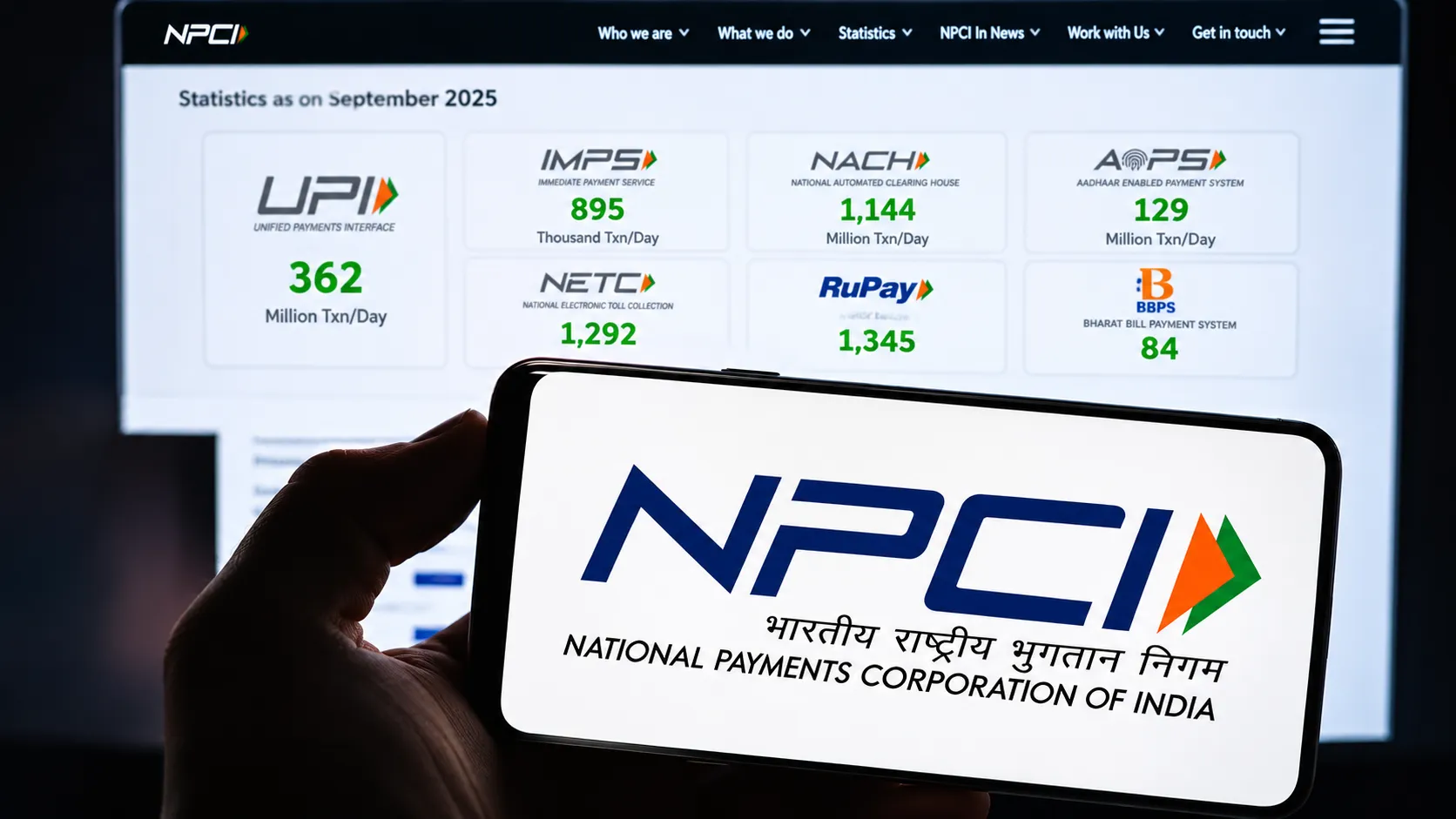
The National Payments Corporation of India (NPCI), the organisation behind the Unified Payments Interface (UPI), has set up a new wholly owned subsidiary focused on artificial intelligence, blockchain and the technology that underpins digital financial services.
The new company, NPCI Tech Solutions Ltd (NTSL), was announced on Wednesday, November 4. It will focus on developing AI-led solutions, blockchain applications and digital financial infrastructure. It will also provide global capability centre (GCC) services.
NPCI's chief technology officer, Vishal Kanvaty, has been appointed managing director and chief executive of the new entity. NPCI did not disclose the size of its investment in NTSL.
NPCI's fourth subsidiary
NTSL is NPCI's fourth subsidiary. The organisation already runs NPCI International Payments Ltd (NIPL), which takes UPI and RuPay to overseas markets; NPCI Bharat BillPay Ltd (NBBL), which operates the Bharat BillPay bill payments system; and NPCI BHIM Services Ltd (NBSL), which runs the BHIM payments app.
Each subsidiary allows NPCI to focus on a specific area with its own management team, governance and business model. The creation of a technology-focused subsidiary suggests NPCI wants to separate its work on emerging technologies from the day-to-day operation of India's core payment systems.
That separation could be important. UPI, which handles billions of transactions a month, is critical national infrastructure. Its reliability and security take priority over experimentation. A separate subsidiary gives NPCI room to develop and test new technologies without risking disruption to the systems that hundreds of millions of Indians rely on every day.
Why AI and blockchain
NPCI's managing director and chief executive, Dilip Asbe, framed the move as a response to rapid technological change. "Advancements in AI and other emerging technologies are creating new possibilities across digital infrastructure and financial services," he said.
AI has several potential applications in payments. It can improve fraud detection by spotting unusual transaction patterns in real time. It can help banks and payment apps handle customer queries, resolve disputes and manage risk. It can also support new services, such as conversational payments, where users initiate transactions through voice or chat interfaces.
Blockchain and distributed ledger technology offer other possibilities, including tokenised assets, programmable money and more efficient cross-border settlement. India's central bank, the Reserve Bank of India, has been piloting a digital rupee, and blockchain-based infrastructure could support a range of applications in that ecosystem.
The role of Global Capability Centres
NTSL's mandate to provide GCC services is notable. Global capability centres are offshore units that multinational companies set up, often in India, to handle technology, operations and research.
India has become the world's largest hub for GCCs, with thousands of centres employing more than a million people. By offering GCC-style services, NTSL could provide technology development and support for financial institutions, possibly including those in countries adopting UPI-style systems.
This fits with NPCI's international ambitions. Through NIPL, NPCI has been promoting UPI in other countries, and several have adopted or are working on systems based on India's model. A technology services arm could help support those deployments, offering expertise in building and operating real-time payment systems.
A leader from within
The appointment of Vishal Kanvaty as head of NTSL brings continuity. As NPCI's CTO, Kanvaty has been closely involved in the development and scaling of the organisation's systems, including UPI's growth to handling a substantial share of the world's real-time digital payments.


