StartupsLatest5 MIN READ

NuSynth Raises ₹36.5 Crore Seed Round to Rewrite How India Makes Complex Chemicals Using AI

Bengaluru-based NuSynth Technologies, founded this year, has raised ₹36.5 crore in a seed round co-led by Avaana Capital and Shastra VC to pair AI-driven predictive synthesis with chemical R&D, starting with pharmaceutical and electronics chemicals.

By Nisha Omkumar · Author14 October 2026New
NuSynth Raises ₹36.5 Crore Seed Round to Rewrite How India Makes Complex Chemicals Using AI

NuSynth Technologies, a Bengaluru-based speciality chemicals startup founded this year, has raised ₹36.5 crore (about $4 million) in a seed round co-led by Avaana Capital and Shastra VC.

The startup, which announced the funding on October 13, is trying to change how complex chemicals are made. Rather than adopting the long, multi-step synthesis routes the industry has used for decades, NuSynth combines laboratory research with AI tools to design alternative processes. It says these can be cheaper, safer and less dependent on imported inputs.

NuSynth was founded by Poorvank Purohit, Ramesha A R, Abhishek Deo and Dipak Bajaj. It plans to use the money to strengthen its R&D and technology capabilities, build an initial portfolio of proprietary chemical processes, develop scale-up capabilities and expand its team.

The problem with how chemicals are made

Many of the speciality chemicals that go into medicines, semiconductors and electronics are produced through elaborate synthesis routes involving numerous reaction steps. Each step adds cost, time, energy use and waste. Many processes rely on hazardous reagents, high temperatures or large volumes of solvents, which raise safety risks and environmental compliance costs.

For India, there is an additional strategic dimension. Despite being one of the world's largest producers of generic medicines, the country depends heavily on imported intermediates and key starting materials for its pharmaceutical and chemical industries, a large share of them from China. Supply disruptions in recent years have exposed how vulnerable that dependence makes Indian manufacturers, and policymakers have since pushed hard for domestic alternatives.

NuSynth says it is targeting four specific pain points: complex multi-step synthesis, high material and energy costs, dependence on imported intermediates, and the use of hazardous reagents.

How the technology works

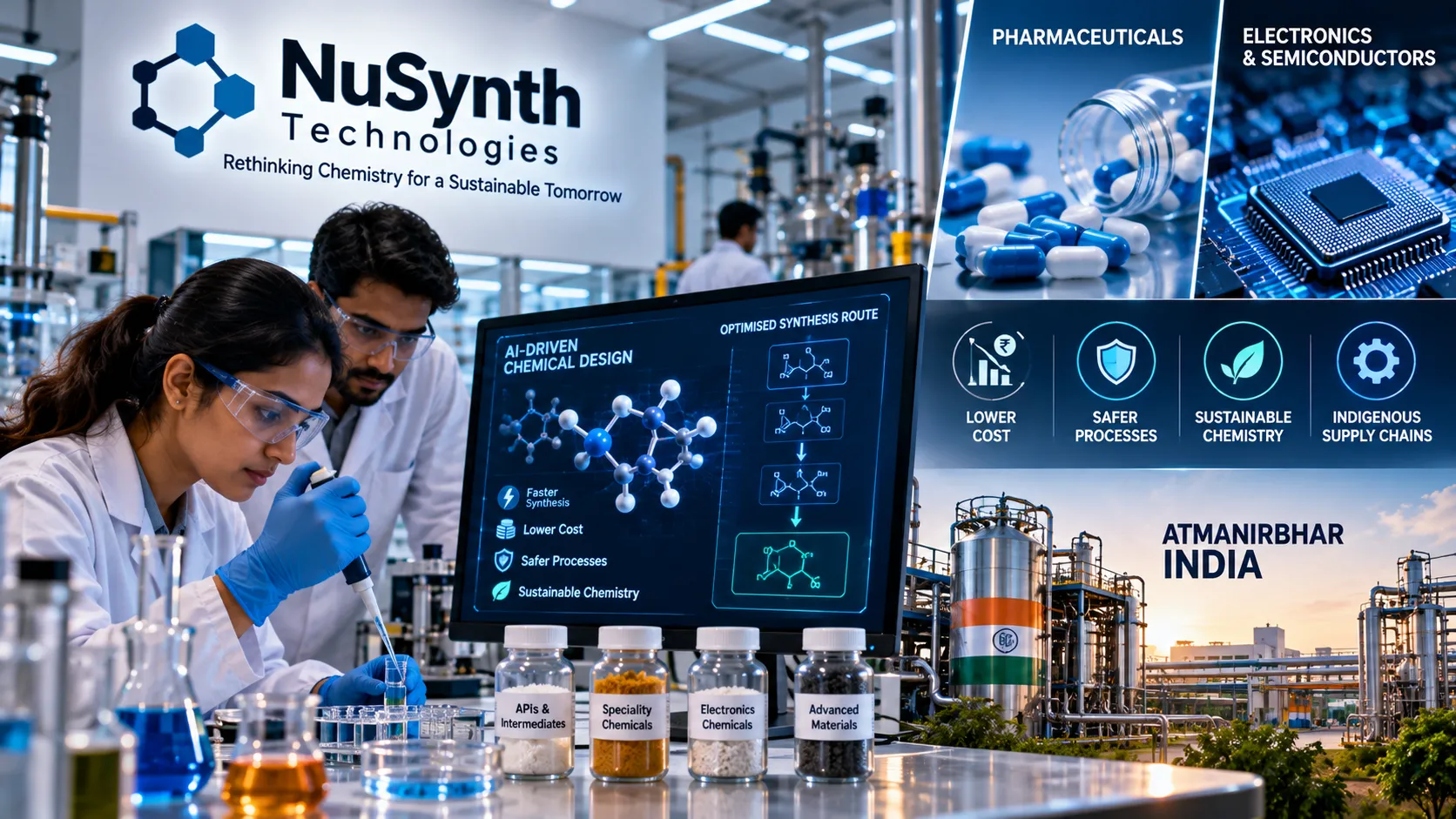
At the core of NuSynth's approach is an R&D platform that pairs predictive synthesis models with an AI-enabled engine. Each research cycle generates experimental data, and the engine turns that data into a proprietary knowledge base. In principle, that makes the company's chemists faster and more accurate with every project.

According to Avaana Capital, NuSynth's processes are designed to reduce the number of reaction steps, eliminate hazardous reagents, lower temperature requirements, and replace solvent-intensive processes with catalytic and water-based alternatives. Each of those changes can cut costs and environmental impact at the same time. That combination is particularly attractive in an industry facing tighter pollution regulation and pressure from global customers to decarbonise their supply chains.

Co-founder Poorvank Purohit described the company's philosophy as "going back to first principles – questioning established routes, redesigning processes." He has said the team engineers processes for commercial scale from day one, rather than treating scale-up as an afterthought, and aims to build proprietary process technology out of India for customers around the world.
454922c9-86f0-421e-9212-5b216c27c598.png

Why pharma and electronics first

NuSynth's choice of initial markets reflects two of India's most important industrial priorities. In pharmaceuticals, the government launched a production-linked incentive scheme in 2020 to encourage domestic manufacturing of key starting materials, drug intermediates and active pharmaceutical ingredients, precisely because of the country's reliance on imports for these inputs. Companies that can make such chemicals more cheaply and cleanly in India are well placed to benefit.


“Going back to first principles – questioning established routes, redesigning processes.”
— Poorvank Purohit, Co-founder, NuSynth Technologies

In electronics, the push to build a domestic semiconductor industry under the India Semiconductor Mission is creating demand for ultra-high-purity speciality chemicals used in chip fabrication and assembly. With fabrication and packaging plants under construction in states such as Gujarat and Assam, a reliable local supply of electronics-grade chemicals is becoming a strategic requirement rather than a commercial nicety.

An asset-light route to market

NuSynth does not plan to build its own large factories, at least not initially. It intends to operate an asset-light model, partnering with Indian contract manufacturers to move processes from the laboratory to industrial-scale production.

This approach has become common among a new generation of Indian chemical technology startups, which see value in owning the intellectual property and process know-how while using existing manufacturing capacity. The company's initial focus will be on pharmaceutical and electronics chemicals, two segments where purity requirements are high, margins are attractive and customers are actively seeking alternatives to concentrated supply chains.

The model also keeps capital requirements manageable at the seed stage. Instead of spending heavily on plants, NuSynth can direct its funding towards research, talent and the pilot-scale work needed to prove that its processes perform reliably at volume.

The investors and the deeptech moment

Avaana Capital is a climate and sustainability-focused venture firm that has backed several companies working on cleaner industrial processes. Shastra VC is an early-stage fund that invests in technical founders building deep technology products. Their joint lead reflects a growing appetite among Indian investors for startups that apply AI to physical industries rather than consumer software.

The broader data support that trend. Indian deeptech startups raised about $290 million across 28 deals in the July–September quarter of 2026, up 176% from $105 million across 29 deals a year earlier. Overall startup funding grew only about 5% to $2.2 billion over the same period. In other words, deeptech has captured a rising share of a market that is otherwise growing slowly.

NuSynth enters a space that is starting to draw attention. Other Indian startups combining R&D with manufacturing partnerships include Scimplify, Mstack and Distil, though each has a distinct focus. Competition for chemistry talent and for capacity at the best contract manufacturers is likely to intensify as more capital arrives.

What to watch

For a company founded only this year, the real test lies ahead. Investors and customers will want to see whether NuSynth's AI-driven processes deliver the promised reductions in steps, cost and hazard when run at commercial scale, and whether the resulting products meet the stringent quality standards of global pharmaceutical and electronics buyers.

Speciality chemicals is an industry that rewards patience. Customer qualification can take months or years, especially in regulated sectors such as pharmaceuticals. But the opportunity is substantial. Global companies are diversifying their chemical supply chains, India is pushing to become a more self-reliant manufacturing base, and AI tools are making it possible to explore chemical design space far faster than traditional trial-and-error methods allow.

If NuSynth can show that a small team using AI can redesign established chemical routes more efficiently than incumbents, it could help reposition India from a low-cost producer of molecules invented elsewhere into a source of process innovation in its own right.

TagsNuSynth TechnologiesAvaana CapitalShastra VCseed fundingspeciality chemicalsAIdeeptechchemical R&Dgreen chemistrypharmaceuticalselectronics chemicalsBengalurustartup fundingIndiamanufacturingsupply chainimport substitutioncatalysisstartupsclimate tech

Reader reviews

Sign in to rate and review this article.
Loading reviews…
