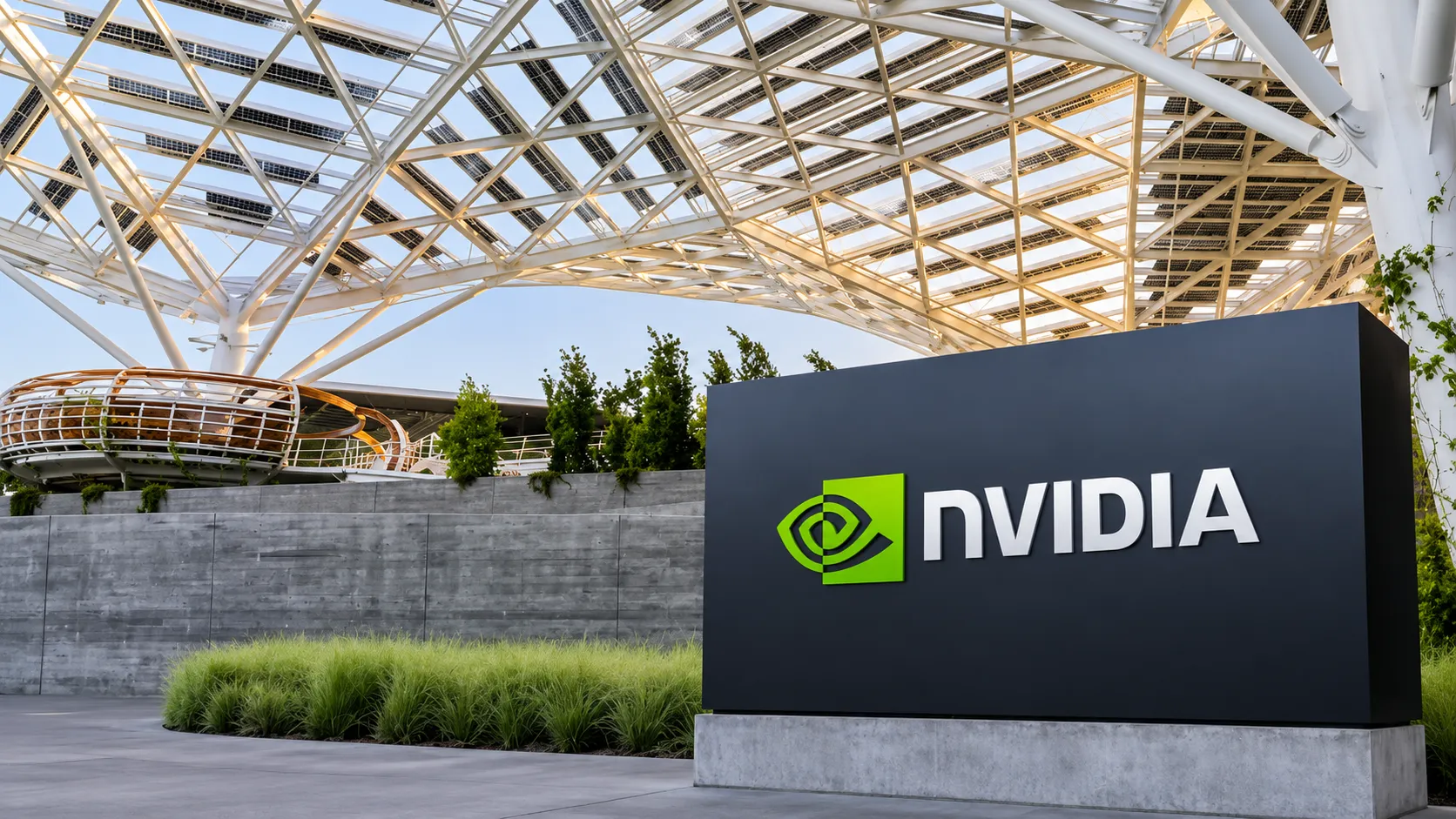
Nvidia is deepening its financial ties to Europe's artificial intelligence industry, unveiling planned investments in four French companies as chief executive Jensen Huang promised a fresh wave of deals across the continent.
Speaking in Paris on 13 October, Huang said Nvidia would announce $2 billion in new European AI deals within a week, on top of the $8 billion the company says it has invested in Europe over the past year. Nvidia now puts its total European commitment at nearly $10 billion, though it has not separated equity investments from infrastructure spending.
The first four companies named were Doctolib, Genesis AI, Pigment and Entalpic. Nvidia described them as planned investments in which it will take minority stakes. It has not disclosed the size of any of the investments, according to Tech Funding News.
Four Very Different Bets
The four companies span healthcare, robotics, enterprise software and materials science, reflecting how broadly Nvidia is spreading its bets across the AI economy.
Doctolib, founded in 2013 by Stanislas Niox-Chateau, is one of Europe's best-known health technology companies. It says 100 million patients and 580,000 health professionals use its services. Doctolib has been using Nvidia technology for a year, and the investment will fund AI hiring and give it access to Nvidia's experts for training models in Europe. The company said it will build on open models and keep health data in the EU and UK under its sole control.
Genesis AI, based in Paris and Palo Alto, is a robotics startup that emerged from stealth in July 2025 with a $105 million seed round co-led by Eclipse Ventures and Khosla Ventures. It was founded by Zhou Xian, a robotics PhD from Carnegie Mellon University, and Théophile Gervet, a former Mistral researcher. Bloomberg reported in July that Genesis was in talks to raise about $500 million at a $3 billion pre-money valuation; the company has not confirmed those discussions.
Pigment, founded in 2019 by Eléonore Crespo and Criteo co-founder Romain Niccoli, makes business planning software. It raised a $145 million Series D in April 2024 led by ICONIQ Growth, and its customers have included Unilever, Merck and Klarna. Nvidia says Pigment helps companies forecast and model scenarios across finance, sales, workforce and operations.
Entalpic, founded in 2024 by Mathieu Galtier, an Owkin alumnus, with Mila researchers Victor Schmidt and Alexandre Duval, uses AI to design advanced materials at the atomic scale. It raised an €8.5 million seed round in September 2024 from Breega, Cathay Innovation and Felicis. Nvidia highlighted its expertise in semiconductor manufacturing and next-generation electronics.

An Investor That Is Also the Supplier
Nvidia's role as an investor is inseparable from its role as the dominant supplier of AI computing hardware. Each of the four companies is also a customer for Nvidia's chips, and AFP reported that Doctolib's models will run on Nvidia hardware.
That dual role has drawn scrutiny. A Forrester analyst, quoted by French technology site Clubic, argued that such stakes keep partners tuned to Nvidia's architecture and make a later switch to rival chipmakers such as AMD more costly. Counterpoint Research has found that 92 per cent of sovereign large language models across more than 80 countries outside the United States and China use Nvidia chips.
For the startups, the benefits are tangible: capital, technical support and privileged access to scarce computing resources. For Nvidia, the investments help cultivate an ecosystem that reinforces demand for its products. Whether that relationship ultimately limits the startups' flexibility on costs and suppliers is one of the open questions raised by the deals.
Nvidia's Growing European Footprint
The new investments build on Nvidia's existing presence in European AI. The company is a backer of Mistral, France's flagship AI model developer, which raised a €3 billion Series D at a valuation above €21 billion on 8 September. Samsung Electronics led that round, with Nvidia participating.
In the UK, Nvidia has made a compute donation valued at $250 million over five years to support AI safety and security research.
The company's European strategy dovetails with a growing political push for "sovereign AI": the idea that countries and regions should have their own AI models, data centres and computing capacity rather than relying entirely on American or Chinese providers. Nvidia has embraced the concept, positioning itself as a partner to governments and companies that want to build domestic AI capabilities, while ensuring those capabilities run on its hardware.
Closing Europe's Funding Gap
The investments also highlight how far Europe lags the United States in AI funding. According to the OECD, AI companies attracted $258.7 billion, or 61 per cent, of global venture capital in 2025. US-based AI firms drew about $194 billion, roughly 75 per cent of that total and about 12 times the $15.8 billion, or 6 per cent, that went to companies based in the European Union.
European policymakers have been trying to close that gap. France's finance ministry said in June that it had raised another €13 billion in institutional capital for technology. Strategic investors such as Nvidia can help by bringing both money and credibility to European startups competing for talent and customers against well-funded American rivals.
The pattern is not unique to Europe. Nvidia has built a sprawling portfolio of stakes in AI companies worldwide, from model developers to cloud providers that rent out its chips, and governments from the Middle East to Asia, including India, have courted the company as they plan national AI computing capacity. For policymakers pursuing technological independence, that creates a paradox: the fastest route to sovereign AI capability often runs through a single American supplier. Europe's response to that tension will shape not only its startups but the region's broader industrial strategy.
What Comes Next
Nvidia's promise of $2 billion in new European deals within a week suggests that the four French investments are only the start. Investors and policymakers will be watching to see which countries and sectors the remaining deals target, and whether they lean towards equity stakes in startups or towards data centres and infrastructure.
For European AI founders, the message is clear: the world's most valuable chipmaker is actively looking for partners on the continent. The harder question, as Tech Funding News noted, is whether European startups can build on Nvidia's chips and capital without ceding control of their economics to the company that supplies both.
With none of the stakes priced publicly, the full scale of Nvidia's influence over Europe's AI ecosystem remains difficult to measure. What is clear is that Huang intends Nvidia to be at the centre of it.