TechArtificial Intelligence5 MIN READ

Nvidia Posts $115.8 Billion in Revenue and Guides to $130 Billion in Its First Quarter Without Jensen Huang, Saying Demand Far Exceeds Supply

Nvidia reported third-quarter revenue of $115.8 billion on November 17, up 103% year on year, with data centre revenue of $107.6 billion, and guided to $130 billion for the fourth quarter. Interim CEO Colette Kress said Vera Rubin was off to an "explosive start" and that demand far exceeds supply, while the board said it would take its time choosing a permanent chief executive.

By Aravind Kumar · Author19 November 2026New
Nvidia Posts $115.8 Billion in Revenue and Guides to $130 Billion in Its First Quarter Without Jensen Huang, Saying Demand Far Exceeds Supply

The man who built Nvidia was gone, but the numbers he left behind kept growing.

Nvidia reported revenue of $115.8 billion for its third quarter of fiscal 2027, ended October 25, up 103% from a year earlier and 20% from the previous quarter, according to the company's results release filed with the US Securities and Exchange Commission on Tuesday, November 17. It was Nvidia's first quarterly report since co-founder Jensen Huang stepped down as chief executive.

Data centre revenue, which includes the AI chips that power most of the world's large AI models, reached $107.6 billion, up 110% year on year and 21% quarter on quarter. GAAP net income was $65.3 billion, and diluted earnings per share were $2.70 on a GAAP basis and $2.68 on an adjusted basis, beating analysts' forecast of about $2.47.

A $130 billion forecast

Nvidia guided to fourth-quarter revenue of $130 billion, plus or minus 3%, according to the release. The quarter includes an extra week, and the forecast assumes no data centre compute revenue from China.

The company raised its expectation for revenue growth in fiscal 2028 to about 75%, from about 70%, according to the earnings call transcript published by Investing.com.

"Vera Rubin is off to an explosive start, our roadmap is on track and our ambition has never been greater," said Colette Kress, who is serving as interim chief executive while remaining chief financial officer.

Demand still outstrips supply

On the earnings call, Kress said, "Demand far exceeds supply," citing demand from hyperscale cloud providers, frontier AI labs, specialist cloud providers known as neoclouds, enterprises and governments. Revenue from hyperscalers reached about $60 billion, up 23% from the previous quarter.

Nvidia's purchase commitments rose to $390 billion as it secures components and manufacturing capacity, and the company announced new supply agreements with partners including Samsung Electro-Mechanics, Kinsus and SPIL, adding to earlier deals with Amkor, KYEC and Unimicron.

The Rubin ramp

Vera Rubin, Nvidia's newest AI platform, generated nearly $20 billion in its first quarter of production shipments, according to the call. Management said Rubin reached production in about one month, half the time it took Grace Blackwell. Partners deploying Vera Rubin NVL72 systems include CoreWeave, Google Cloud, Microsoft Azure, Oracle Cloud Infrastructure and Nebius.

Nvidia also said it had expanded collaborations with Meta and with Anthropic, which is gaining access to Grace Blackwell and Vera Rubin capacity through cloud providers. Vera Rubin Ultra is due next year, followed by the Feynman architecture in 2028.

Margins near the bottom

Gross margin was 74.8% on a GAAP basis. Nvidia guided to a fourth-quarter gross margin of 71% to 72%, which management described as the bottom, reflecting higher memory costs. Margins are expected to recover to 72% to 73% in fiscal 2028.

China

Licensed sales of Hopper data centre chips to China were $2.4 billion in the third quarter, according to the call. Nvidia said its guidance excludes such sales and that it is no longer shipping them to China. Management said it was still studying new US Commerce Department export rules released during the week.

Returning cash

Nvidia returned $28.1 billion to shareholders in the quarter through buybacks and dividends. In September, the board added $150 billion to its repurchase authorisation, leaving about $227.3 billion available at quarter-end. The company will pay a quarterly dividend of $0.25 per share on December 23.
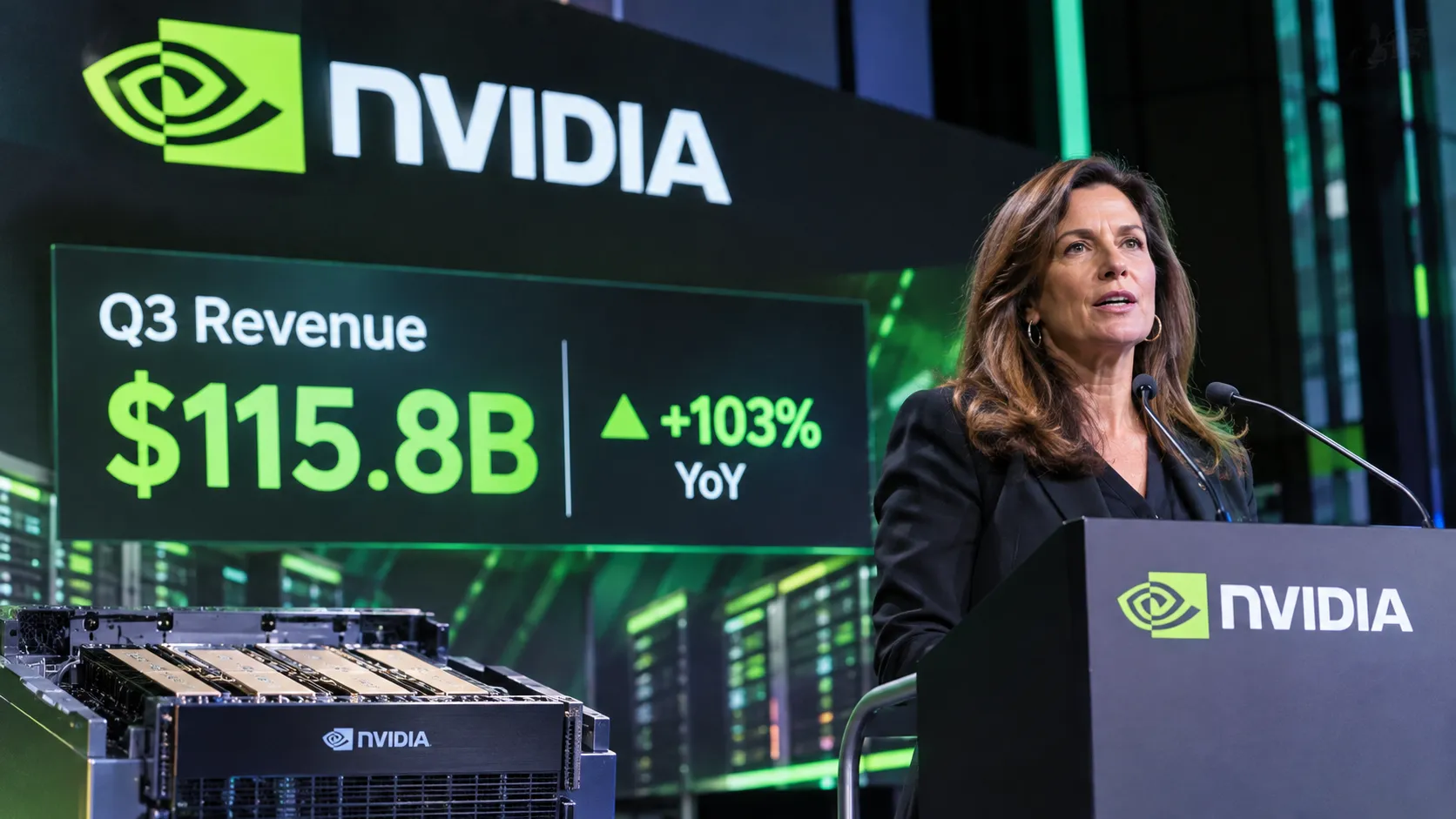

“Vera Rubin is off to an explosive start, our roadmap is on track and our ambition has never been greater.”
— Colette Kress, Interim CEO and CFO, Nvidia

The leadership question

The call was dominated by questions about leadership. Board chairman Harvey Jones said the board would not rush the search for a permanent chief executive: "we won't expedite the CEO before finding exactly the right person." According to TradingKey, Jones also said the board would not reinstate Huang and had hired a search firm.

Kress said the business was running as usual and that customers and suppliers were "100% up behind us."

2d86ea8d-983f-4402-af47-0f117731098f.png

Market reaction

Nvidia's shares rose about 4.6% in after-hours trading on Tuesday, according to Investing.com, but the gains faded. On Wednesday, the stock opened higher and then fell, closing down 2.89%, according to TradingKey. Shares of rival AMD rose 5.3% and Broadcom gained 3.7%.

The muted reaction reflected the uncertainty over leadership, concerns about margins and questions about whether the AI spending boom can continue at its current pace.

What it means for the AI industry

Nvidia's results are seen as a barometer for the AI industry. The scale of its growth, and its statement that demand exceeds supply, suggest that spending on AI infrastructure by technology companies and governments remains strong. That matters for chip suppliers, cloud providers, data centre developers and energy companies worldwide.

What it means for India

For India, Nvidia's growth has implications for its AI ambitions. Nvidia supplies chips to Indian data centre operators and cloud providers, supports the IndiaAI Mission and employs thousands of engineers in the country. Governments, including India's, are building sovereign AI capacity, a source of demand Kress highlighted.

Customer concentration

A large share of Nvidia's revenue comes from a relatively small number of hyperscale cloud providers and AI developers. This concentration means the company's growth depends heavily on the spending plans of a few customers. Several of these customers are also developing their own AI chips, which could reduce their reliance on Nvidia over time.

Nvidia has sought to broaden its customer base by targeting enterprises, specialist cloud providers and governments, which Kress highlighted on the call.

The software and networking advantage

Analysts often attribute Nvidia's dominance not only to its chips but to its CUDA software platform, which developers use to build AI applications, and its networking products, which connect thousands of chips in data centres. This combination makes it difficult for competitors to match Nvidia's full offering, even when their chips are competitive on performance or price.

Analysts noted that Nvidia's results also matter for its suppliers and partners, from memory makers such as SK Hynix, Samsung and Micron to packaging and substrate companies, many of which have seen their own businesses boom on the back of AI demand.

Some investors also raised questions about Nvidia's growing role in financing its customers, including guarantees for specialist cloud providers. Management said on the call that such terms were not new and that shareholder returns remain its top capital priority.

What comes next

Investors will watch the search for a permanent chief executive, the ramp-up of Vera Rubin, margin trends and the impact of new export rules. Nvidia's next report, for the fourth quarter, will show whether it can meet its $130 billion forecast.

TagsNvidiaQ3 resultsColette KressJensen HuangHarvey JonesVera RubinBlackwelldata centreAI chipsGPUsgross marginshare buybackhyperscalersChina export controlsHopperAnthropicMetaNasdaqAI stocksinvestors

Reader reviews

Sign in to rate and review this article.
Loading reviews…

