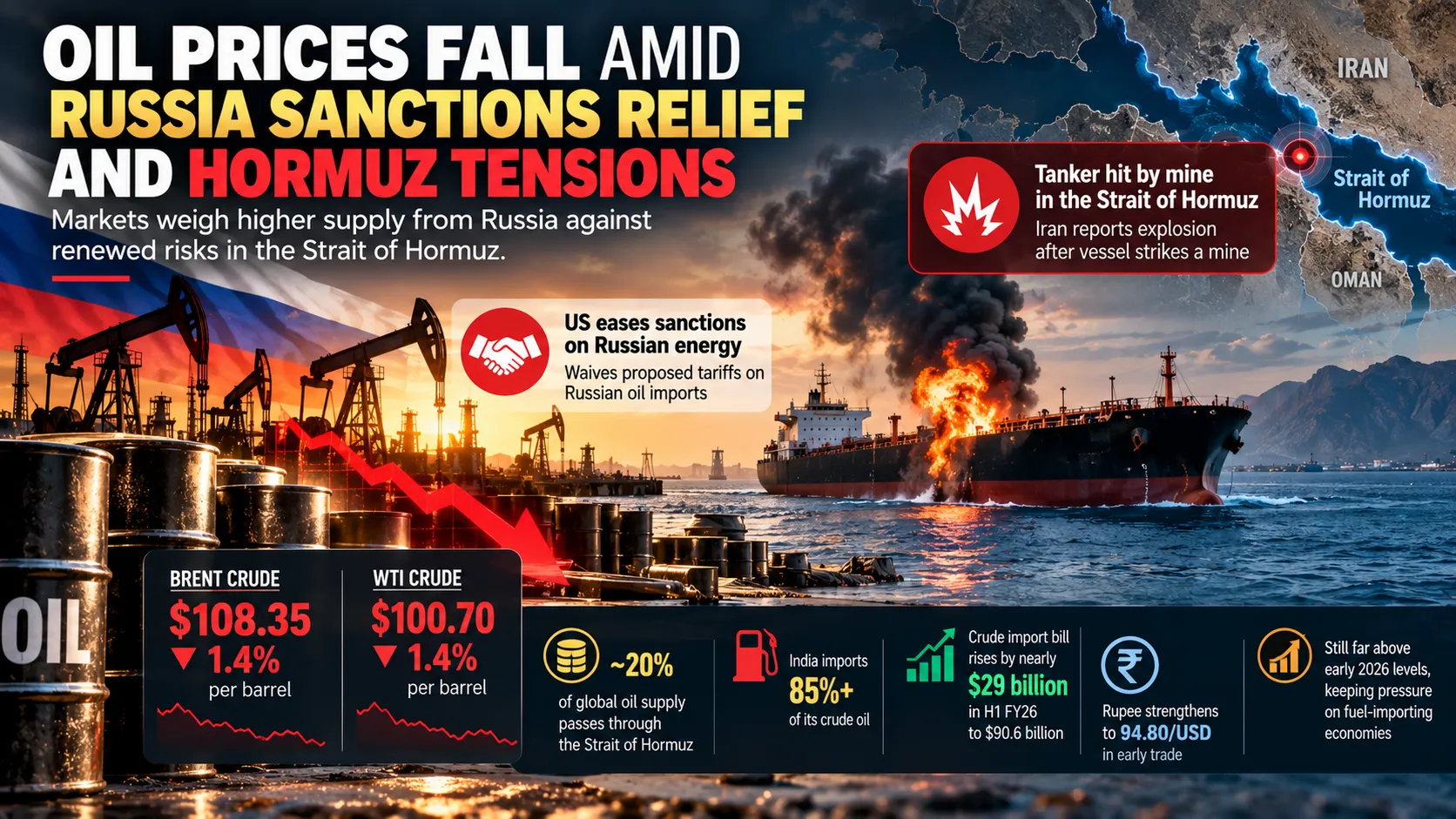
Oil prices fell at the start of the trading week as markets weighed two powerful and opposing forces: a decision by US President Donald Trump to ease sanctions on Russian energy, and a reported mine attack on an oil tanker in the Strait of Hormuz, the world's most important energy chokepoint.
Brent crude futures fell about 1.4% to $108.35 a barrel in early Asian trade on Monday, October 19, according to market reports, while US West Texas Intermediate slipped to around $100.70. Brent had risen nearly 5% the previous week on fears of supply disruptions in the Middle East. Even after Monday's decline, oil remains far above the levels of early 2026, keeping pressure on fuel-importing economies such as India.
The moves capped a dramatic weekend for energy markets, in which Washington loosened restrictions on one major supplier while tensions escalated around another critical supply route.
Trump's Russia waiver
On Friday evening, Trump signed an executive order suspending numerous sanctions on Russia just days before they were due to take effect. He also waived proposed tariffs on countries that import Russian oil, saying the move was in the US national interest.
The decision followed a diesel import agreement between the United States and Russia agreed the previous week, under which some Russian fuel will reach markets including Turkey. In a post on his Truth Social platform, Trump said the waiver would help keep Russia engaged in peace talks over the war in Ukraine. He also blamed Ukrainian drone attacks on Russian energy facilities for pushing up global fuel prices.
US Secretary of State Marco Rubio described the waiver as a temporary pause, saying it would give officials time to assess its impact on the global economy and trade. The move drew criticism from lawmakers in both of America's main parties, many of whom have pushed for tougher measures against Moscow. Ukraine said it would continue attacking Russian energy infrastructure and expressed concern about further agreements between Washington and Moscow.
Domestic politics are also a factor. Rising fuel prices have become a major issue for American households ahead of the US midterm elections, and the White House has been looking for ways to bring down petrol and diesel costs.
A mine strike in Hormuz
Pulling prices in the other direction was a reported attack in the Strait of Hormuz. On Sunday, Iranian media, citing the navy of Iran's Islamic Revolutionary Guard Corps, reported that an oil tanker caught fire and exploded after striking a naval mine in the southern part of the strait. The vessel was not named, and details of casualties were not available. The claim could not be independently verified.
The incident adds to a long series of disruptions in the region, where tensions between the United States and Iran have repeatedly threatened shipping. Roughly a fifth of the world's oil supply typically passes through the Strait of Hormuz, along with large volumes of liquefied natural gas from Qatar. Attacks on vessels there have sharply raised war-risk insurance premiums for shipowners this year and forced some operators to reroute or suspend voyages.
Elsewhere in the region, clashes between Saudi Arabia and Iran-backed Houthi forces in Yemen have raised concerns about disruption to Red Sea shipping and Gulf energy infrastructure. Riyadh's main airport only reopened on October 18 after closures linked to Houthi attacks.