Oil and Natural Gas Corporation, India's largest oil and gas producer, reported a sharp jump in quarterly profit as high global crude prices, driven by the conflict involving Iran, boosted the value of its output, even as production volumes edged lower.
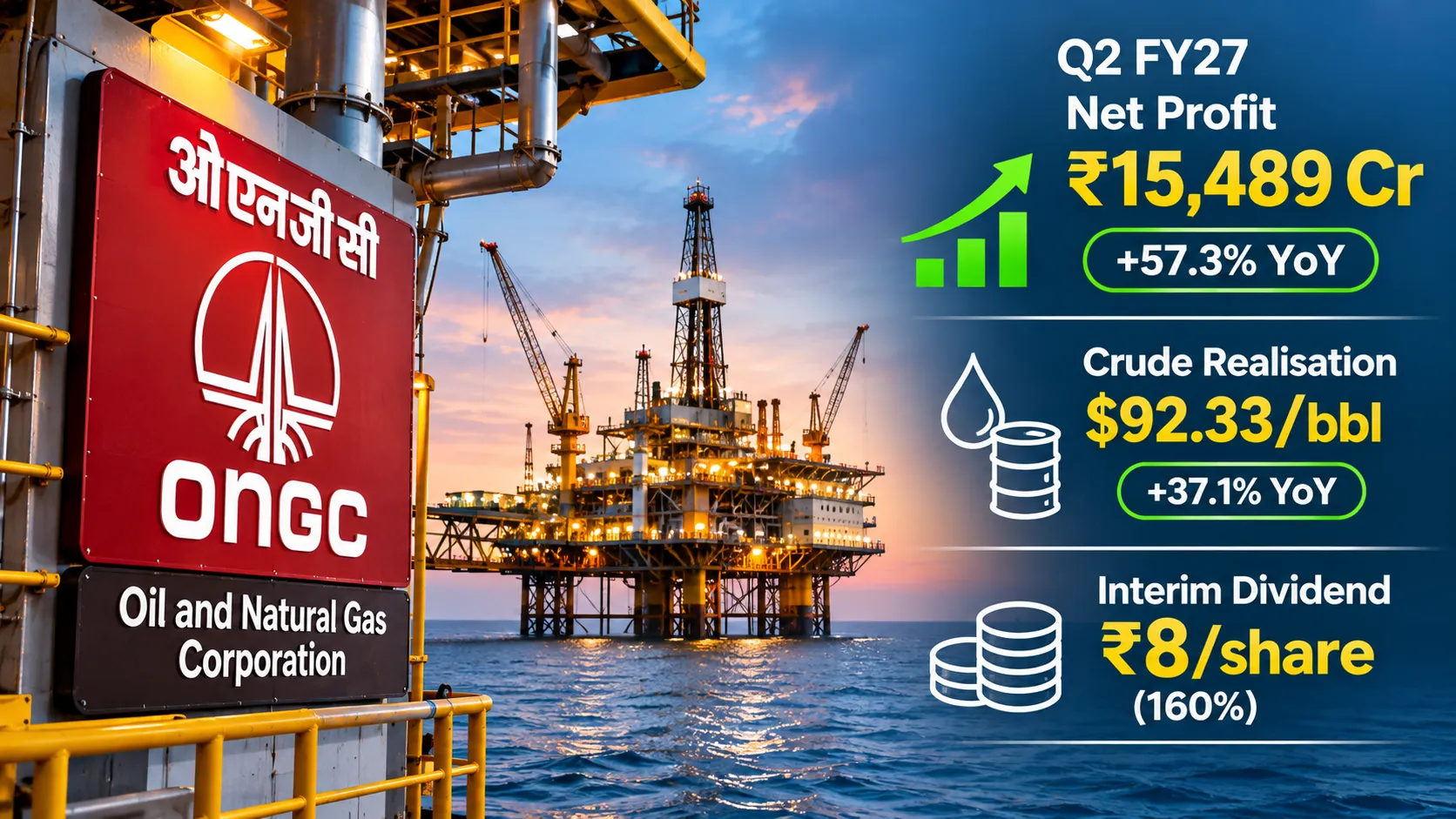
The state-owned company posted a standalone net profit of ₹15,489 crore for the July-September quarter, the second quarter of the 2026-27 financial year, up 57.3% from a year earlier, according to its results announced on Thursday, November 5, and reported by PSU Connect. Standalone gross revenue rose 32.8% to ₹43,875 crore.
For the first half of the financial year, ONGC's standalone net profit was ₹32,522 crore, up 82%, its highest ever for a first half, and gross revenue rose 38.9% to ₹90,336 crore.
On a consolidated basis, including subsidiaries such as Hindustan Petroleum and Mangalore Refinery and Petrochemicals, net profit rose 46.9% to ₹18,535 crore, and net profit attributable to owners rose 55.3% to ₹16,744 crore, on gross revenue of ₹1,98,263 crore.
A record dividend
ONGC's board declared an interim dividend of 160%, or ₹8 per share on a face value of ₹5, amounting to ₹10,064 crore, the company's highest ever in a single instalment, according to PSU Connect. The record date is November 12, 2026.
The government, which owns a majority stake in ONGC, will be the largest recipient of the dividend, providing a boost to public finances at a time when high oil prices are straining India's import bill.
Crude prices drive profits
The surge in profit was driven by much higher prices for ONGC's crude oil. The company realised $92.33 per barrel for crude from its nominated fields in the quarter, up 37.1% from a year earlier, according to PSU Connect. In rupee terms, the realisation rose 50.2% to ₹8,826 per barrel, reflecting both higher dollar prices and a weaker rupee. Crude from joint venture fields fetched $97.02 per barrel, up 41.9%.
Global oil prices have risen sharply this year because of the conflict involving Iran, which has disrupted supplies from the Middle East, including through the Strait of Hormuz, a critical route for global oil shipments.
Gas prices also rose. ONGC received $7.00 per million British thermal units for gas from its nominated fields, up 3.7%, under India's administered pricing formula, and $10.24 for gas from new wells, up 22.5%. Revenue from new well gas in the first half was ₹7,050 crore, more than 34% of the revenue from ONGC's nominated gas portfolio.
Production slips
Despite the higher profits, ONGC's production declined. Standalone crude oil output fell to 4.437 million tonnes in the quarter from 4.630 million tonnes a year earlier, and gas output fell to 4.839 billion cubic metres from 4.918, according to PSU Connect. Total standalone oil and gas output, excluding joint ventures, fell about 3% to 9.515 million tonnes of oil equivalent.
The company attributed the year-on-year decline to reservoir complexities at its KG-98/2 asset in the Krishna-Godavari basin, monsoon-related challenges, pipeline replacement delays and lower gas offtake by onshore consumers. "ONGC maintained broadly stable production during Q2FY'27," the company said, compared with the previous quarter.
Reversing the decline in output from ageing fields has been a long-standing challenge for ONGC, and a key priority for India, which imports more than 85% of its crude oil needs.