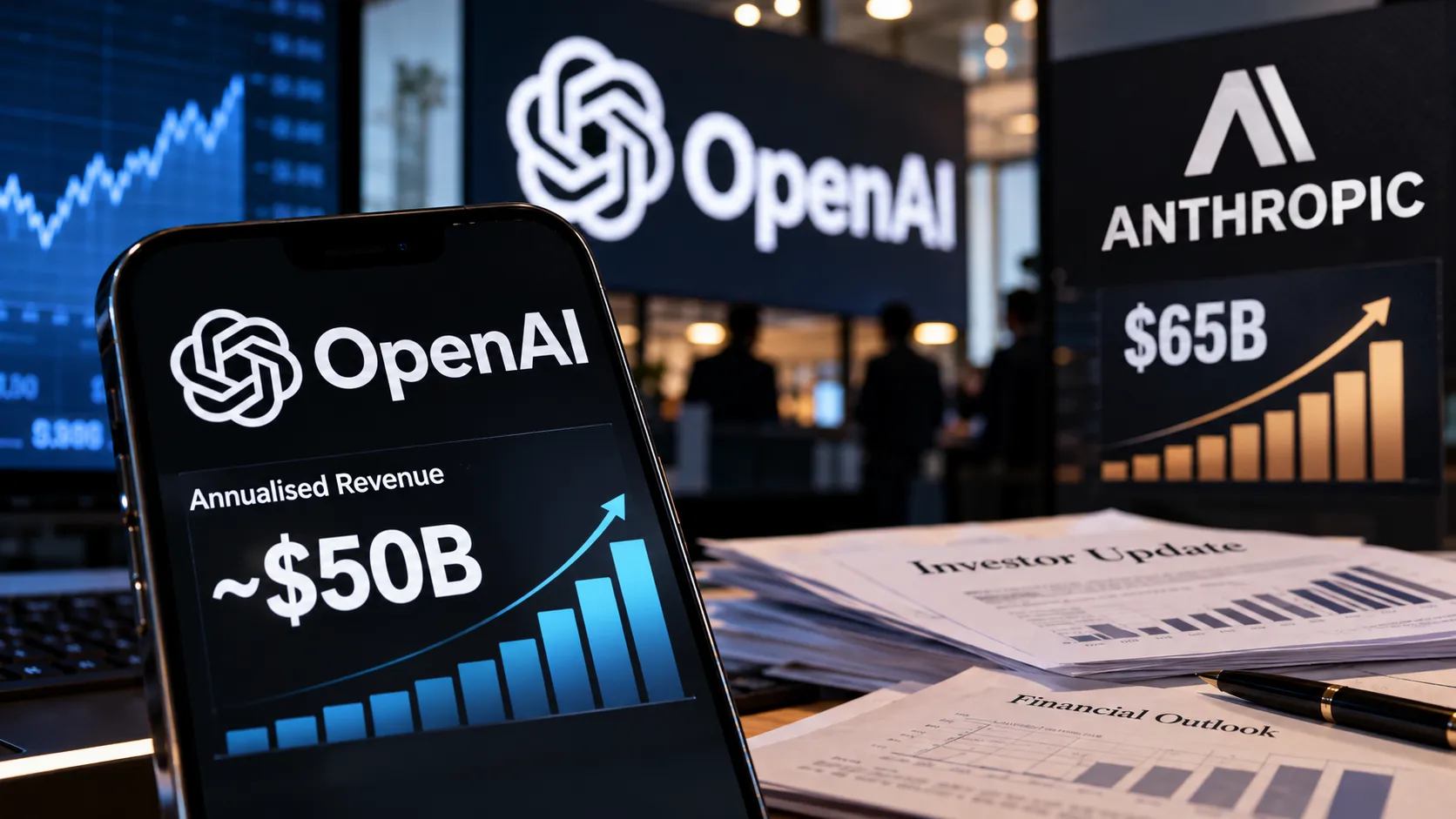
SAN FRANCISCO, Oct 8 — OpenAI has told investors that its annualised revenue is "approaching $50 billion", according to a report by the Financial Times, a figure roughly $20 billion lower than the $70 billion run rate reported just weeks earlier.
The gap has prompted fresh questions about how leading AI companies measure and present their growth, at a time when investors are pouring unprecedented sums into the sector and comparisons between rival labs carry enormous weight in fundraising and valuations.
On September 29, Axios reported that OpenAI's annualised revenue was nearing $70 billion. That figure would have put the ChatGPT maker ahead of Anthropic, which had a reported run rate of about $65 billion in July, according to CNBC.
Key facts at a glance
• New figure: OpenAI told investors annualised revenue is "approaching $50 billion" (Financial Times)
• Earlier figure: nearly $70 billion (Axios, September 29)
• Rival benchmark: Anthropic run rate of about $65 billion in July (CNBC)
• Cause of the gap: different treatment of sales through cloud partners
• Funding: $122 billion raised in March 2026
• 2025: leaked financials showed about $13 billion in revenue, with significantly higher spending
• IPO: pushed from 2026 to early 2027 (CNBC)
Where the $70 billion figure came from
According to the Financial Times, the higher number originated in information shared with OpenAI's investors and reflected "attempts by OpenAI's own investors to produce a direct comparison with Anthropic's annualised revenues".
The issue lies in accounting. Anthropic includes in its revenue figures sales of its models made through cloud partners, such as large cloud computing providers that offer its models to their customers. OpenAI does not count such sales the same way. That means the two companies' headline annualised revenue figures are not directly comparable.
Adjusting OpenAI's numbers to match Anthropic's methodology appears to produce a higher figure; OpenAI's own reported measure is lower. Neither number is necessarily wrong — but presenting one without the other can create a misleading picture of relative scale.
Why run rates matter so much
Annualised revenue, or run rate, is a common metric among fast-growing technology companies. It typically takes revenue from a recent period — often a single month — and multiplies it to estimate a yearly total. For companies growing quickly, it offers a more current picture than trailing twelve-month revenue.
But run rates have limitations. They can be inflated by one-off contracts, seasonal spikes or aggressive accounting choices, and they do not reflect costs or profitability. In the AI industry, where companies spend heavily on computing infrastructure, talent and model training, revenue growth alone says little about whether a business is sustainable.
TechCrunch said it had contacted OpenAI for comment; no response was included in its report.
The bigger financial picture
OpenAI has raised extraordinary sums to fund its ambitions. In March 2026, it raised $122 billion in a funding round, one of the largest private capital raises in history. Leaked financials for 2025 showed revenue of about $13 billion, with spending significantly higher.
The company's costs are dominated by computing power — both for training new models and for serving hundreds of millions of users of ChatGPT and its developer platform. OpenAI has signed large, multi-year agreements for data-centre capacity and chips, reflecting its expectation that demand will continue to rise steeply.
An initial public offering, previously expected in 2026, has been pushed to early 2027, according to CNBC. As OpenAI moves closer to the public markets, the way it reports revenue, costs and growth will come under far greater scrutiny from regulators, analysts and investors.
The Anthropic rivalry
The episode also highlights the intensifying competition between OpenAI and Anthropic. Both companies have grown at a remarkable pace, driven by demand from consumers, developers and enterprises. Anthropic has built a strong position in enterprise and coding applications, while OpenAI retains the largest consumer audience through ChatGPT.
Investor attempts to compare the two directly reflect how much is at stake. Rankings of revenue scale influence perceptions of market leadership, which in turn affect valuations, the ability to attract talent and the terms of partnerships with cloud providers and enterprise customers.
Why partner revenue is contentious
Selling AI models through cloud platforms is a large and growing channel. When an enterprise accesses a model through a cloud provider's marketplace, the customer typically pays the cloud provider, which then shares a portion with the model developer. Whether the developer should count the full amount paid by the customer or only its share is a judgement call — and the choice can produce very different headline numbers.
Counting gross sales makes a company look larger and better reflects end-customer demand for its models. Counting only net receipts gives a more conservative picture of the money that actually reaches the developer. Public companies follow detailed accounting standards on this question; private companies have more latitude in how they present figures to investors.
What a listing would change
An IPO would force greater consistency. Public filings require audited financial statements prepared under established accounting rules, along with detailed disclosures on revenue recognition, customer concentration, related-party arrangements and costs. For investors who have relied on private disclosures and press reports, that would provide a much clearer basis for comparing the leading AI companies.
Lessons for investors
For investors, the episode is a reminder to look beyond headline numbers. Revenue definitions, the treatment of partner sales, the time period used to annualise and the relationship between revenue and costs all matter. As AI companies approach public listings, standardised and audited disclosures will make comparisons easier — and more reliable.
For business leaders adopting AI, the competition between leading labs is likely to continue driving rapid improvements in capability and reductions in price. For India's technology industry and the global Indian diaspora working across the AI ecosystem, the rivalry shapes everything from the tools developers use to the opportunities available at the world's leading AI companies.
The headline difference between $50 billion and $70 billion may be partly a matter of accounting. But in an industry where perception drives capital, the way the numbers are counted can matter almost as much as the numbers themselves.