For many Indian banks, hospitals and government contractors, the question has never been whether artificial intelligence is useful, but whether they can use it without sending sensitive data abroad. OpenAI is betting that a new option will change that calculation.
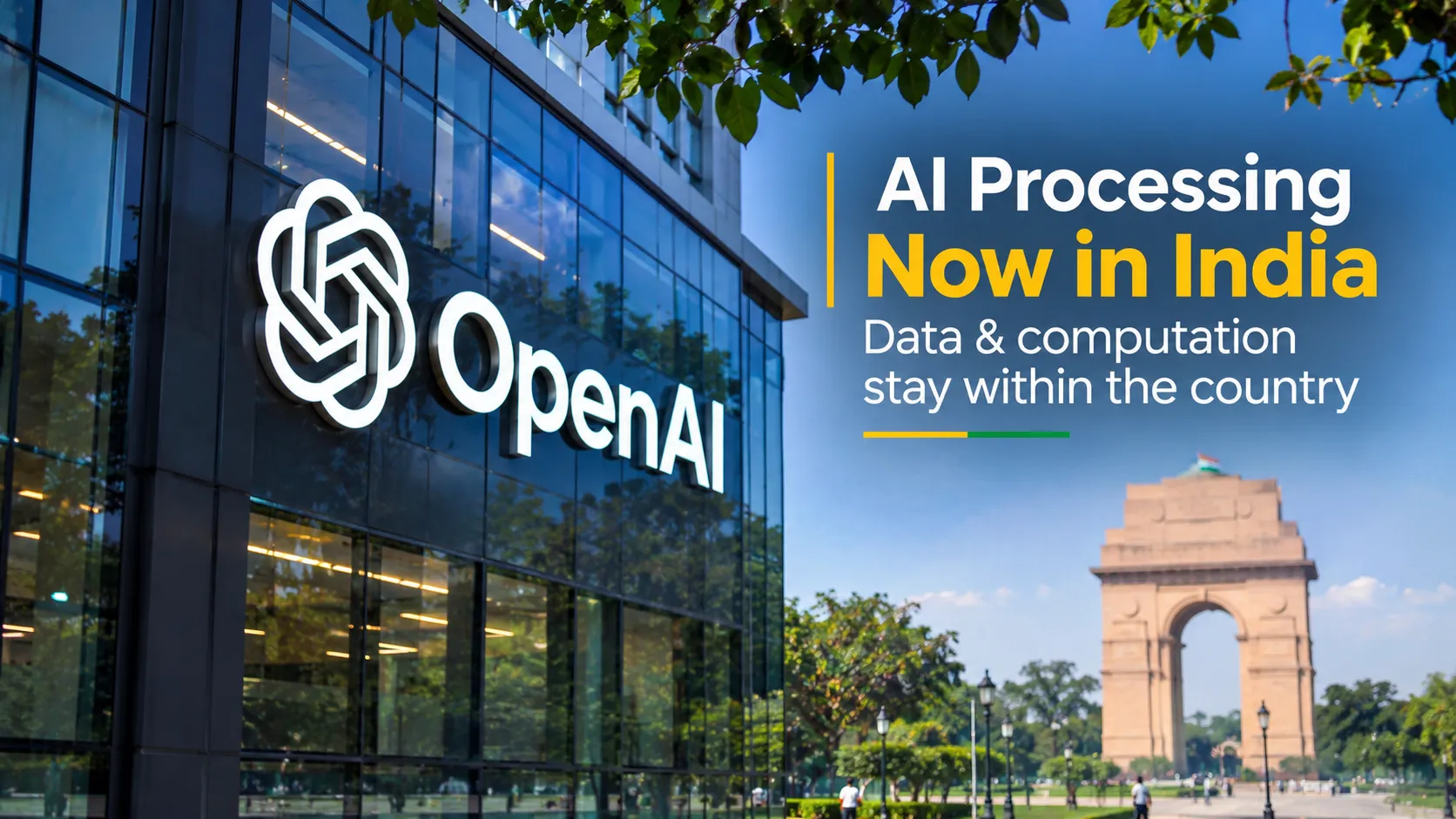
OpenAI said on Thursday, November 12, that eligible businesses in India can now process supported workloads through its application programming interface (API) inside the country, according to Inc42. The service, known as inference residency, extends the data residency options OpenAI already offered in India, under which customer data could be stored locally.
Inference is the process of running an AI model to generate responses, as opposed to training it. With inference residency, both the storage of data and the computation that produces answers take place within India.
How it works
The service initially covers OpenAI's GPT-6 Luna model through its Responses and Chat Completions APIs, according to Inc42. Customers create a new API project, select India for both data storage and processing, and use the India regional endpoint.
India joins Australia and Japan as markets where OpenAI offers this option. OpenAI introduced data residency in several Asian markets last year, allowing enterprises and education customers to store data locally, and expanded it to more business customers worldwide.
Why it matters
Nitin Bawankule, who leads OpenAI's enterprise business in India, said the move addresses hesitation among Indian companies. "Some Indian businesses have not fully deployed AI for important work," he said, according to Inc42.
Many Indian organisations operate under regulations that require certain data to remain in the country. The Reserve Bank of India, for example, requires payment data to be stored only in India, and other regulators have imposed data localisation requirements for sensitive sectors. India's Digital Personal Data Protection Act also gives the government powers to restrict the transfer of personal data to certain countries.
Even where the law does not strictly require it, many companies prefer to keep sensitive data in India for security, compliance and reputational reasons. Inference residency removes a key obstacle to using AI for tasks involving customer data, financial records, medical information or confidential business documents.
The competitive race
OpenAI is not alone in courting Indian enterprises with local processing. Anthropic announced in August plans for in-country inference of its Claude models in India through Amazon Bedrock, and has since offered similar residency for certain models, according to Inc42. Amazon Web Services has also made OpenAI models available on Bedrock in India.
Google, Microsoft and other cloud providers offer AI services through data centres in India, giving businesses a range of options. The competition is likely to drive down prices and improve service for Indian customers.
A challenge for Indian AI startups
Local processing has been one of the selling points of Indian AI companies such as Sarvam AI, which build models trained on Indian languages and hosted in India. Inc42 noted that OpenAI's move could narrow the advantage of such startups.
However, Indian AI companies argue that they offer other advantages, including models optimised for Indian languages and contexts, lower costs and alignment with the government's push for sovereign AI capabilities under the IndiaAI Mission.
OpenAI's India push
India is one of OpenAI's most important markets. More than 10 crore (100 million) people in India use ChatGPT every week, according to Inc42. The company has opened an office in New Delhi, offered lower-priced subscription plans for Indian users, and earlier this year partnered with the Tata Group on domestic AI data centre capacity.
OpenAI is also bringing new business features to India. Its beta Businesses in ChatGPT programme lets companies claim profiles through a Business Hub, which is available in India subject to eligibility and verification. Business Agents, however, are initially limited to eligible US e-commerce and online service businesses, according to Inc42.
The data centre build-out
Offering inference residency requires computing capacity in India, which is in short supply. India's data centre industry is expanding rapidly, with companies such as Reliance, Adani, Airtel, Yotta and global players investing billions of dollars in new facilities. AI workloads require specialised GPU clusters and large amounts of power, making them more demanding than traditional data centres.
The growth of local AI processing could accelerate investment in India's data centre sector, creating opportunities for developers, power companies and equipment suppliers.
Implications for regulated sectors
Banks, insurers, hospitals and government agencies are among the organisations most likely to benefit. Banks can use AI for customer service, fraud detection and document processing while keeping data in India. Hospitals can use AI to analyse medical records and assist doctors. Government departments can deploy AI for citizen services without sending data abroad.
However, organisations will still need to ensure that their use of AI complies with sector-specific rules, protects privacy and is accurate and fair.
The sovereign AI debate
The arrival of global AI companies with local processing raises questions about India's ambition to build its own AI capabilities. The IndiaAI Mission supports the development of domestic foundation models and shared computing infrastructure. Some policymakers argue that India should not depend entirely on foreign AI models, even if they are hosted locally, for strategic and economic reasons.
What enterprises should consider
For Indian companies evaluating the new option, residency is only one factor. They will also weigh model performance, cost, support for Indian languages, integration with existing systems and the terms on which their data may be used. Many enterprises adopt a multi-model approach, using different AI providers for different tasks to avoid dependence on a single supplier.
Legal and compliance teams will want to review contractual commitments on data handling, security certifications and the location of any human review or support functions, which may still sit outside India even when data and processing are local.
The cost of local compute
Running AI models in India may initially cost more than running them in larger data centre markets, since local GPU capacity is scarcer. How OpenAI prices the service relative to its global offerings will influence how widely Indian businesses adopt it.
What comes next
OpenAI is likely to expand inference residency to more models and APIs in India over time. Indian enterprises will weigh the option against offerings from Anthropic, Google, Microsoft and domestic AI companies. For India's AI ecosystem, the arrival of local inference from the world's best-known AI company marks a significant step towards wider enterprise adoption.