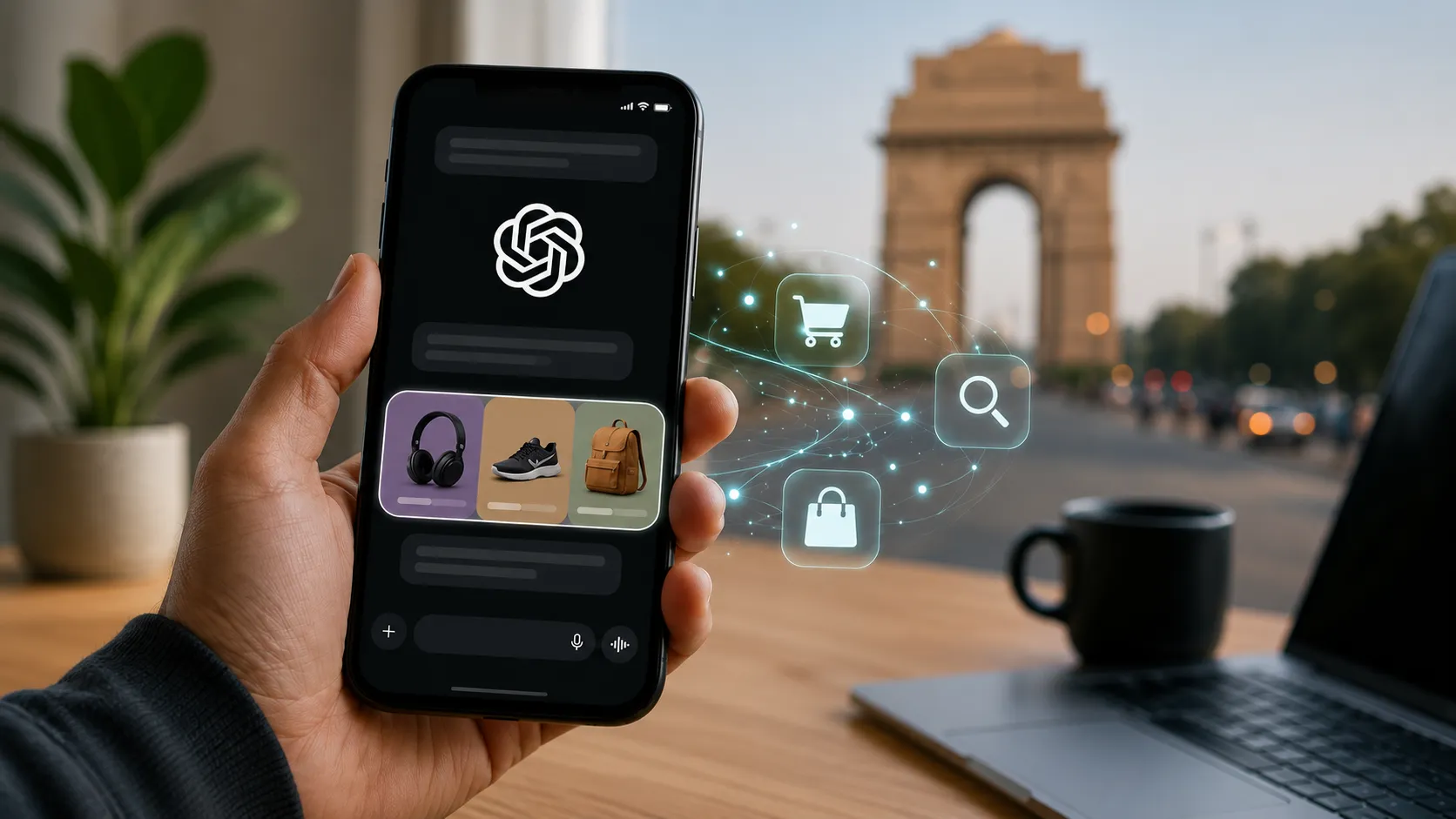
OpenAI has begun rolling out advertising within ChatGPT in India, opening a new monetisation channel in one of the platform's largest and fastest-growing user markets. The rollout initially targets logged-in adults on the Free and Go subscription plans, while users on Plus, Pro, Business, Enterprise and Education tiers will continue to experience the product without advertising, at least for now.
The company has named WPP and Omnicom as its first advertising agency partners in India, a signal that it intends to work through established media-buying infrastructure rather than build a fully self-serve advertising stack from scratch in its early days. More than fifty brands are expected to go live on the platform within the first week of the rollout, according to details shared around the launch, giving an early indication of advertiser appetite for placement within AI-generated conversations.
A self-serve ads manager is scheduled to open on 4 September, with daily budgets starting as low as ₹725 — a threshold designed to make the format accessible to small and mid-sized Indian businesses rather than only the large consumer brands typically associated with early-stage OpenAI advertising partnerships. The timing is unlikely to be coincidental: India's festive shopping season, anchored around Diwali and the months that follow, represents the single largest concentrated period of consumer spending in the country's retail calendar.
OpenAI has sought to pre-empt privacy concerns by stating that ads will appear below ChatGPT responses only when contextually relevant, will be clearly labelled as advertising, and that advertisers will not be given access to users' conversations, chat history or personal details. That framing echoes the privacy assurances made by earlier generations of search and social platforms during their own advertising build-outs, though it remains to be tested how India's evolving data-protection regime will scrutinise AI-native advertising formats over time.
For OpenAI, India represents a critical proving ground. The company has repeatedly pointed to the country as one of its largest user bases globally by download and engagement, even as monetisation from that base has lagged its performance in wealthier markets. Advertising offers a path to revenue that does not depend on subscription conversion, a metric that has historically proven difficult to move in price-sensitive markets regardless of product quality.
The rollout also positions OpenAI more directly in competition with Google and Meta for India's digital advertising budgets, at a moment when both incumbents are themselves racing to embed generative AI features into their own ad-supported products. Whether Indian marketers view conversational AI placement as a genuinely new advertising surface — or simply an extension of existing search and social budgets — will shape how quickly the format scales beyond its initial fifty-brand cohort.
India's digital advertising market has historically been characterised by fierce price competition and a marketer base highly attuned to measurable return on ad spend, conditions that could work either for or against OpenAI's new format. On one hand, the country's advertisers have shown willingness to experiment aggressively with new formats — from short-video advertising to voice-commerce integrations — when the underlying platforms demonstrate genuine reach and engagement. On the other, the same price sensitivity that has made India one of the most competitive digital advertising markets globally could compress margins on conversational AI ad inventory faster than in wealthier markets where OpenAI has more room to experiment with premium pricing.