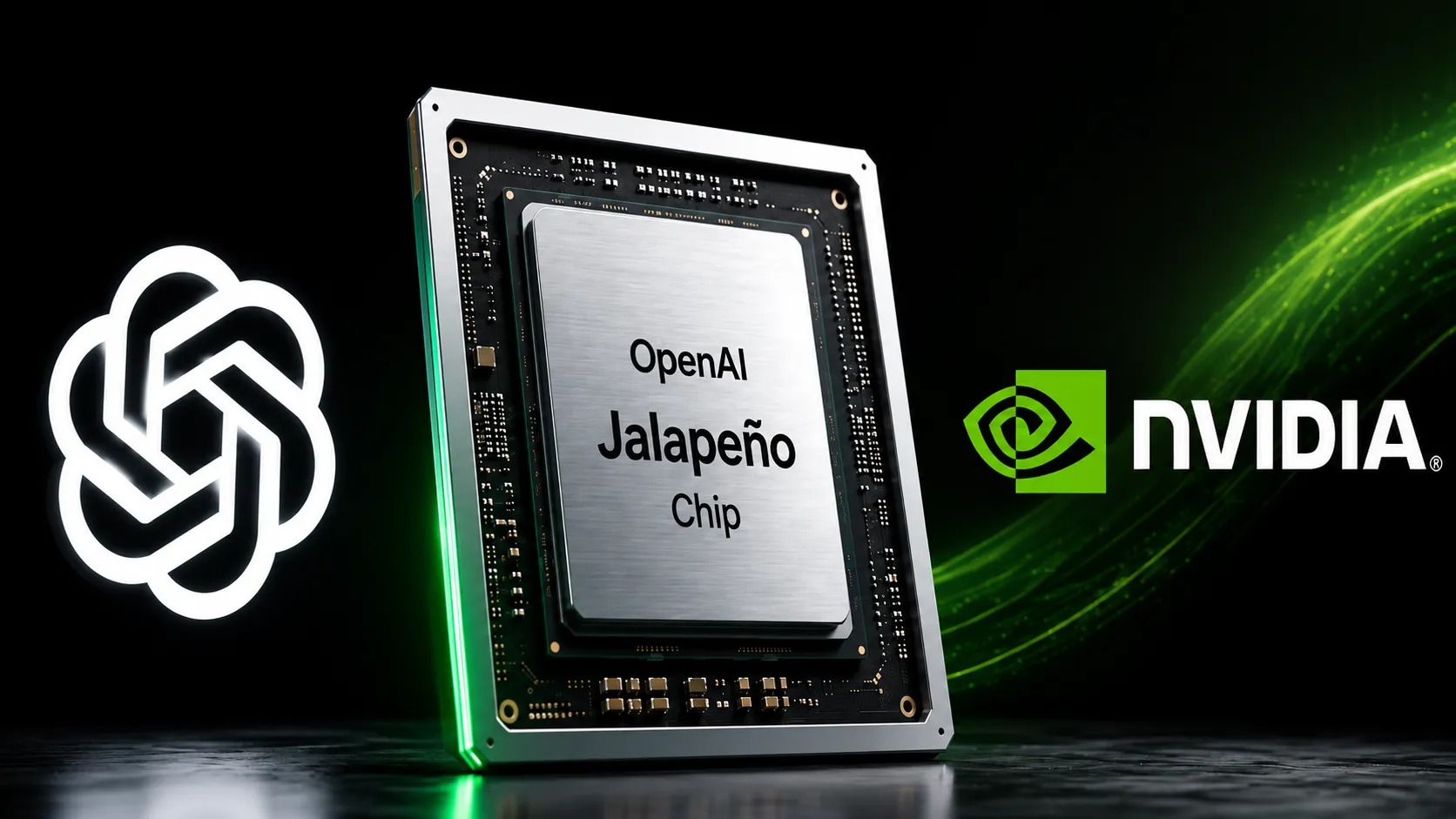
OpenAI says its first custom inference chip now beats Nvidia's Blackwell systems on AI work per watt in benchmark tests, according to reporting published August 26, 2026, a claim that, if borne out at scale, would mark a significant milestone in the broader industry-wide race among leading AI labs to reduce their dependence on third-party chip suppliers and gain greater control over the underlying economics of running increasingly large and computationally intensive AI models.
The development reflects a wider strategic shift across the AI industry, in which power-per-watt efficiency has become an increasingly critical metric as the scale of AI inference workloads — the computation required to actually run trained models and serve responses to end users, as distinct from the training process itself — has grown dramatically alongside the proliferation of AI products across consumer and enterprise applications. As inference workloads increasingly dominate the total computational and energy footprint of running large-scale AI systems, efficiency gains on this specific metric translate directly into meaningful cost savings at scale.
For OpenAI, developing custom silicon represents a natural evolution of a strategy pursued by several of the world's largest technology companies, many of which have invested heavily in designing their own AI-specific chips to reduce reliance on Nvidia, whose graphics processing units have dominated the AI training and inference hardware market for much of the current AI boom. Companies including Google, Amazon and Microsoft have each pursued custom silicon strategies of varying scope and maturity, and OpenAI's move into this space signals the company's ambition to exert similar control over its infrastructure economics as it scales its own products and services.

The claim that OpenAI's custom chip now outperforms Nvidia's Blackwell architecture — widely regarded as among the most advanced AI accelerator hardware currently available — on the specific metric of AI work per watt is a notable one, given Nvidia's continued dominance of the broader AI hardware market and the company's own aggressive pace of architectural innovation. Benchmark comparisons of this kind are frequently contested and depend heavily on the specific workloads and configurations used for testing, meaning independent verification of OpenAI's claims will likely be an important next step for the broader industry in assessing their significance.
The development comes amid a broader reshaping of the competitive dynamics underpinning the global AI industry, one increasingly defined not solely by model capability but by control over the chips, memory, data centres and energy infrastructure required to train and run those models at scale. This shift has been further underscored by Samsung's unveiling of new processing-in-memory technology aimed at accelerating AI inference, and by Nvidia's own recent warnings to enterprise customers of price increases exceeding 15 percent driven by rising memory costs — developments that together illustrate an AI hardware ecosystem under considerable strain as demand for compute continues to outpace available supply.
For Nvidia, continued progress by major AI labs toward developing competitive custom silicon represents a long-term strategic risk to its dominant position in the AI hardware market, even as the company's near-term revenue and market position remain robust given the sheer scale of current AI infrastructure buildout across the industry. Whether OpenAI's custom chip can be manufactured and deployed at the scale required to meaningfully reduce the company's reliance on Nvidia hardware across its full range of products remains an open question that will likely play out over the coming months and years.
As the AI industry's compute demands continue to grow, the emergence of credible custom silicon alternatives from leading AI labs themselves is likely to intensify competitive pressure across the broader semiconductor industry, with implications not just for Nvidia but for the wider ecosystem of chip designers, foundries and memory manufacturers that together constitute the physical infrastructure underpinning the current AI boom.


