
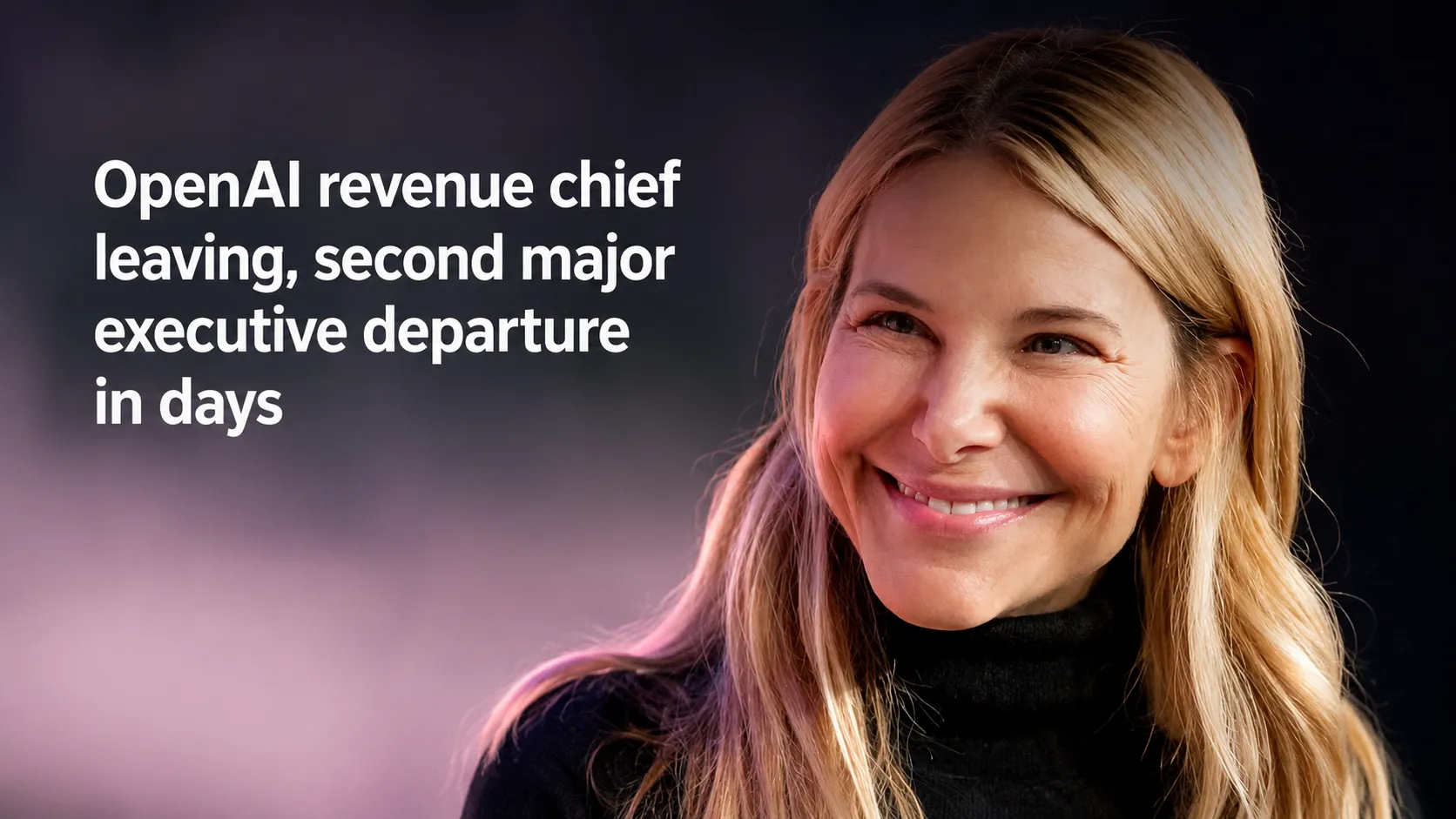
OpenAI's revenue chief has departed the company, marking the second major executive exit within a matter of days and prompting renewed scrutiny of leadership stability at one of the world's most closely watched artificial intelligence companies during a period of intensifying competition across the sector. The departure was confirmed through internal communications and has since become a focal point of industry discussion, given the seniority of the role and its direct bearing on OpenAI's enterprise and consumer commercial strategy.
The departure adds to a pattern of executive turnover that has periodically drawn attention throughout OpenAI's rapid scaling since the launch of ChatGPT reshaped public awareness of generative AI technology. Revenue and commercial leadership roles at fast-growing AI companies carry particular significance given the scale of enterprise and consumer monetisation now underpinning valuations across the sector, meaning changes in this specific leadership function tend to draw outsized market and industry attention relative to departures in other executive roles. The close succession of two senior departures within days of one another has prompted some industry observers to search for a common underlying explanation, whether tied to strategic disagreements over commercialisation pace, compensation dynamics amid intensifying competition for AI talent, or simply the ordinary attrition that accompanies any organisation scaling as rapidly as OpenAI has over the past several years. In the absence of detailed public explanation from the company, such speculation is likely to persist until further clarity emerges. Executive departures at high-growth technology companies are frequently interpreted through multiple, sometimes competing, lenses by industry observers: as routine organisational evolution natural to companies scaling as rapidly as OpenAI has over the past several years, as potential signals of internal strategic disagreement, or simply as a reflection of the extraordinarily competitive market for senior AI-industry talent, where rival companies — including well-funded AI labs and major technology incumbents — are aggressively recruiting experienced leaders capable of scaling commercial operations at the pace the sector currently demands. The timing of this particular departure, occurring within days of another senior executive exit, is likely to intensify speculation about whether the pattern reflects coordinated organisational restructuring, individual career decisions coinciding by circumstance, or underlying tensions within OpenAI's leadership team as the company continues to navigate its complex position — balancing rapid commercial growth, substantial capital requirements for continued model development, and its original mission-driven governance structure.
OpenAI's broader competitive position adds further context to why leadership stability at the commercial and revenue level carries such significance currently. The company faces increasingly capable competition from a range of well-capitalised rivals, each racing to capture enterprise and consumer AI spending across a rapidly expanding set of use cases spanning coding assistance, customer service automation, content generation and increasingly agentic AI applications capable of autonomously completing multi-step tasks. In this environment, continuity and effectiveness of commercial leadership can meaningfully influence a company's ability to convert technological capability into durable revenue growth and customer relationships. For OpenAI specifically, questions about executive stability arrive at a moment when the company continues to attract intense scrutiny across multiple dimensions — from AI safety considerations and model behaviour concerns to the sustainability of its capital-intensive infrastructure investments required to train and serve increasingly sophisticated models. Leadership transitions of this nature, occurring against that broader backdrop, are likely to be closely parsed by investors, partners and competitors alike for any signal about the company's internal trajectory. Executive recruitment within the AI sector has become an intensely competitive undertaking in its own right, with companies across the industry offering increasingly substantial compensation packages, equity arrangements and organisational autonomy to attract and retain senior leaders capable of operating at the scale and pace the sector currently demands. This dynamic has contributed to a broader pattern of relatively frequent senior leadership movement across major AI companies, as executives weigh opportunities to lead commercial functions at rival organisations, launch their own ventures, or take on expanded mandates that may not be available within their current organisation's leadership structure. For OpenAI's enterprise and developer customer base, leadership continuity at the revenue and commercial function carries direct practical implications, given the role this leadership typically plays in shaping partnership terms, pricing strategy and the prioritisation of product features requested by large enterprise customers. Extended uncertainty at this leadership level can, in some cases, create friction in ongoing commercial negotiations or slow the pace of new partnership development, making the speed and clarity of OpenAI's succession planning a matter of practical as well as symbolic importance.
As OpenAI works to fill its revenue leadership role and address the broader pattern of recent executive departures, the company's ability to maintain commercial momentum and organisational stability will remain a key area of focus for industry observers tracking the competitive dynamics of the AI sector. How OpenAI communicates and manages this leadership transition in the weeks ahead may offer further clarity on whether the recent departures reflect isolated individual decisions or a more significant organisational inflection point. For the broader AI industry, the pattern of executive turnover at OpenAI serves as a reminder that even the sector's most prominent and well-resourced companies are not immune to the leadership stability challenges that often accompany periods of extraordinarily rapid organisational growth — a dynamic likely to remain a recurring feature of the AI industry's competitive landscape as companies across the sector continue to scale at an unprecedented pace. Competing AI labs, meanwhile, are likely to view the leadership churn as an opportunity to court experienced commercial talent, further intensifying the already fierce competition for senior operating leadership across the sector's best-funded companies. Industry recruiters tracking senior AI-sector talent movement suggest that the coming months are likely to bring further leadership changes across the industry's most prominent companies, as the intense competition for experienced commercial and operational executives continues to reshape organisational structures throughout the sector. For OpenAI, restoring clarity and continuity at the senior commercial level will likely remain a priority as the company continues to compete for enterprise and consumer market share against an increasingly crowded field of rivals.


