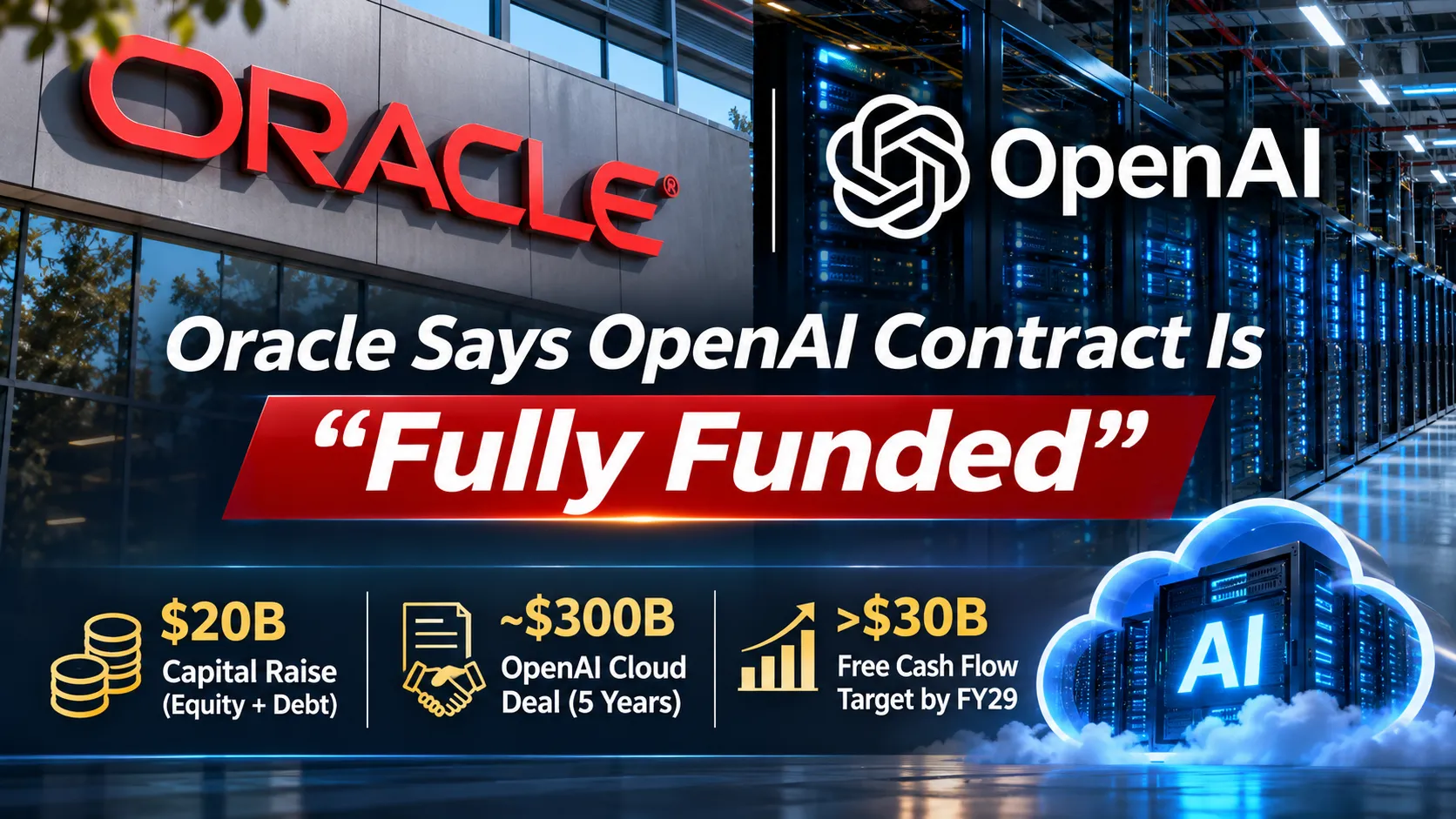
Oracle has sought to reassure investors about one of the largest and most closely watched contracts in the technology industry. In a statement released after US market hours on Friday, November 20 (early Saturday, November 21, in India), Oracle said its OpenAI contract was now "fully funded."
The statement followed a $20 billion capital raise, split roughly evenly between equity and debt, which Oracle completed as it builds out data centres to serve OpenAI and other AI customers. Oracle priced $20 billion of common stock and senior notes, according to its investor relations disclosures. The company also said it targets more than $30 billion of free cash flow in its 2029 financial year.
The OpenAI contract
Oracle's relationship with OpenAI has transformed the company. In 2025, Oracle signed a contract with OpenAI reported to be worth about $300 billion over five years, under which Oracle would provide cloud computing capacity for OpenAI's AI models. The deal caused Oracle's remaining performance obligations, a measure of contracted future revenue, to surge.
The contract helped make Oracle one of the central players in the AI infrastructure boom. Oracle is also part of the Stargate project, a large AI infrastructure initiative involving OpenAI and other partners.
However, the scale of the commitment has raised questions. S&P has estimated that OpenAI accounts for about half of Oracle's backlog. That means much of Oracle's future growth depends on a single customer that is itself burning large amounts of cash and needs to keep raising money.
OpenAI posted a third-quarter operating loss of about $13.5 billion including stock-based compensation, according to reports, and its latest funding round reportedly reached $15 billion, about half of its original target.
Why investors are nervous
Oracle has been borrowing heavily to build the data centres needed to fulfil its AI contracts. Its debt load has grown significantly, and it has announced plans to raise tens of billions of dollars in debt and equity. Some US banks have reportedly pulled back from financing Oracle-linked data centre projects.
The broader market context has added to concerns. AI-related stocks suffered a sharp selloff in the week to November 20, driven partly by worries about the financing of AI infrastructure. Critic Ed Zitron warned on CNBC that the AI build-out is being propped up by circular financing between Nvidia, Oracle, cloud providers and AI labs, and argued that the worst is yet to come.
"Circular financing" refers to arrangements where companies invest in or lend to their own customers, who then use the money to buy the investors' products. Critics argue that such arrangements can inflate demand and obscure risks.
What "fully funded" means
Oracle's statement that its OpenAI contract is fully funded appears designed to address concerns that it might not be able to finance the data centres required to meet its commitments. By raising $20 billion in equity and debt, and combining it with existing vendor financing arrangements, Oracle says it has secured the capital needed for the contract.
That does not resolve all concerns. The ultimate risk lies in whether OpenAI can pay for the capacity it has committed to buy. If OpenAI's revenue does not grow fast enough, or if it struggles to raise further funding, Oracle could face lower utilisation of its data centres and pressure on returns.
Oracle has previously said it is highly confident in OpenAI's ability to raise funds and meet its commitments.
The equity component
Issuing roughly $10 billion of new equity dilutes existing shareholders. Oracle has said it is balancing debt and equity to maintain a solid investment-grade credit rating. Maintaining that rating is important because it keeps borrowing costs lower.
The decision to issue equity, rather than relying entirely on debt, signals that Oracle is mindful of its leverage, but it also shows how capital-intensive the AI infrastructure build-out has become.
The free cash flow target
Oracle's target of more than $30 billion in free cash flow in FY29 is intended to show investors that the heavy spending of recent years will eventually generate substantial cash returns. Data centres are expensive to build, but once operational and contracted, they can generate steady revenue for years.
Investors will want to see evidence that this trajectory is on track, including utilisation rates, customer diversification and margins on AI cloud services. Oracle's next quarterly results, due in mid-December, will be closely watched for signs of whether new contracts are coming from customers other than OpenAI.
Implications for India
Oracle has a large presence in India, including significant engineering and support operations. Oracle Financial Services Software (OFSS), its Indian listed subsidiary, was in focus in Indian markets after the statement.
India is also a growing market for cloud computing and data centres, and Oracle has expanded its cloud infrastructure in the country. The health of the AI infrastructure boom matters for India's technology sector, which provides services, software and talent to global cloud and AI companies.
The bigger picture
The questions surrounding Oracle reflect a broader debate about whether the AI investment boom is sustainable. Supporters argue that demand for AI computing is real and growing rapidly, and that today's investments will generate strong returns. Sceptics warn that spending has run ahead of revenue, and that financial engineering is masking risks.
For The Impactful Global Indian's readers, Oracle's statement is a useful window into how the world's largest technology companies are financing the AI era, and into the risks that come with concentrating so much investment on a small number of customers.
Customer concentration risk
Customer concentration is a well-known risk for suppliers. When a single customer accounts for a large share of a company's revenue or backlog, any difficulties at that customer can have an outsized impact. Analysts will watch whether Oracle can diversify its AI cloud customer base by signing contracts with other AI labs, enterprises and governments. Oracle has said it is seeing demand from a wide range of customers, and its upcoming results will provide evidence of whether that demand is translating into signed contracts.


