Origin, a construction robotics startup founded by a team of Indian entrepreneurs, has raised $20 million to scale robots that automate interior building work, as investors bet that physical AI can ease chronic labour shortages in the global construction industry.
The round was co-led by Accel and Zacua Ventures, a fund focused on construction technology, according to Entrackr. Unilazer Ventures, Schema Ventures and Z21 also participated, along with angel investors from Anduril, Skild AI, 1X and Tesla.
Origin, which is based in San Francisco, describes itself as a "physical AI startup building robots for interior construction". It was founded in 2025.
A Founding Team With an Exit Behind It
Origin co-founder Yogesh Ghaturle previously founded Perpule, a cloud-based point-of-sale startup for retailers that Amazon acquired in 2021. His co-founders are Ashish Daga, who leads hardware and previously worked at digital pathology startup Morphle Labs, and Tushar Makkar, who leads autonomy and previously worked at Eightfold AI.
The team's background spans software, hardware and artificial intelligence, a combination that robotics companies need but rarely assemble at the earliest stage. Ghaturle's prior exit to Amazon also gives the company credibility with investors in a capital-intensive sector.
The OG-1 Robot
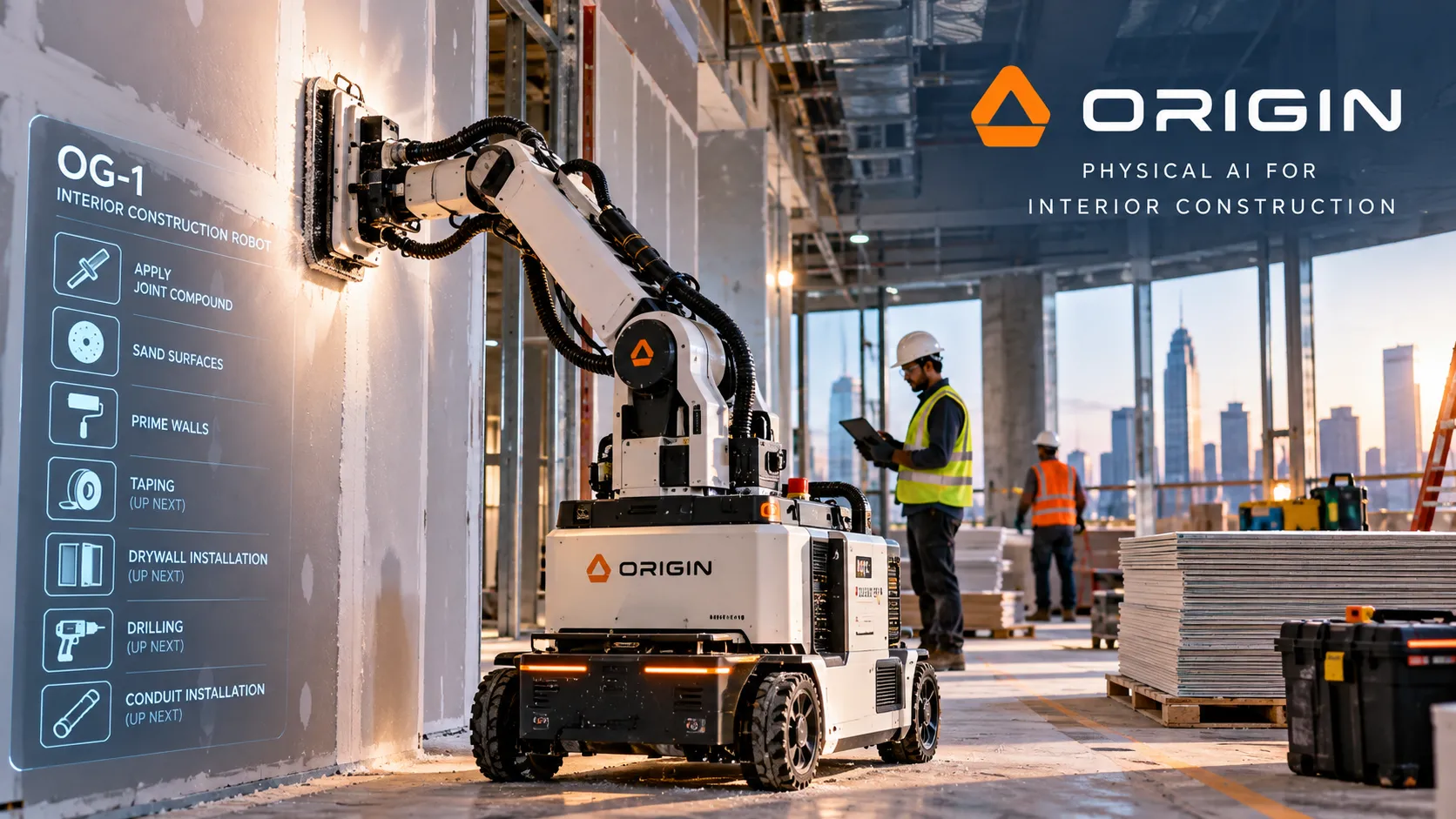
Origin's flagship robot, OG-1, currently handles wall finishing, one of the most labour-intensive and repetitive tasks in interior construction. The robot applies joint compound, sands surfaces and primes walls, work that typically requires skilled finishers and multiple passes.
The company plans to extend the platform to additional tasks, including taping, drywall installation, drilling and conduit installation. Its robots run on what Origin calls a Construction Action Model, a foundation model for construction workflows that combines task planning, autonomous navigation and tool control.
Origin targets commercial spaces, residential apartments, data centres, hotels and warehouses, building types where interior finishing work is extensive and schedules are tight.
From Founding to Job Site in Ten Months
The company says it deployed its first robots at construction sites in New York within 10 months of being founded, a rapid timeline for a hardware company. It is preparing pilots with two large US drywall finishing contractors and plans further pilots in Germany, Sweden, France and Saudi Arabia.
Origin is targeting 150 deployed robots by the end of 2027. The new funding will be used to expand its robot fleet, deploy OG-1 more widely, run customer pilots in the United States and Europe, and extend the platform to more interior construction tasks.
A Labour Crisis Driving Investment
Origin's pitch rests on a structural problem. Construction in many developed economies faces persistent shortages of skilled workers, as experienced tradespeople retire and fewer young people enter the trades. A September 2026 survey by the Associated General Contractors of America found that worker shortages had delayed projects for 42 per cent of surveyed US construction firms.
At the same time, demand for construction remains strong, driven in part by the boom in data centres for artificial intelligence, as well as housing shortages in many markets. The mismatch between demand and available labour has made construction one of the most promising sectors for robotics and automation.
Investors have taken notice. Construction robotics startups drew $1.36 billion in venture funding in the first three quarters of 2025, compared with $612 million in all of 2024, according to a report by Zacua Ventures with Hilti Ventures and 94 Ventures.
The Physical AI Wave
Origin is part of a broader surge of investment in "physical AI", the application of advanced AI models to robots that operate in the real world. Advances in foundation models, computer vision and simulation have made it more feasible to build robots that can handle varied, unstructured environments such as construction sites, rather than repeating identical tasks on a factory floor.
The participation of angel investors from companies such as Anduril, Skild AI, 1X and Tesla, all of which are building advanced robotics or autonomy systems, signals that Origin's approach has credibility within the robotics community.
An Indian Diaspora Story
Origin also reflects the growing role of Indian founders in global deep technology. While the company is headquartered in San Francisco and targets US and European customers, its founding team includes entrepreneurs with roots in India's startup ecosystem, and its backers include Unilazer Ventures, the investment firm founded by Indian media entrepreneur Ronnie Screwvala.
Indian-origin founders have increasingly moved from software into hardware and robotics, drawing on engineering talent in both India and the United States.
Why Interior Finishing First
Origin's decision to start with wall finishing is strategic. Interior finishing is highly repetitive, labour-intensive and physically demanding, often requiring workers to spend long hours on ladders and scaffolding applying compound, sanding and painting large surfaces. It is also a task where quality is visible and measurable, making it easier to demonstrate that a robot performs as well as or better than human crews.
Starting with a narrowly defined task allows a robotics company to refine its hardware and software in real conditions before expanding into more complex work. Many earlier construction robotics ventures struggled because they attempted to automate too much at once or targeted tasks where site conditions varied too widely. By building a foundation model for construction workflows and then extending it task by task, Origin is betting it can accumulate the data and experience needed to automate progressively more of the interior construction process.
The company's choice of markets also reflects where labour costs are highest. In the United States and Western Europe, skilled construction labour is expensive and increasingly scarce, which makes the economics of automation more compelling than in countries with lower wages. Saudi Arabia, where large-scale construction projects are under way, offers another market where speed and labour availability are pressing concerns. Demonstrating clear savings in these markets would give Origin a strong case for wider adoption.
The Challenges Ahead
Construction robotics remains difficult. Job sites are chaotic and constantly changing, and robots must work safely alongside human crews. Contractors operate on thin margins and are often cautious about adopting new technology. Hardware companies also require significant capital to build, deploy and maintain fleets.
Origin's success will depend on proving that its robots deliver consistent quality, reduce costs and keep projects on schedule across many different sites. If it reaches its target of 150 robots by the end of 2027 with strong customer results, it could become one of the leading players in a sector that is only beginning to be transformed by AI.