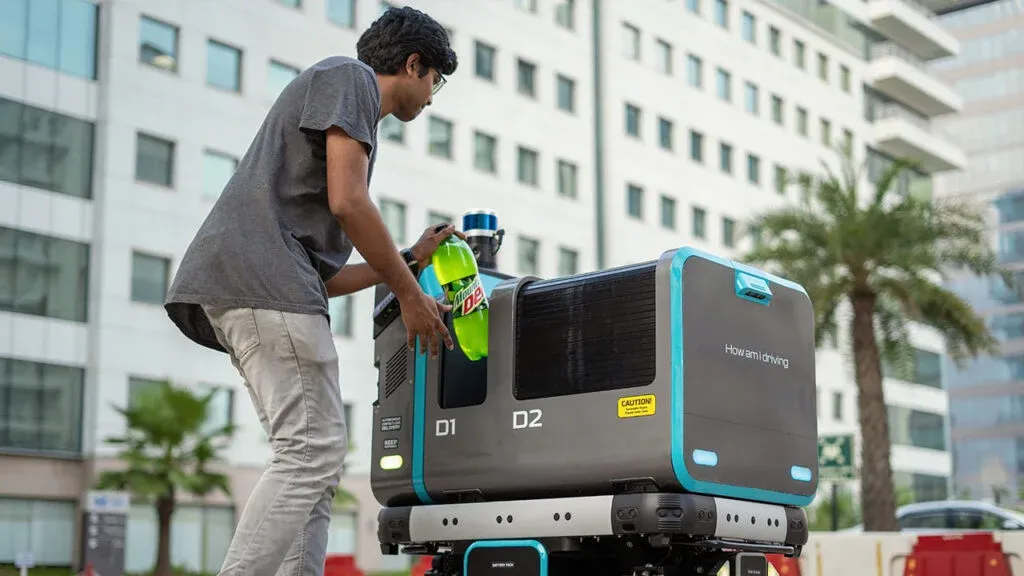
While the logistics industry has spent the past decade automating warehouses and long-haul freight routes, one segment has stubbornly resisted robotics: the unstructured, unpredictable middle stretch between buildings, elevators and campuses where samples, meals, parts and parcels still move largely by human hand. Ottonomy, an autonomous-robotics startup, has built its entire thesis around closing that gap, and its founder, Ritukar Vijay, describes the challenge as deceptively simple but operationally brutal.
The company's premise is that logistics automation over the past decade has addressed the easy problems first — sorting inside a warehouse, routing trucks along fixed highway corridors — while leaving the messiest, most human-dependent segment of the supply chain largely untouched. That segment, often called the 'middle mile' or, in Ottonomy's own framing, the 'messy middle,' involves navigating elevators, revolving doors, security checkpoints, uneven terrain and unpredictable pedestrian traffic — conditions that are far harder to automate reliably than a structured warehouse floor or a fixed delivery route.
Ottonomy's robots are designed specifically for this in-between environment: moving items such as lab samples, meal deliveries, spare parts and parcels between buildings on hospital campuses, corporate parks and mixed-use developments, where the volume of individual trips is high but each trip is too short and too irregular to justify a human courier dedicated solely to that task. The company's bet is that by solving navigation, elevator integration and building-access challenges reliably, it can capture a category of logistics demand that has remained largely unautomated even as robotics has advanced dramatically in adjacent domains.
Vijay's framing of the problem reflects a broader pattern playing out across robotics and automation startups globally in 2026: rather than chasing the most visually dramatic automation challenges, an increasing number of founders are targeting unglamorous, high-friction operational gaps that incumbents have found too fragmented or too low-margin to solve with dedicated infrastructure. The messy middle of logistics — moving small quantities of goods across short, awkward distances within and between buildings — fits squarely into that category.

Ottonomy's emergence also reflects the broader maturation of India's homegrown robotics-hardware supply chain, which has historically lagged behind software development in the country's technology ecosystem. Building reliable autonomous-navigation hardware requires not just software expertise but access to precision sensors, actuators and battery systems — components that Indian robotics startups have often needed to source internationally, adding cost and complexity relative to peers building in more established hardware-manufacturing hubs.
India's broader robotics and automation ecosystem has grown steadily more sophisticated through 2026, with a wave of startups building specialised hardware and software for warehousing, agriculture, defence and now hyperlocal logistics. Ottonomy's positioning within this landscape reflects a maturing understanding among Indian robotics founders that the most defensible opportunities often lie not in replicating what global robotics giants have already built for structured environments, but in solving distinctly local, operationally specific problems that require deep integration with existing building infrastructure, security systems and human workflows.
The company's approach also reflects a broader industry shift toward what practitioners increasingly call 'boring' robotics — automation aimed not at spectacle but at quietly removing friction from repetitive, low-value logistics tasks that currently consume disproportionate amounts of human time and organisational overhead, particularly in institutional settings such as hospitals and corporate campuses where reliability and safety requirements are exceptionally high.
That dynamic has begun shifting as India's electronics and precision-component manufacturing base has deepened, partly as a byproduct of the same government incentive schemes driving growth in adjacent sectors such as electric vehicles and defence manufacturing. For robotics startups like Ottonomy, an increasingly capable domestic hardware ecosystem could meaningfully compress both development timelines and per-unit costs as the company scales deployments beyond its initial pilot installations.
For Ottonomy, the path forward will likely hinge on proving that its robots can operate reliably enough, across enough different building types and campus layouts, to become a default infrastructure choice rather than a novelty. If the company succeeds in scaling deployments across hospital networks, corporate campuses and mixed-use developments, it could help define an entirely new category within India's fast-growing robotics sector — one built not around dramatic automation of factories or warehouses, but around the quieter, messier logistics gaps that most automation efforts have so far chosen to avoid.