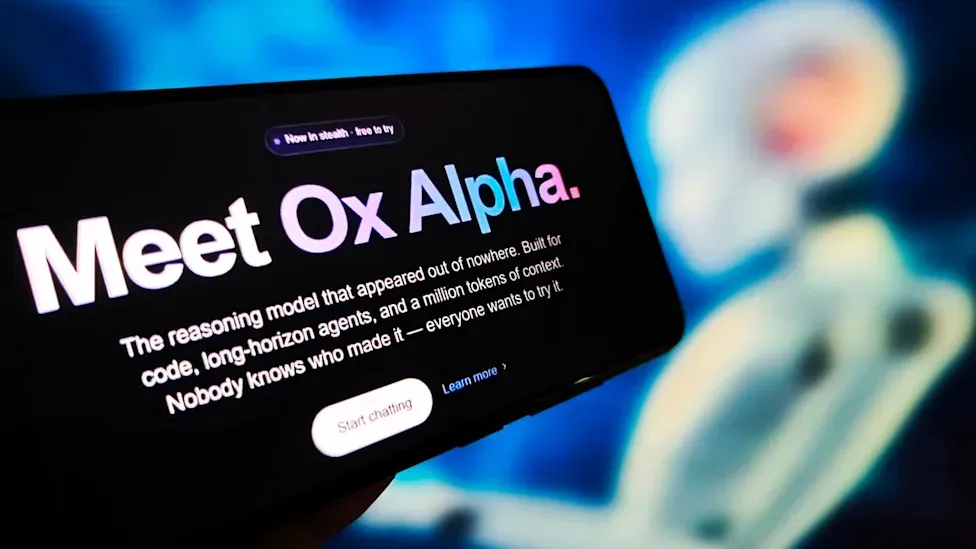
A new artificial intelligence model called Ox Alpha is gaining rapid traction among developers after appearing online for free, even as the identity of the lab behind it remains entirely unconfirmed. The model surfaced on AI marketplace OpenRouter on August 20 under the generic label “stealth model,” listed as stealth/ox-alpha, and was simultaneously promoted through the open-source terminal coding agent OpenCode as a free preview for complex coding and long-horizon agentic tasks.
Ox Alpha's technical specifications read like a frontier-class release: a context window of roughly 1.05 million tokens, a maximum output of 131,072 tokens per response, and full multimodal capability spanning text, image and video input — a combination few models at any price currently offer. OpenRouter lists the model at $0 per million tokens for both input and output, with the free access window expected to run for approximately one week, through around August 27, according to reporting that cited the anonymous provider's claimed capacity of 100 trillion tokens per day.
No company has publicly claimed the model, but community investigation has converged on a leading theory: serving-layer forensics — including stack traces, a matching error code and a tokenizer signature reported to align exactly with existing infrastructure — point toward Zhipu AI's Z.ai as the likely provider, according to developers who examined the model's technical footprint. Z.ai has not confirmed or denied the association.
The stealth-release playbook Ox Alpha follows is a familiar one in 2026's AI landscape: labs increasingly test unreleased or unbranded models against real developer traffic before committing to a public launch, absorbing any reputational risk from a weak showing under an anonymous codename while banking the goodwill of a strong one toward an eventual branded release. Developers examining Ox Alpha's terms of use have flagged a wrinkle, however: the OpenRouter Stealth Model End User License Agreement grants the platform and the unnamed provider the right to use submitted content for training and evaluation, meaning code or data sent to the model during the free window may be retained — a term that conflicts in places with the more limited per-model notice accompanying the listing.
Community testers have reported strong early results on coding benchmarks and real repository tasks, fuelling further speculation about the model's origin and capabilities, even as security-conscious developers have been advised to treat Ox Alpha as experimental — suitable for toy projects and benchmarking, but not yet appropriate for production workloads or sensitive proprietary code, given the unresolved questions around data retention and the absence of any named, accountable provider.
Whether Ox Alpha is eventually claimed by Zhipu AI, another established Chinese lab, or an entirely new entrant, the episode illustrates how central stealth releases have become to competitive dynamics in frontier AI: a genuinely capable model can now generate a week of global developer attention and benchmark data without its creator ever having to attach a name, a press release, or a pricing page to the launch.


