
OXG Space, a Bengaluru-based spacetech startup founded by former Indian Space Research Organisation (ISRO) engineers, has raised ₹17 crore to develop a satellite network that processes data in space rather than on the ground.
The round was led by Aum Ventures through its India Innovation Fund II. Skyroot Aerospace co-founders Pawan Kumar Chandana and Bharath Daka also invested, alongside Cosmoserve founder Chiran Phanindra. The participation of the founders behind Skyroot, India's best-known private launch company, gives OXG an unusually well-connected set of backers within the country's young space industry.
The startup will use the money to test its core technologies in orbit over the next 12 months.
The Problem: Data That Waits
Most Earth-observation satellites today operate on a simple but slow model. They capture images as they orbit, store them on board, and transmit them only when they pass over a ground station. Depending on the satellite's orbit and the location of ground infrastructure, that can mean data sits on board for hours before it reaches the people who need it.
For many applications, that delay is tolerable. For others, it is critical. A defence analyst tracking troop movements, a disaster response team mapping a flood or a commercial operator monitoring shipping traffic may find that imagery loses much of its value if it arrives hours after it was captured. Industry estimates cited by Whalesbook suggest data is inaccessible for a significant part of each day under the current model.
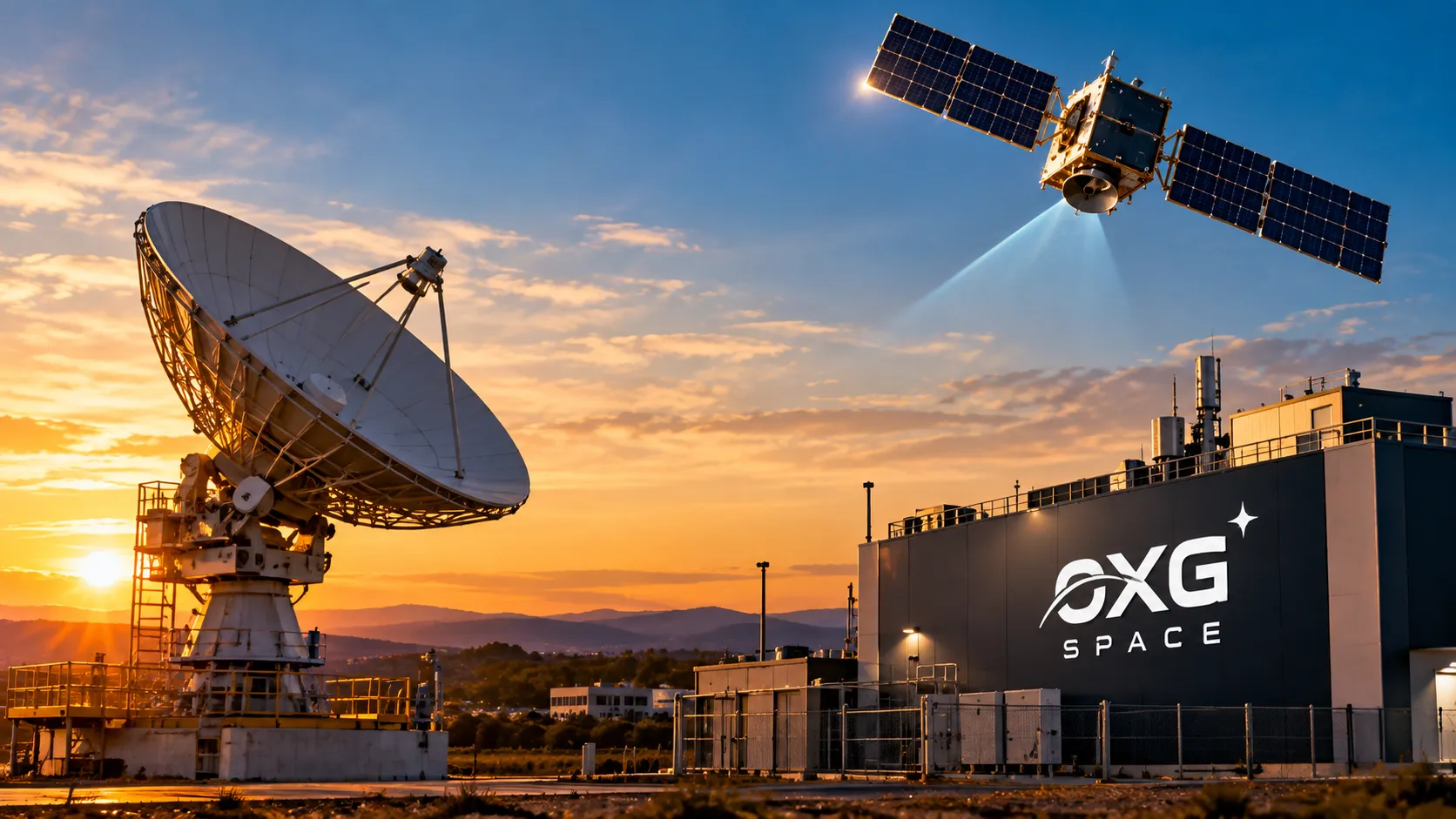
OXG Space wants to change that by processing data in orbit and transmitting the results quickly, so that satellite images reach users in near real time rather than hours later. The company describes its technology as "edge cell towers in space".
Mission Synapse
The centrepiece of OXG's near-term plan is Mission Synapse, a 12-month initiative to demonstrate in-orbit edge computing. The mission aims to show that Earth-observation data can be processed on board, cutting the dependence on ground-station passes.
The company's technology stack includes a Ka-band phased-array antenna, which it plans to scale from 1 Gbps to 64 Gbps per spacecraft; a deployable mesh reflector for links to the ground; and specialised solar arrays to power what is an energy-intensive communications payload.
Ka-band frequencies allow for much higher data rates than older bands commonly used in satellite communications, making them well suited to moving large volumes of imagery and processed data. Phased-array antennas, which can steer their beams electronically without moving parts, are increasingly central to modern satellite constellations, but building space-grade versions that are reliable, efficient and affordable remains a significant engineering challenge.
Who Is Building It
OXG Space is led by Akash Shetty and Sanjay Gorur, both former ISRO engineers. Their background reflects a wider pattern in India's private space sector, where alumni of the national space agency are bringing institutional experience in satellite design, testing and operations into a new generation of commercial ventures.
That experience is especially valuable in hardware-heavy segments such as communications payloads and power systems, where mistakes are expensive and the margin for error in orbit is essentially zero.
Targeting Defence and Commercial Customers
OXG is targeting defence, intelligence and commercial satellite operators. Defence and intelligence users are likely to be the most demanding early customers, as they place the highest value on timely data and are often willing to pay a premium for capabilities that shorten the time between observation and decision.
Commercial operators represent a larger long-term market. As constellations of small Earth-observation satellites multiply, the bottleneck is increasingly shifting from capturing images to moving and analysing the resulting data. Companies that can relieve that bottleneck could become important infrastructure providers for the broader industry.
Domestic demand is also rising. India's armed forces have placed growing emphasis on space-based surveillance, and the government approved the third phase of its Space-Based Surveillance programme in 2024, an initiative expected to put dozens of additional satellites into orbit, with a significant share built by private industry. More satellites watching more territory will generate far more data, increasing the value of any technology that can analyse imagery on board and deliver actionable results to commanders quickly. For a young Indian company, a credible domestic defence customer can provide early revenue, technical validation and a foundation from which to pursue international commercial contracts.
India's Space Economy Opens Up
The raise comes as India's private space sector continues to mature following reforms that opened the industry to private companies. The creation of IN-SPACe as a regulator and promoter for private space activity, together with a series of policy changes, has allowed startups to build satellites, launch vehicles and ground infrastructure that were once the preserve of ISRO.
Skyroot, whose co-founders are now backing OXG, has become a symbol of that shift. Its founders' decision to invest in an adjacent startup suggests a growing ecosystem in which successful operators are recycling expertise and capital into the next wave of companies.
In-orbit computing is also attracting attention elsewhere in India. Earlier this year, other Indian startups put AI computing payloads into orbit, part of a global push to move processing closer to where data is generated.
Risks and Milestones
OXG Space faces the challenges common to early-stage space hardware companies. Space-grade phased-array hardware must undergo rigorous testing, and delays in building, integrating or launching hardware are common across the industry. Operating complex electronics in the harsh radiation and thermal environment of orbit introduces technical risks that cannot be fully eliminated on the ground.
The business is also capital-intensive. Space startups typically need several rounds of private funding before they reach commercial viability, and ₹17 crore is a modest sum by global standards for satellite hardware development. The company has not disclosed its valuation, its expected launch dates or any commercial customers.
The in-orbit computing market itself is still emerging, and OXG will face competition from established global satellite operators as well as other startups pursuing similar ideas.
The Test Ahead
The performance of Mission Synapse over the next 12 months will be the key milestone. A successful demonstration would validate OXG's technology, strengthen its case with defence and commercial customers and lay the groundwork for a larger fundraise to build out a constellation.
For India's space ambitions, the company represents an important category of innovation. Launch vehicles and satellites capture headlines, but the systems that move and process data in orbit may ultimately determine how much value the country's growing space infrastructure can deliver. If OXG Space can prove its "edge cell towers in space" concept, it could help ensure that Indian-built satellites deliver not just images, but timely intelligence.


