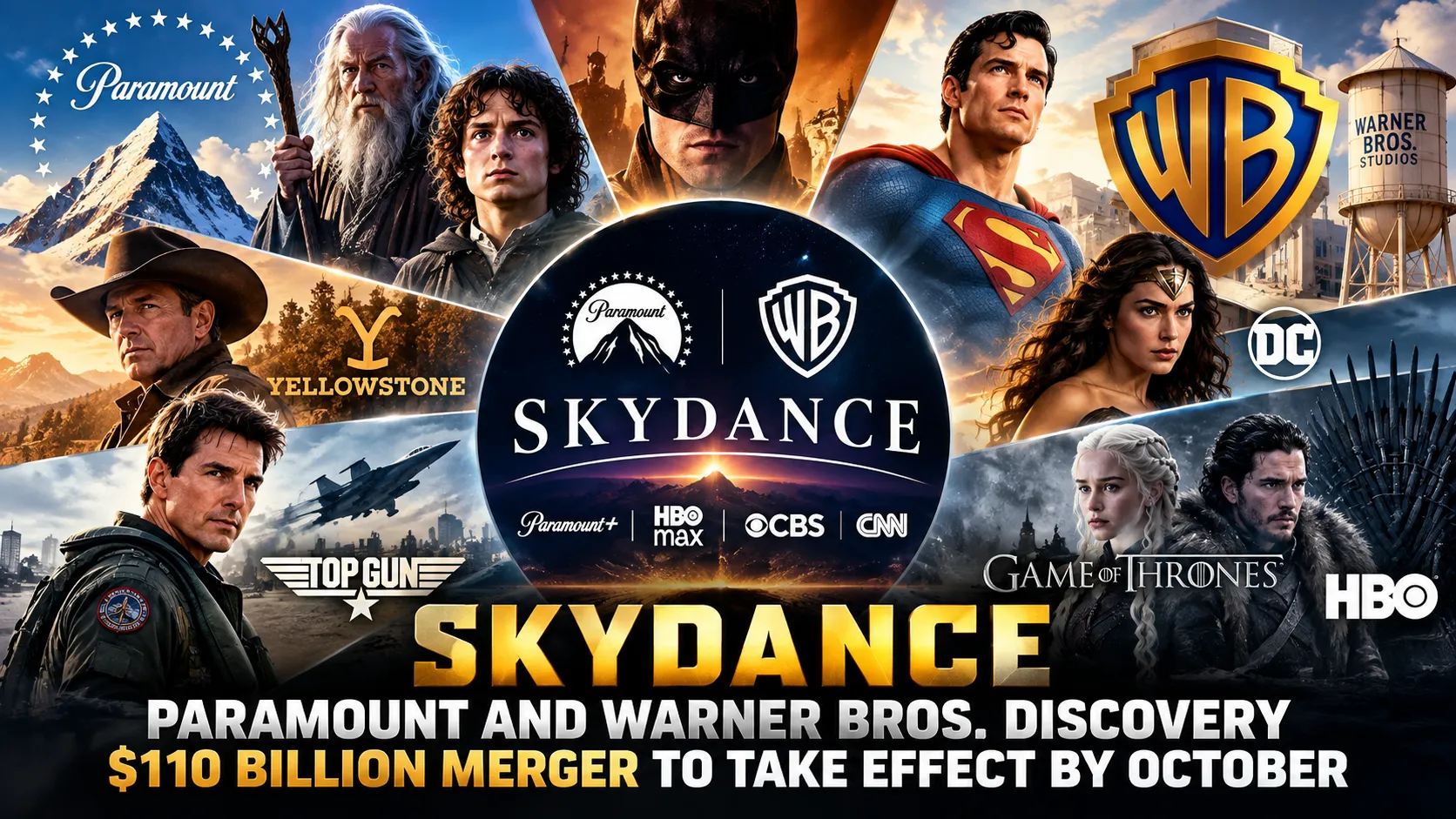
Two of Hollywood's most storied companies are about to share a new name. David Ellison, chief executive of Paramount, said on Friday, 2 October, that the combined Paramount and Warner Bros. Discovery will operate under the Skydance name once their merger is completed, creating one of the largest entertainment groups in the world.
The deal, valued at about $110 billion, is expected to close on 6 October, according to TechCrunch. It brings together CBS, CNN, HBO, Paramount Pictures, Warner Bros. studios, a large portfolio of cable networks and two major streaming services, Paramount+ and HBO Max, under a single corporate roof.
Ellison, who announced the name on social media, said the choice was designed to give the group its own identity without overshadowing its famous brands. "We never wanted a new corporate identity to diminish, alter or overshadow either one," he said. The Skydance name, he said, gives "the company an identity of its own" while both studios "remain in the spotlight".
Skydance is the production company Ellison founded in 2010, which merged with Paramount in a deal that closed in 2025. Taking the name for the combined group cements his position as the architect of a new media giant.
Regulatory hurdle cleared
The path to completion became clearer this week when a judge approved a settlement with state attorneys general. Twelve states had challenged the merger, raising concerns about its impact on competition, consumers and workers. The terms of the settlement were designed to address those concerns and allow the transaction to proceed.
Large media mergers in the United States typically face scrutiny over their effects on content prices, the bargaining power of distributors and the number of independent voices in news. With CNN and CBS News under common ownership, the combined company will control two of the most prominent news organisations in the country, an issue that attracted attention from critics during the review process.
What the combined company owns
The scale of the group is striking. It will control franchises including "The Lord of the Rings", "Game of Thrones", the DC Universe of superheroes and "Yellowstone", alongside vast film and television libraries built over a century. Its networks include CBS, CNN, MTV, TBS, Comedy Central and Food Network.
In streaming, the merger combines Paramount+ and HBO Max, two services that have struggled to match the scale of Netflix and the bundled offerings of Disney and Amazon. Industry analysts have long argued that the streaming market cannot sustain many independent subscription services of mid-tier size, and that consolidation was inevitable. Combining two libraries and subscriber bases could give the new company more pricing power and a stronger position in negotiations with advertisers and distributors.
The brands themselves will remain prominent. Rather than folding HBO into Paramount or vice versa, the strategy appears to be to keep the consumer-facing names intact while integrating the corporate, technology and distribution functions behind them.
The economics of scale
Traditional media companies have faced a difficult decade. Cable television, once a reliable source of subscription and advertising revenue, has been in steady decline as households cut the cord. Streaming services required heavy investment in content and technology and took years to approach profitability. Box office revenue has recovered from pandemic lows but remains volatile.
Against that backdrop, scale offers several advantages. A larger company can spread the cost of technology platforms and marketing over more subscribers, negotiate better terms with cinema chains and distributors, and squeeze more value from its libraries by licensing content across more channels and territories. Cost synergies, typically achieved through job cuts and the consolidation of overlapping functions, are usually a central part of the financial case for deals of this kind.
The risks are equally familiar. Media mergers have a mixed track record, and integrating two large organisations with distinct cultures is difficult. Warner Bros. Discovery itself was the product of a 2022 merger between WarnerMedia and Discovery that was followed by heavy debt, write-downs and restructuring. Investors will watch closely to see whether the new combination can avoid similar problems.
Debt will be a key issue. Large media acquisitions are often financed with borrowing, and servicing that debt at a time of elevated interest rates can constrain investment in content.
Talent, creativity and the AI question
The merger also arrives as Hollywood grapples with the impact of artificial intelligence on production. Studios are experimenting with AI tools for visual effects, dubbing and pre-production, while writers, actors and other creative workers have pressed for protections over the use of their work and likenesses. A larger studio group will have greater resources to invest in such tools, and greater influence over the industry's norms. The approach Skydance takes will matter for creative workers far beyond its own payroll. ## The Ellison factor
David Ellison is the son of Larry Ellison, the co-founder of software giant Oracle and one of the world's richest people, whose financial backing was central to Skydance's earlier takeover of Paramount. That combination of family wealth and a founder-led studio has made the younger Ellison one of the most closely watched executives in the entertainment industry. Bringing Warner Bros. Discovery under his control dramatically expands his influence, and the decision to put his original company's name on the combined group signals how personally he identifies with the project. Employees across both companies will be watching for details of integration plans, which in media mergers typically include consolidation of overlapping corporate functions.
Global implications
For international audiences, including in India, the combination will shape what content is available and how it is priced. Both HBO content and Paramount's catalogue are licensed to streaming and broadcast partners in many markets, and changes in licensing strategy after a merger can move popular shows from one platform to another. In India, where streaming competition is intense and dominated by local players and global giants alike, the strategy of a merged Hollywood group on licensing versus direct-to-consumer services will be watched closely by platform operators.
The deal also signals the direction of the global media business. Scale is increasingly seen as essential to compete with technology companies that can subsidise video with revenue from devices, cloud services or advertising. Whether the new Skydance can compete on that playing field will depend on how well it integrates two complex organisations and how effectively it turns a century of creative assets into a sustainable business.
For now, the name change marks the end of one era in Hollywood and the beginning of another, with Ellison at the centre of it.