FundingMarket Data Women6 MIN READ

PB Fintech Suffers Record One-Day Crash as IRDAI's Commission-Cap Plan Threatens India's Insurance Distribution Model

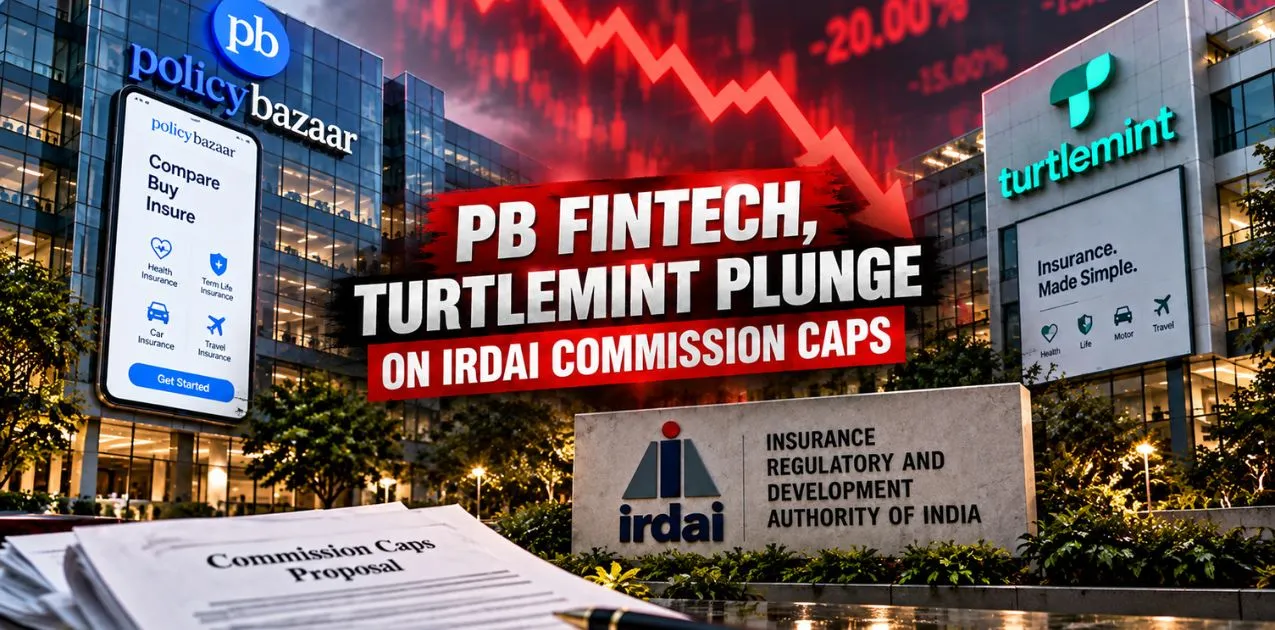
Policybazaar parent PB Fintech fell as much as 36% and Turtlemint hit its lower circuit after India's insurance regulator proposed hard caps on distributor commissions, wiping out more than ₹25,000 crore in market value in a single session.

By Aravind Kumar · Author25 September 2026Breaking
PB Fintech Suffers Record One-Day Crash as IRDAI's Commission-Cap Plan Threatens India's Insurance Distribution Model

India's largest online insurance marketplace had the worst trading day in its history on Thursday, September 24, as investors rushed to price in a regulatory proposal that could rewrite how insurance is sold in the country.

Shares of PB Fintech, the parent of Policybazaar and PaisaBazaar, fell as much as 36% to ₹1,207.20 on the National Stock Exchange, the stock's steepest single-day decline since it listed in 2021. The shares had closed at ₹1,886.30 in the previous session. By the end of trade, more than ₹25,000 crore had been erased from the company's market value, leaving it at roughly ₹56,000 crore.

Turtlemint, the insurance distribution platform that listed only in June 2026, fared no better. Its shares fell 20% to hit the lower circuit at about ₹109, the lowest level since the company's market debut.

The trigger was a consultation paper released a day earlier by the Insurance Regulatory and Development Authority of India (IRDAI), titled "Recalibrating Economics of Insurance Distribution". The document proposes hard caps on the commissions insurers can pay to intermediaries and a tighter ceiling on how much insurers can spend on running their businesses.

What the regulator has proposed

The draft ties commission payouts to the segment, line of business, distribution channel, product complexity and the effort involved in selling and servicing a policy. In practical terms, it would sharply reduce what intermediaries earn on some of their highest-volume products.

For motor insurance, IRDAI has proposed nil commission for distribution entities on third-party cover for new vehicles and a 5% cap on own-damage cover for new vehicles. According to figures cited in the consultation, motor commissions currently average about 24%, and range from 13% to as much as 50%.

In health insurance, commissions would be limited to 15% on first-time sales and 5% on renewals. In life insurance, first-year commissions would be capped at between 5% and 20%, depending on the tenure of the policy, and payouts would be spread across multiple years rather than concentrated at the point of sale. The paper also proposes lower commissions for products sold through open-architecture channels such as brokers and banks, which account for a large share of health, motor and life insurance sales.

Alongside the commission caps, IRDAI has proposed tighter limits on insurers' expenses of management (EoM). Life insurers would have to bring EoM down to 15% within two years and 12.5% within five years, while general insurers would face limits of 25% within two years and 20% within five years.

The proposals are not yet final. IRDAI has invited feedback from stakeholders until October 25, 2026, and implementation has been proposed from the 2027-28 financial year.

Why the market reacted so sharply

For a digital distributor, commissions are not a line item. They are the revenue. That is why brokerages identified PB Fintech as the listed company most exposed to the proposed framework.

Jefferies estimated that the caps could cut commissions in health, term and motor insurance by between one-third and one-half. The brokerage calculated that every 10% reduction in new-business commission rates could translate into a 10–12% decline in earnings for PB Fintech and Turtlemint. It also said the chance of a major rollback appeared limited, because IRDAI had published supporting data alongside the consultation paper.

Bernstein said the proposed cuts were steeper than it had expected and threatened the unit economics of distributors such as Policybazaar, especially in health and motor. It nonetheless expects strong pushback from the industry during the consultation period. Macquarie also named PB Fintech as the most exposed company, noting that the proposals appear to favour tied agents over broker channels.

Citi warned that distribution economics could compress by 70–90% in high-margin categories, and flagged credit-linked insurance — policies sold alongside loans, where commissions are often several times the proposed caps — as particularly vulnerable. HSBC described the EoM limits as stringent and said HDFC Life, Max Financial Services and PB Fintech could face a greater impact than SBI Life.

“For a distributor, the commission is not a fee on top of the business. It is the business — and the regulator has just proposed to redraw it.”
— TIGI Analysis

The selling spread well beyond the two distributors. Max Financial Services fell about 12% during the session, while HDFC Life Insurance and Bajaj Finance each dropped around 6% and Bajaj Finserv slipped about 4%.

image.png

Management calls the plan "quite extreme"

PB Fintech's management held a call with analysts on the same day. According to excerpts posted by analysts and reported by Business Standard, the company described the proposals as "quite extreme" and said they could significantly affect its general insurance business, while the impact on life insurance would be more limited. Life and non-life products contribute roughly equally to its revenue.

The company said that if general insurance commissions fell by 60%, it could make up part of the gap through higher volumes, although the net present value of the business would suffer. It expects that larger agents may find it less attractive to sell insurance at the proposed rates, that hiring will slow, and that it will need to rework its point-of-sale person (POSP) business.

Management also said the company may explore new business options, including seeking a licence to manufacture insurance products itself — a notable shift for a company built as a marketplace. It does not expect any impact on the current financial year, anticipates that FY28 will be volatile as the new framework takes effect, and aims to be back on track by FY29. Its international expansion plans are unchanged.

The remarks carried a pointed reminder: PB Fintech took 15 years to turn profitable. Investors on Thursday were effectively asking how much of that hard-won profitability rests on commission structures the regulator now wants to change.

The policy logic behind the draft

IRDAI's stated aim is to improve transparency, reduce mis-selling and make insurance more affordable for policyholders. High commissions, particularly on bundled and credit-linked products, have long been criticised for pushing customers towards policies that pay the seller well rather than products that suit the buyer. By tying payouts to the effort and complexity involved in a sale, the regulator is trying to reward advice and service rather than volume alone.

That argument has support among consumer advocates, and some insurers stand to benefit. Jefferies noted that Star Health and Allied Insurance, which sources around 85% of its business through its own agency network, could be relatively better placed. It also suggested that any correction in SBI Life, Star Health and ICICI Lombard could offer buying opportunities, given their limited exposure and potential market-share gains.

For India's insurtech sector, however, the question is existential. The business model of online aggregators rests on high-volume, low-touch sales in motor and health, precisely the categories where the proposed caps bite hardest.

What to watch next

Three things will shape the outcome over the coming months.

The first is how much of the draft survives consultation. With feedback open until October 25, insurers, brokers, banks and distributors are expected to lobby hard for softer caps and longer transition periods.

The second is the timeline. The EoM glide path runs over two to five years, and brokerages have flagged FY28 as the year when earnings pressure could become visible if the framework is adopted largely as proposed.

The third is how companies adapt. PB Fintech has already signalled that it could move into manufacturing insurance, slow hiring and restructure its agent network. Other distributors are likely to look for fee-based services, advisory models and non-insurance revenue to reduce their dependence on commissions.

For investors, Thursday's sell-off was a reminder that regulatory risk in financial services can reprice a business in a single session. For policyholders, the proposal could mean cheaper and more transparent products over time. For India's insurance distribution industry, the next four weeks may decide what its business model looks like for the rest of the decade.

TagsPB FintechPolicybazaarTurtlemintIRDAIInsuranceInsurtechCommission CapDalal StreetJefferiesBernsteinIndian MarketsFintechRegulation

Reader reviews

Sign in to rate and review this article.
Loading reviews…