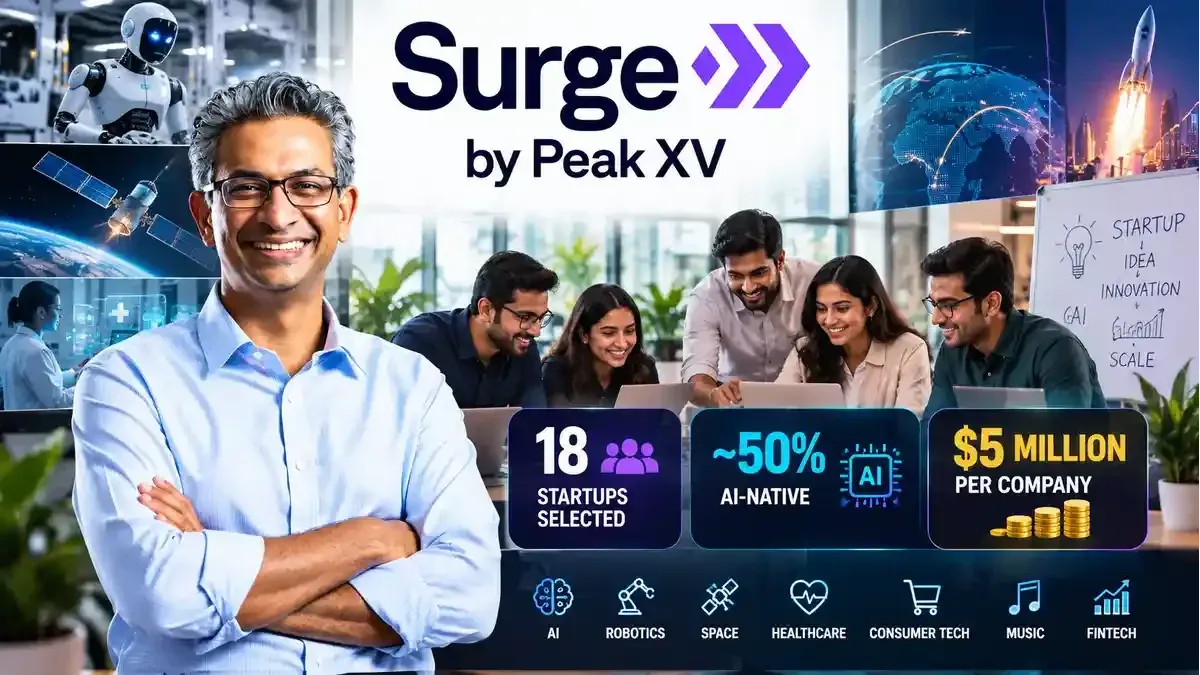
Peak XV Partners has unveiled the 12th cohort of Surge, its early-stage investment programme, selecting 18 startups and raising the maximum amount it will invest in each company from $3 million to $5 million. The move reflects a sharp change in the economics of early-stage venture capital, where founders now need more capital, and more progress, before they can raise a Series A.
"The bar to raise a Series A has gone up pretty significantly," Rajan Anandan, managing director at Peak XV, said in comments reported by TechCrunch. He pointed to the rise of capital-intensive deep technology companies as one reason seed rounds are getting larger.
Peak XV has invested more than $50 million in the Surge 12 cohort, and the companies have collectively raised more than $90 million in seed funding. Five of the startups are building primarily for Indian markets, while 13 are targeting global customers. Their founders represent more than 18 nationalities, with companies based in cities ranging from San Francisco to Sydney.
Who made the cohort
Fifteen of the 18 companies have been named publicly, with three still operating in stealth across education, applied AI and medical products. The disclosed list spans a wide range of sectors, although artificial intelligence runs through most of them.
In consumer and health, Hoola Health offers integrated healthcare for children, covering consultations, vaccines, diagnostics, therapy and dental care. August AI combines artificial intelligence with physician oversight and says it serves more than nine million users across 160 countries. Wingit is building a premium beauty discovery and shopping platform for Indian consumers, while Ditto is an AI matchmaker for college students that works inside iMessage.
In financial services, Tribe Money is an AI-powered personal finance platform for tracking spending and researching investments. GameStock applies competitive game mechanics to trading and investing, and Rosella is building an AI-native commercial insurance brokerage that automates the placement process.
The enterprise AI contingent includes Hiloop, a post-training platform that helps AI companies adapt general-purpose models; Reinforce Labs, which provides evaluation, red-teaming and remediation tools for enterprise AI; Kello, which uses AI to discover talent beyond formal credentials; and Kindling, an AI-powered storytelling system for startup communications.
The deep technology companies may prove the most striking. Puralink builds autonomous robots that navigate underground pipe networks for inspection, Ulook develops autonomous satellite systems for radio-frequency sensing and spectrum intelligence, and Alma is building a personal computing platform focused on speed and affordability. Riffle, a browser-based collaborative music creation platform, rounds out the list.
Why seed cheques are getting bigger
The decision to lift Surge's investment ceiling by two-thirds says as much about the state of venture capital as it does about Peak XV's ambitions. After the funding boom of 2021, investors became far more selective at the Series A stage. Startups that once raised a Series A on the strength of early traction are now expected to show meaningful revenue, clear product-market fit and, increasingly, a credible path to efficiency.
At the same time, the nature of what founders are building has changed. Companies developing AI models, robotics hardware or satellite systems need far more capital to reach meaningful milestones than a software application built on existing cloud infrastructure. A $3 million seed round may be enough for a lean consumer app, but it can be quickly consumed by a hardware startup paying for prototypes, testing and specialist engineers.
By raising its cap to $5 million, Peak XV gives founders a longer runway to hit the metrics that Series A investors now demand. It also positions the firm to compete for the most sought-after early-stage deals, where larger global funds and specialist AI investors are offering generous terms.
Surge's track record
Surge was launched in 2019 by what was then Sequoia Capital India and Southeast Asia. The firm rebranded as Peak XV Partners in 2023 after separating from Sequoia's US and China businesses. Since its launch, Surge has backed more than 180 startups, and Peak XV says the 10 largest companies from the programme now generate more than $1 billion in combined annual revenue.
The programme combines capital with a structured curriculum of mentorship, founder workshops and access to Peak XV's network of portfolio companies and later-stage investors. Its alumni include several companies that have gone on to raise significant later-stage funding, making a Surge selection a valued signal for early-stage founders.
## What founders should take from the cohort
For founders preparing to raise, Surge 12 offers several signals. First, AI is now a baseline expectation rather than a differentiator; almost every company in the cohort uses it at the core of its product. What distinguishes them is the specific problem they are solving and the data or distribution advantage they can build around it. Second, hardware and space are back in favour, provided founders can show a credible path to commercial customers. Third, investors are prepared to back consumer ideas, such as children's healthcare and beauty discovery, when they address clear gaps in the Indian market.
The larger cheques also bring higher expectations. A $5 million seed round is closer in size to what many Series A rounds looked like a decade ago. Founders who accept that capital will be expected to use it to reach commercial milestones, not just to refine a prototype.
India and the world
The composition of Surge 12 also reveals how Peak XV thinks about geography. With 13 of 18 companies targeting global markets, the cohort reflects a view that founders from India and Southeast Asia can build products for customers anywhere from day one, particularly in AI and software. The five India-focused companies, meanwhile, show continued conviction in domestic consumption themes such as children's healthcare, beauty and personal finance.
For India's startup ecosystem, the move to larger seed cheques could have ripple effects. Other early-stage funds may feel pressure to match Peak XV's terms, and founders may begin to expect bigger first rounds. That could help deep technology startups in particular, which have historically struggled to raise enough early capital in India to compete with better-funded peers in the United States.
The risk, as always, is that larger rounds raise expectations and valuations before companies have proved their models. But for now, Peak XV is betting that giving founders more room to build is the best way to find the next generation of breakout companies.