India's digital payments revolution has created some of the world's busiest payment networks, but turning that activity into profit has proved difficult for many fintech companies. Pine Labs, one of the oldest names in Indian merchant payments, is showing signs of making the transition.
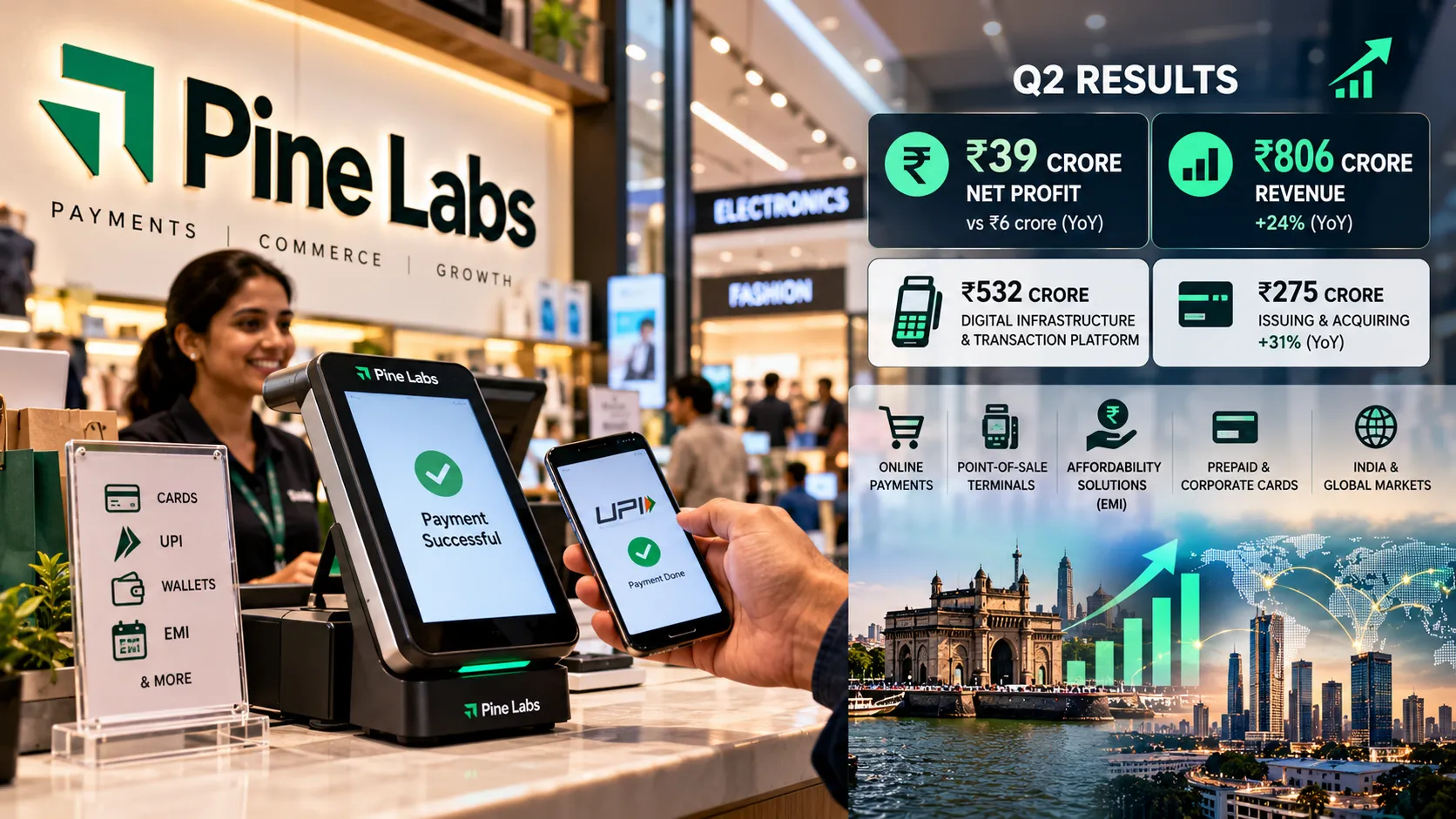
The Noida-based company reported net profit of ₹39 crore for the July-September quarter, up from ₹6 crore a year earlier, according to StartupTalky on Thursday, October 29. Revenue rose 24% to ₹806 crore.
Its digital infrastructure and transaction platform business contributed ₹532 crore of revenue, while revenue from issuing and acquiring rose 31% to ₹275 crore.
Breaking down the business
Pine Labs operates two main businesses. The first, its digital infrastructure and transaction platform, provides point-of-sale terminals, online payment gateways and software that allow merchants to accept payments by card, UPI, wallets and other methods. It also offers value-added services such as affordability solutions, which enable consumers to pay for purchases in instalments through partnerships with banks and brands.
The second business, issuing and acquiring, includes services for banks and companies that issue prepaid cards, gift cards and corporate cards, as well as processing services. Growth of 31% in this segment, faster than overall revenue growth, suggests it is becoming an increasingly important contributor.
From terminals to platforms
Founded in 1998, Pine Labs began as a provider of payment technology for fuel stations and later became known for its point-of-sale terminals in shops and malls across India. Over time, it has expanded into a broader platform offering online payments, instalment financing at checkout, loyalty programmes, gift cards and software for merchants and brands.
The affordability business has been a key differentiator. Pine Labs partners with consumer electronics and appliance brands and with banks to offer no-cost and low-cost EMIs at the point of sale, allowing consumers to spread the cost of purchases such as smartphones, televisions and refrigerators. Brands and banks pay Pine Labs for facilitating these transactions, which helps drive sales of high-value goods.
A listed fintech
Pine Labs listed on Indian stock exchanges in November 2025, joining a growing group of publicly traded Indian fintech companies, including Paytm, PB Fintech (Policybazaar) and MobiKwik. Public market investors have generally been more demanding than private investors, placing greater emphasis on profitability, cash generation and predictable growth.
The rise in profit from ₹6 crore to ₹39 crore will be welcomed by shareholders as evidence that the company can grow its bottom line while expanding its revenue. However, the profit margin remains relatively thin, at under 5% of revenue, leaving room for improvement.
The UPI effect
India's Unified Payments Interface has transformed how Indians pay, with billions of transactions each month. UPI payments are free for consumers and largely free for merchants under current rules, which has made it difficult for payment companies to earn revenue directly from UPI transactions. This has pushed fintech companies to find other sources of revenue, such as lending, merchant software, card-based payments and value-added services.
For Pine Labs, card payments, affordability solutions and enterprise services remain important revenue drivers. Card payments carry merchant discount rates, giving payment processors a share of each transaction. Credit card usage in India has grown strongly, supporting card-related revenue, even as UPI dominates by number of transactions.
International expansion
Pine Labs has expanded beyond India into Southeast Asia and the Middle East, where it offers payment and affordability solutions to merchants and banks. Markets such as Malaysia, Singapore, the United Arab Emirates and others offer growth opportunities, particularly in instalment payments and card issuing. International markets also allow Pine Labs to diversify its revenue and reduce reliance on India's regulatory environment.
Competition
Pine Labs competes with a wide range of companies. In offline merchant payments, it faces competition from Paytm, PhonePe, Razorpay's offline business and bank-owned terminals. In online payments, Razorpay, Cashfree, PayU and others are strong competitors. In the issuing and processing business, it competes with global and domestic technology providers.
Competition has intensified as UPI-based soundboxes and QR codes have made it cheaper for small merchants to accept digital payments without traditional card terminals. Pine Labs has focused on larger merchants, brands and enterprises, where its broader range of services offers more value.
The regulatory environment
The Reserve Bank of India closely regulates payment companies, including through licences for payment aggregators and rules on data storage, tokenisation of card data and customer protection. Regulatory changes can have significant effects on fintech business models. In recent years, the RBI has tightened oversight of digital lending and payment aggregators, and companies have had to invest in compliance.
The RBI's action against Paytm Payments Bank in 2024 highlighted the regulatory risks facing fintech companies, and investors now pay close attention to governance and compliance.
The bigger picture for Indian fintech
India's fintech sector has matured significantly over the past decade. After years of rapid growth funded by venture capital, many companies are now focused on profitability and sustainable business models. Public listings have brought greater transparency, allowing investors to compare performance across companies.
Pine Labs' results add to evidence that the leading fintech companies can generate profits, though margins in payments remain competitive. Lending, wealth management and insurance distribution are generally more profitable areas, and many payment companies are seeking to expand into them.
What it means for investors
For investors, Pine Labs' results show a business that is growing steadily and moving towards stronger profitability. Key questions include how quickly margins can improve, the growth trajectory of its international business and the sustainability of its affordability solutions as consumer credit conditions change.
The festive season, when consumers buy electronics, appliances and other high-value goods, is particularly important for Pine Labs' affordability business, and the October-December quarter could show a seasonal boost.
The merchant software opportunity
Beyond payments, Pine Labs has been building software that helps merchants manage loyalty programmes, run promotions and analyse customer data. Such software can deepen relationships with merchants and brands, making them less likely to switch to competitors. It also provides opportunities for recurring revenue, which investors typically value highly.
What comes next
Pine Labs will need to show that it can sustain revenue growth while expanding margins. Its performance during the festive quarter, the growth of its issuing business and its progress in international markets will be key indicators. As India's digital payments market continues to grow, the company's long experience with merchants and banks gives it a solid foundation, but competition and regulation will remain important challenges.