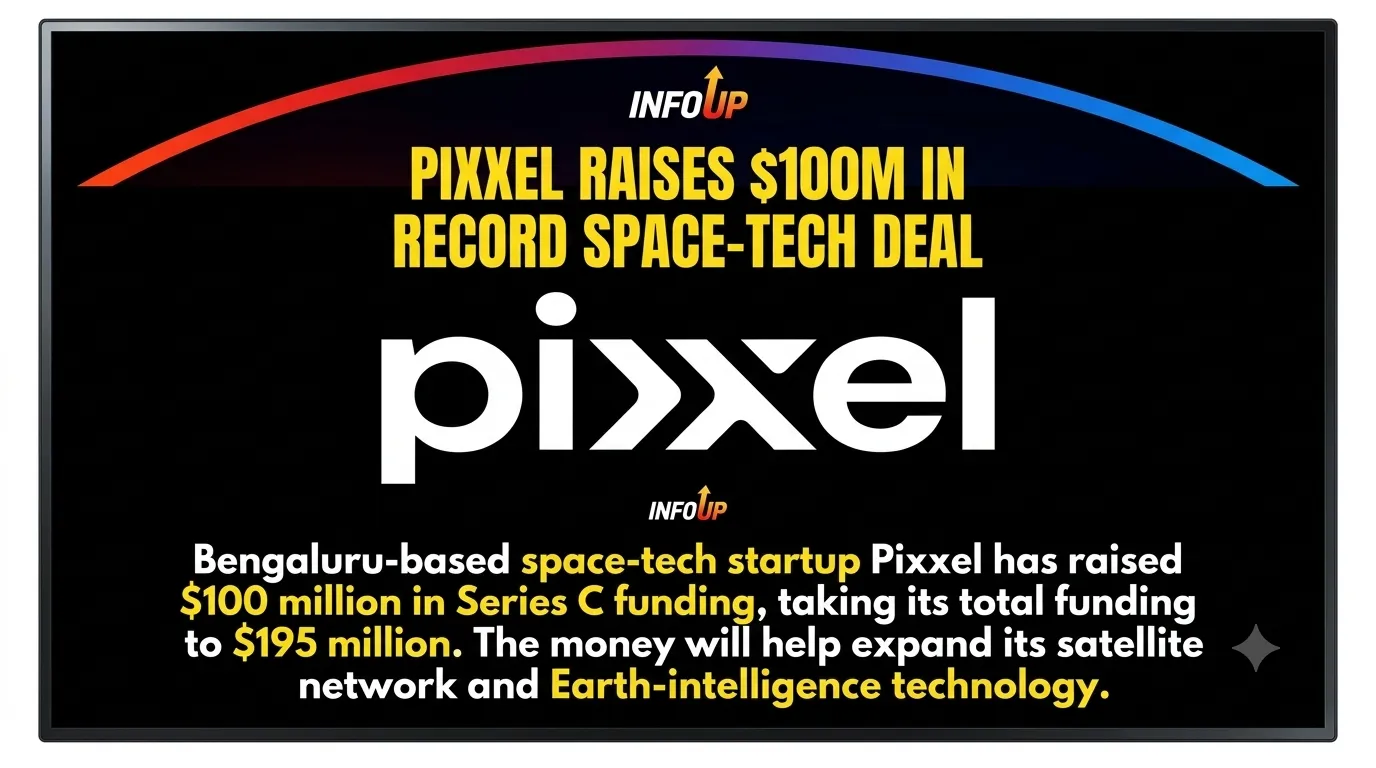
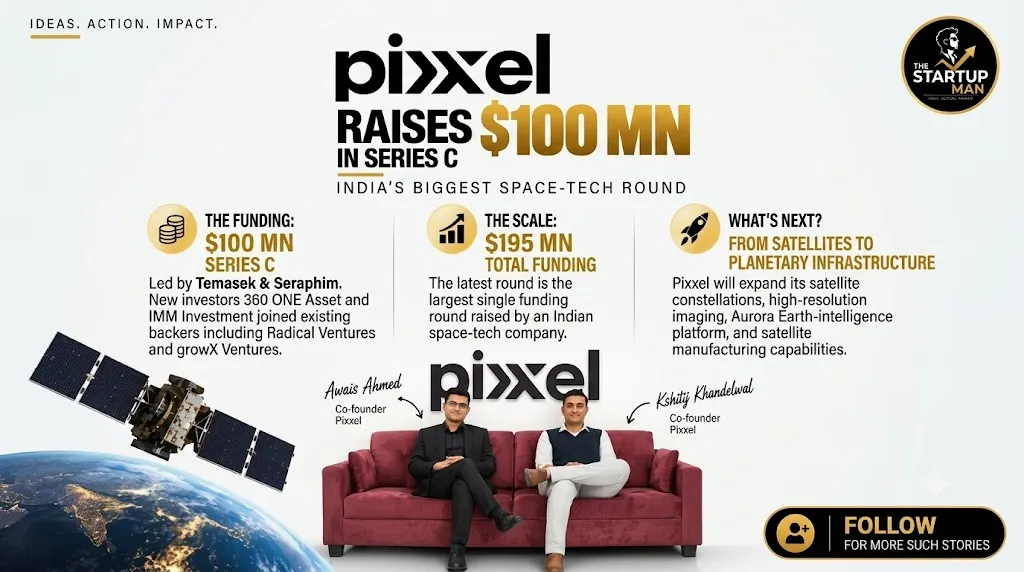
Pixxel, the Bengaluru-founded hyperspectral satellite company, has raised $100 million in a Series C funding round co-led by Temasek and Seraphim, with new investors 360 ONE Asset and South Korea's IMM Investment joining alongside existing backers Radical Ventures and growX Ventures. The round, announced on September 7 and confirmed in weekly funding data through September 11, takes Pixxel's total disclosed funding to $195 million, making it the best-capitalised private space technology company in Indian history.
Founded in 2019 by Awais Ahmed and Kshitij Khandelwal, Pixxel builds hyperspectral satellites capable of capturing detailed information about the Earth's surface far beyond what conventional optical imaging satellites can detect. Hyperspectral sensors record data across dozens or hundreds of narrow wavelength bands rather than the handful captured by standard cameras, allowing analysts to identify the chemical and material composition of what is being observed — distinguishing between crop types and detecting early-stage plant stress, for instance, or identifying mineral deposits and monitoring methane emissions from industrial facilities.
That capability has positioned Pixxel at the intersection of two of the fastest-growing demand drivers in the commercial space sector: climate and environmental monitoring, and defence and intelligence applications. Governments and corporations alike have shown increasing appetite for high-resolution, chemically detailed Earth observation data, whether for agricultural insurance underwriting, supply-chain verification, environmental compliance monitoring, or national security purposes — a demand base broad enough to support multiple well-funded competitors globally without any single company capturing the entire addressable market.
The composition of Pixxel's Series C investor base reflects that dual commercial and strategic positioning. Temasek, the Singapore state investment firm, and Seraphim, a specialist space-technology venture fund, bring both deep pockets and sector-specific expertise to the cap table, while the participation of 360 ONE Asset and IMM Investment broadens Pixxel's institutional investor base across South and Southeast Asia. The continued involvement of Radical Ventures and growX Ventures, both of which backed earlier rounds, signals sustained conviction from Pixxel's existing investor base even as the company's valuation and capital needs have scaled considerably since its founding.
India's broader space technology sector has undergone a rapid transformation since the government opened the industry to private participation in 2020, moving from a landscape dominated almost entirely by the state-run Indian Space Research Organisation to one that now includes dozens of venture-backed startups building satellites, launch vehicles and ground infrastructure. Pixxel's emergence as the best-funded of these companies underscores investor confidence that India's spacetech ecosystem can produce globally competitive players rather than companies confined to serving only the domestic market.
The new capital is expected to support the continued deployment of Pixxel's satellite constellation, expansion of its data-analytics and customer-delivery platform, and further investment in the ground infrastructure required to process and distribute hyperspectral imagery at commercial scale. The company has previously stated ambitions to build one of the largest commercial hyperspectral constellations globally, a goal that requires sustained capital investment given the manufacturing and launch costs inherent to any satellite constellation business.
The raise arrives during an unusually active week for Indian startup funding more broadly, with total venture investment into Indian companies doubling week-on-week to $392 million across 27 deals in the period spanning September 5 to 11, according to weekly tracking data. Pixxel's round represented by far the largest single transaction in that period, more than double the size of the next-largest deal, underscoring the extent to which a small number of high-conviction, capital-intensive deep-tech bets are now driving headline Indian funding figures even as overall deal counts remain comparatively modest.
For India's spacetech sector specifically, Pixxel's Series C is likely to be read as a bellwether. As global competition in Earth observation intensifies — with well-funded rivals operating out of the United States, Europe and China — the ability of an Indian company to attract marquee international investors at this scale suggests the domestic sector has moved decisively past its earliest, most speculative phase and into a period where serious global capital is willing to back Indian-built space infrastructure on its technical and commercial merits alone.