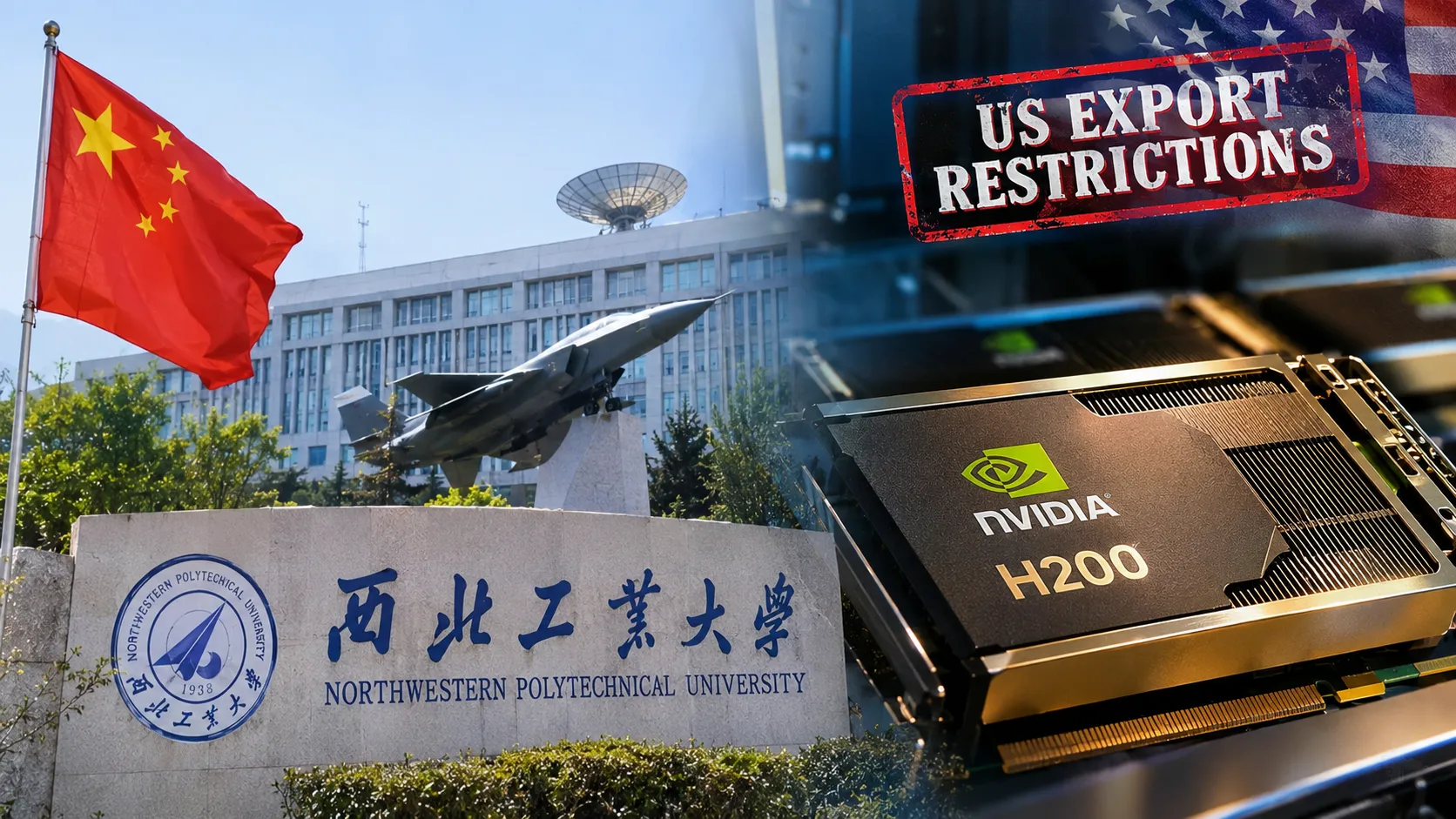
A Chinese university with deep ties to the country's military bought advanced Nvidia artificial intelligence chips this year despite being on a US government blacklist, according to procurement records reviewed by Reuters, raising fresh questions about the effectiveness of American export controls.
Northwestern Polytechnical University, based in Xi'an, bought two Nvidia H200 chips for its management school for 874,700 yuan, about $123,000, in October, according to a procurement record dated October 21 on the university's website, Reuters reported on Wednesday, November 11. The chips were supplied by Shaanxi Bosuan Network Technology, not by Nvidia directly, and Reuters could not find contact details for the supplier.
More purchases
The university's cybersecurity school also signed two seven-month contracts in January, worth 441,700 yuan and 441,000 yuan, for servers containing eight H200 chips each, to be used for AI fine-tuning and reinforcement learning training, according to Reuters. The university also rented servers with Nvidia's A100 and A800 chips and signed five contracts for rented computing this year.
Reuters reviewed 26 Chinese procurement and corporate records from this year in its investigation.
A university with military ties
Northwestern Polytechnical University is part of the so-called Seven Sons of National Defence, a group of Chinese universities with close ties to the People's Liberation Army, according to Reuters. It conducts research on military aircraft, missiles and satellites.
The US Commerce Department added the university to its Entity List in 2001 over alleged missile proliferation and military research, and tightened restrictions in 2019, making licence applications subject to a policy of denial in most circumstances, Reuters reported. Companies on the Entity List cannot receive US-origin technology without a licence from the Commerce Department.
The H200 policy
The H200 is one of Nvidia's most powerful AI processors, although it has been superseded by the company's newer Blackwell chips. In January, the Trump administration began allowing some H200 exports to China on a case-by-case basis, according to Reuters. However, that decision did not lift separate restrictions on organisations on the Entity List, and the rules require safeguards against blacklisted entities and military end users remotely accessing exported chips.
The Reuters findings suggest that chips can still reach restricted entities through intermediaries, whether through resale, diversion or smuggling. It is not clear how the chips purchased by the university were obtained or whether any laws were broken by the companies involved.
Other universities
The records also showed purchases by other Chinese universities. Shenzhen University bought three Nvidia H100 chips for 769,800 yuan in September, according to Reuters, and Wuhan University of Technology, Beihang University and the University of Chinese Academy of Sciences also appeared in the records.
Beihang University, formerly known as Beijing University of Aeronautics and Astronautics, is also among the Seven Sons of National Defence.
No comment from Nvidia
Nvidia did not respond to requests for comment, according to Reuters. The Commerce Department's Bureau of Industry and Security, which oversees export controls, also did not respond.
Nvidia's chief executive Jensen Huang has argued that allowing US companies to sell chips to China helps preserve American technological leadership, by keeping Chinese developers dependent on US technology rather than encouraging them to develop alternatives.
Pressure from Washington
The findings add to the pressure on Nvidia in Washington. Democrats and Republicans have urged stronger export controls, according to Reuters, and some lawmakers argue that access to Nvidia's top chips could speed China's development of AI for weapons design, intelligence analysis and military modernisation.
Three Republican committee chairmen have requested a briefing with Huang on November 18 about his reported contacts with an alleged Chinese intelligence operative, Reuters reported. Nvidia's board opened an independent investigation into Huang's conduct on November 8, and on November 11, the Wall Street Journal reported that the board was preparing to oust him.
The challenge of enforcement
Export controls on advanced chips have become a central tool in US efforts to slow China's progress in AI and military technology. But enforcing them is difficult. AI chips are small and valuable, and they can be shipped through third countries, resold by distributors or accessed remotely through cloud services.
Reports of chip smuggling and diversion have prompted proposals for stronger tracking requirements, such as location verification for advanced chips. Nvidia has resisted some of these proposals, arguing that they could be technically difficult and harm its business.
China's response
China has invested heavily in developing its own AI chips, through companies such as Huawei and Cambricon, to reduce its dependence on Nvidia. The Chinese government has also, at times, discouraged domestic companies from buying Nvidia's China-specific chips, as part of efforts to build a self-reliant semiconductor industry.
Despite these efforts, Nvidia's chips remain highly sought after in China because of their performance and the maturity of Nvidia's CUDA software platform.
What it means for India
India is building its own semiconductor and AI ecosystem, and has benefited from US efforts to diversify technology supply chains away from China. As a trusted partner, India has been able to access advanced AI chips, and US technology companies have invested in Indian data centres and research centres. Stricter enforcement of export controls could also affect how chips are distributed to third countries, including India, as US authorities seek to prevent diversion.
The cloud loophole
Reuters's findings that the university also rented servers with Nvidia chips highlights a long-debated gap in export controls. Restricted entities can sometimes access advanced computing power through cloud services or rental arrangements without physically importing chips, making enforcement more difficult. The January rules for H200 exports explicitly sought to address remote access by blacklisted entities and military end users.
Closing such loopholes requires cooperation from cloud providers, distributors and chipmakers, as well as monitoring of transactions that may pass through multiple intermediaries in different countries. Critics argue that without stronger know-your-customer rules for computing services, export controls on physical chips will remain only partly effective.
The episode also illustrates the commercial tension at the heart of US chip policy. Nvidia and other chipmakers earn substantial revenue from China and argue that ceding the market would hand it to domestic rivals such as Huawei, while security hawks argue that any leakage of top-end chips strengthens a strategic competitor.
What comes next
US lawmakers are likely to cite the Reuters findings in pushing for stricter export controls and better enforcement. The Commerce Department may investigate the supply chain that delivered the chips to the university. For Nvidia, the findings come at a particularly difficult moment, as its leadership faces intense scrutiny over its ties to China.